

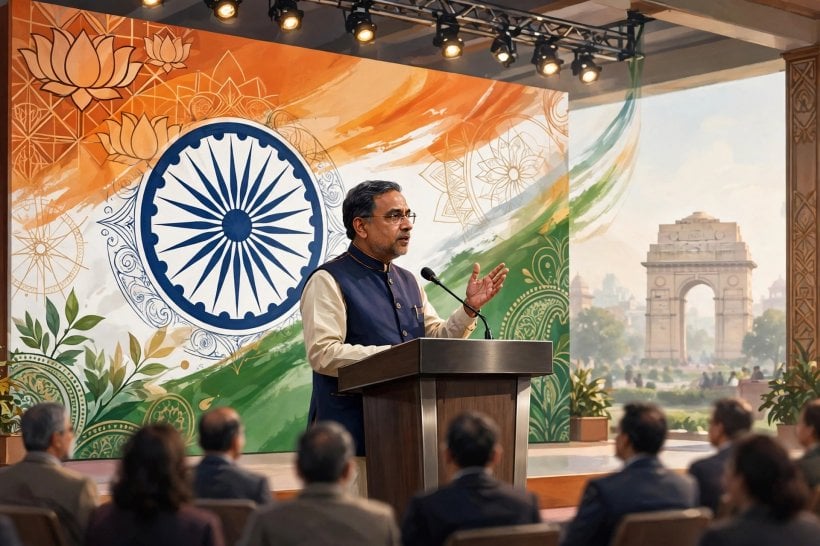
India’s IT minister Ashwini Vaishnaw said on Friday, October 23, that the government will begin a public consultation process for framing AI legislation “in the coming weeks.” According to the PTI wire, Vaishnaw told an NDTV event in New Delhi that a consultation paper is being drafted and will seek inputs from society, citizens and industry. “Today the time has come when the risks of AI have crossed a threshold where we should come up with a law and new regulations,” he said, adding that “harms from the new technology can be regulated.” The minister also urged the world’s top three or four AI ecosystems to work jointly on fundamental principles, a clear signal that India wants a hand in shaping global AI governance as the rules take form.
What The Consultation Will Cover
The consultation paper will gather views from across Indian society — citizens, academia and industry — before the government frames the actual legislation. Vaishnaw did not put a date on the table, saying only that the process would begin in the coming weeks. His framing was deliberate: rather than presenting a finished bill, New Delhi wants a public drafting conversation first, the same approach it used before its recent digital and data legislation. The announcement came at NDTV’s event in the capital, where the minister spoke at length about both regulation and the country’s technology ambitions.
Industry watchers will read the consultation as the first formal step toward India’s own AI statute — something the government has discussed for years without committing to a draft. With the EU AI Act now in force and the United States, China and the UK each pursuing their own regulatory routes, India has so far preferred guidance and mission-led programmes over hard law. That posture appears to be shifting.
The “Threshold” Moment For AI Regulation
Vaishnaw’s choice of words was notable. By declaring that AI’s risks have “crossed a threshold,” he tied the legislation directly to harms the government believes can now be named and regulated — from deepfakes and election-time manipulation to algorithmic bias and data abuse. The phrasing suggests the law will be risk-based rather than blanket, echoing the tiered approach other jurisdictions have taken. He did not detail what the law would prohibit or require, saying that is precisely what the consultation will determine.
The call for the world’s leading AI ecosystems to agree on fundamental principles was equally pointed. India has positioned itself as a bridge between the US and Chinese approaches and the European regulatory model, hosting summits and pushing “AI for all” rhetoric. A joint set of principles among the top ecosystems would give India’s own law international cover — and give Indian firms operating abroad a more predictable compliance map.
Phones, Chips And The 2028 Deadline
Vaishnaw used the same stage to put hard dates on India’s hardware ambitions. Indian-designed and manufactured mobile phones will be ready by October 23, 2028, he said — “Please note it: 23rd October 2028” — and the first made-in-India chip is also expected by 2028. Twelve plants under India Semicon Mission 1.0 are expected to become operational soon, and the government is working on a Semicon 2.0 plan with the stated aim of making India “the design capital of the world.” He noted that 20% of the world’s chip design engineers are already based in India.
The deadlines matter for the AI-law story as much as for industrial policy. A country writing AI legislation while scaling domestic compute, chips and devices is not just regulating consumption of the technology — it is building the stack the law will govern. The consultation paper will land in a landscape where Indian firms are increasingly producers of AI hardware and services, not merely users.
Why It Matters
India is one of the few jurisdictions that can genuinely reshape the global AI rulebook. It has the world’s largest developer population, a fast-growing startup ecosystem, and a government that has shown it will legislate at scale — the Digital Personal Data Protection Act proved that. An Indian AI law written with industry input could become the template for the global south, just as the EU’s statute became the reference point for western regulators. Multinationals training and deploying models in India should watch the consultation paper closely: its risk categories and compliance duties will likely be the skeleton of the eventual statute.
Background
India’s regulatory posture on AI has so far centred on the IndiaAI Mission, launched to build domestic compute capacity and datasets, alongside advisories and guidelines rather than binding law. Globally, the field is crowded: the EU AI Act is phasing in, the US has oscillated between executive orders and deregulation, China regulates generative AI services directly, and countries from Brazil to South Korea are drafting their own statutes. Our survey of AI laws around the world tracks how these regimes compare. Vaishnaw’s announcement is the first clear commitment that India will join them with legislation of its own.
Source: PTI, Fortune India


0 Comments