

German chipmaker Infineon announced on Tuesday, October 27, 2026, that it will invest about 1.1 billion euros, around $1.23 billion, at its Villach site in Austria to build the world’s first high-volume plant for gallium nitride power semiconductors on 300-millimetre wafers. Production is scheduled to start by the end of 2027, with investment continuing through 2034, and the plant will use existing cleanroom infrastructure to expand capacity efficiently. The move targets growing demand for energy-efficient power chips in AI data centres, energy infrastructure, electric mobility and robotics.
Why Gallium Nitride, And Why 300 Millimetres
Gallium nitride, known as GaN, is a wide-bandgap semiconductor material that switches power faster and loses less energy than conventional silicon in suitable applications. That makes it attractive for power conversion systems that manage electricity in data centres, electric vehicles, renewable energy infrastructure and industrial equipment, where smaller, cooler and more efficient systems translate directly into lower operating costs.
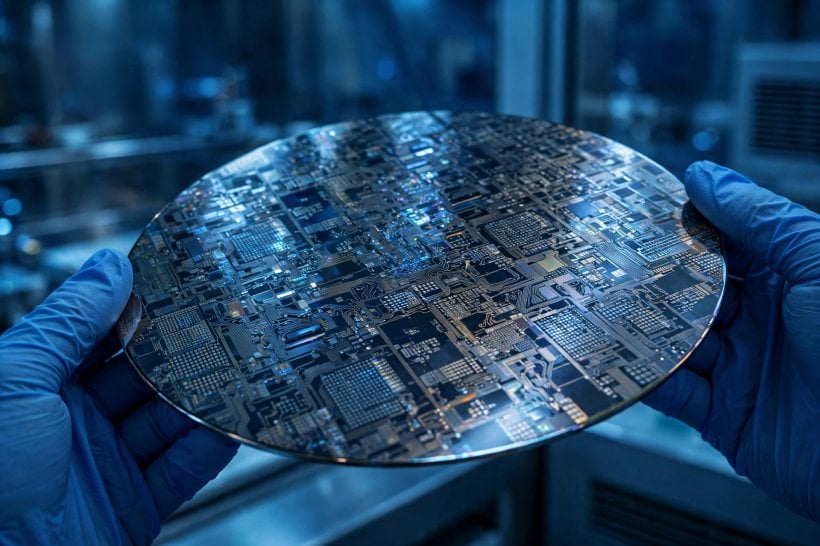
The wafer size is the other half of the story. A 300-millimetre wafer can hold 2.3 times as many chips as the more commonly used 200-millimetre version, which improves manufacturing efficiency and cost-effectiveness. Infineon processed its first 300-millimetre GaN wafers two years ago, and the Villach investment moves that technology from development and pilot production into high-volume manufacturing.
European Chips Act Support
The European Commission has approved 319 million euros in state aid for the project under the European Chips Act, although the formal funding commitment from Austria’s Ministry for Economic Affairs is still expected. The aid underlines how strategically Europe now treats power semiconductors: they are not the headline-grabbing processors that train AI models, but they control the power those systems consume, and supply of them is a matter of industrial policy as much as commerce.
Infineon chief executive Jochen Hanebeck framed the investment as a commitment to strengthening the European semiconductor ecosystem and Europe’s technological sovereignty. By establishing high-volume manufacturing on 300-millimetre wafers, he said, Infineon will be the first company in the world to bring gallium nitride power electronics into volume production. Other chip-exporting economies are warning about AI demand risks, which makes Europe’s effort to build its own capacity look less like a luxury and more like insurance.
What The Market Looks Like
Citing market researcher Yole Group, Infineon says the market for GaN power semiconductors is expected to grow by around 35 percent a year to roughly $3.5 billion by 2031. That growth is driven by the same forces behind the Villach plant: AI data centres that need more power delivered more efficiently, electric vehicles that need lighter and cooler power systems, and energy networks that must handle variable renewable supply.
Infineon has not said how many jobs the new GaN production will create. The company employs about 4,800 people in Villach and about 5,800 across Austria, and the investment is intended to strengthen the city’s role as a global centre for power semiconductors. The ramp-up will be adjusted to market demand, according to the company, rather than following a fixed schedule regardless of orders.
The Share Price Context
Reuters reported that Infineon’s share price, which has fallen around 40 percent since the middle of June, was up nearly 1 percent in early Frankfurt trading after the announcement. That context matters because it shows investors treating the Villach plan as a long-term industrial bet rather than a quick fix: the plant will not produce at volume until the end of 2027, and the investment runs through 2034.
The long horizon also means the project will be judged on execution, not announcement. Building high-volume GaN production on larger wafers is a manufacturing challenge, and the advantage of being first only holds if yields, costs and customer qualification all come together. Cloud providers are meanwhile opening their platforms to rival chips, which increases demand for the power systems that keep those chips running, and established chipmakers are buying their way into new platforms rather than building everything from scratch.
Why It Matters
Infineon’s investment matters because power is becoming the bottleneck for AI just as surely as processor supply. Data centres can only grow as fast as their power systems allow, and more efficient power semiconductors let operators pack more computing into the same energy budget. If Villach delivers the world’s first high-volume 300-millimetre GaN plant on schedule, Europe will own a piece of that bottleneck rather than importing it, and Infineon will have turned a materials advantage into a manufacturing lead that rivals will struggle to copy quickly.
Background
Infineon has built its Villach site into a centre for power semiconductor expertise over many years, and the 1.1 billion euro investment extends that role from development into high-volume production. The project will test whether European industrial policy, existing cleanroom infrastructure and a growing GaN market can combine into a plant that delivers on time and at scale.
Source: Reuters Infineon report and Evertiq GaN fab report


0 Comments