

iQIYI has begun filming its internet feature film “Cop in Trouble” at a newly opened AI Film Studio in Shanghai, the Chinese entertainment platform said on November 2, blending live-action performances with AI-generated environments in what it calls China’s first facility of its kind. Filming on the inaugural project started on October 28 at the iQIYI Creative Center Shanghai, where a roughly 110-square-metre studio pairs in-studio acting with AI post-production through the company’s NadouPro platform, giving filmmakers access to nearly 30 AI models.
What the studio actually does
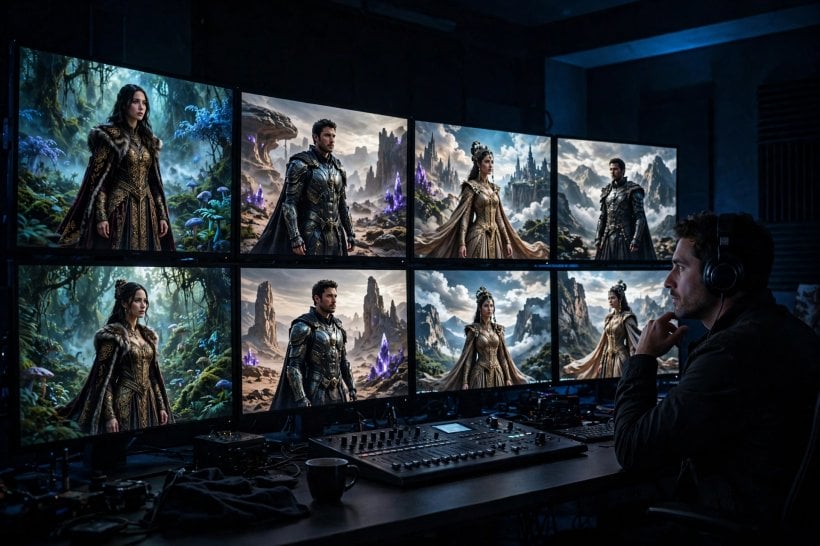
The studio is built around a simple loop: shoot the actors for real, then let AI rebuild the world around them. It offers multi-camera shooting, synchronised high-resolution video and audio recording, digital continuity logging and real-time footage review, so what happens on set is captured precisely enough for software to work with afterwards.
From the set, footage syncs automatically to NadouPro, iQIYI’s AI-powered film and television production platform. That gives filmmakers immediate access to nearly 30 AI models, including Seedance 2.5 and Kling 4.0, plus hundreds of production-focused AI agents and skills that generate new visual elements from the live-action footage.
The point, according to iQIYI, is flexibility after filming rather than perfection on the day. Directors can adjust sets, lighting, costumes, makeup and props, while the actors’ original performances stay intact. “An actor’s performance is the core of any film or series,” said Liang Zhu, iQIYI vice president and head of intelligent production.
What “Cop in Trouble” is testing
The first production is a deliberately ordinary story told with an extraordinary toolkit. “Cop in Trouble” follows Jian Zhang, a low-ranking constable whose fame, riches and admiration begin to crack as his web of lies to take down a notorious outlaw starts to unravel, and the production puts the studio’s hybrid method through its paces.
On set, filmmakers capture nuanced interactions between actors, from intimate conversations to action sequences that need precise coordination between performers and camera movement. Those live-action recordings then supply the AI process with key references for character appearance, performance, composition, lighting and spatial relationships.
That choice matters because it keeps the hardest part of filmmaking human. A generated backdrop can be redone cheaply, but a flat or inconsistent performance cannot be fixed by adding more scenery, so iQIYI is anchoring its AI work to footage of real people rather than asking models to invent the acting as well.
What this actually changes
The wider shift here is from AI video as a clip generator to AI video as a production department. Standalone tools turn a prompt into seconds of footage, while iQIYI’s studio treats AI as the set, costume and effects crew working around a conventional shoot, which is an easier sell to directors who already know how to run a set.
It also shows where the competition is heading. Other AI video efforts are moving in the same direction, including Genspark’s media studio, which directs AI videos end to end, but iQIYI’s version is tied to a working streaming platform with its own productions, giving it a ready-made place to test whether the workflow survives contact with a real shoot.
There are limits worth stating plainly. At roughly 110 square metres, this is a pilot stage rather than a backlot, and the announcement gives no budget, no delivery date and no commercial terms with the model providers. The efficiency gains iQIYI cites from its Hengdian virtual studio, over 30 percent, are the company’s own figures, not independently verified.
Why It Matters
For smaller productions, the promise is access to worlds they could never afford to build. Emerging directors and resource-constrained teams, the audience iQIYI names explicitly, could stage scenes that previously needed locations, sets or effects budgets far beyond their reach, provided the AI output holds up on a full-length feature rather than a short clip.
For the AI video market, the Shanghai studio is a test of integration over novelty. Models such as Seedance and Kling already generate striking footage on their own, but the company that turns them into a repeatable production pipeline, with continuity, review and delivery built in, will own more of the value than the company with the flashiest demo reel.
Background
iQIYI describes the Shanghai studio as the next step from on-location and green-screen work through virtual production, following its Hengdian virtual studio, toward AI-integrated filmmaking that opens new possibilities for directors working across genres. The company says the approach preserves actors’ performances while giving directors more room to adjust visual environments after filming.
Source: iQIYI announcement and China Daily report.


0 Comments