
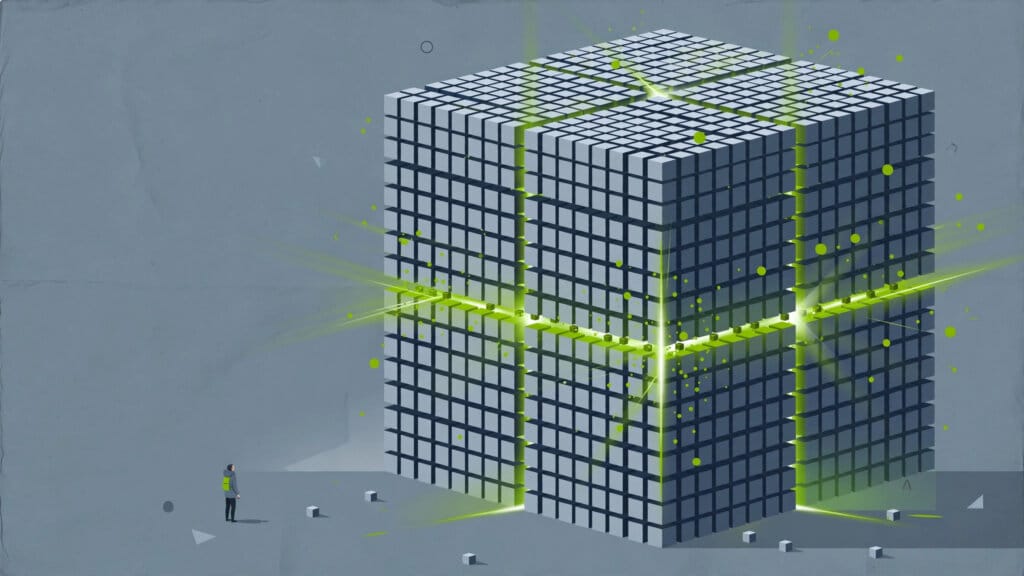
Most open AI models are small enough to run on a strong workstation. Kimi K3 is not. At 2.8 trillion parameters, Moonshot AI’s flagship is one of the largest models ever released with open weights, and its arrival in July 2026 reset expectations of what “open” can mean.
K3 matters less as a download (almost nobody can run it at home) and more as a statement: the open ecosystem now includes models at a scale previously reserved for the biggest closed labs.

What 2.8 trillion parameters means
Parameters are the learned settings inside a model; more of them generally means more capacity to absorb patterns from training data. Frontier closed models are rumoured to live in this size class, but their makers do not publish the numbers or the weights.
K3’s architecture, like most modern giants, does not use all of its parameters for every token. Designs of this kind activate a subset of specialised components per task, which keeps running costs far below what the headline number suggests.
The practical catch is memory. Even efficiently served, a model this size needs serious data-centre hardware. K3 is a model for cloud platforms and large enterprises, not laptops.
Why open weights at this scale is a big deal
An open-weight release at this level hands the world’s researchers a frontier-class object they can inspect, measure and build on. Benchmarks can be checked, behaviours probed, and derivative versions created without asking permission.
It also changes procurement. Enterprises that feared dependence on two or three closed providers gained another credible option, one they can host through cloud partners or, with enough hardware, themselves.
The clearest sign of that shift came in October 2026, when K3 reached Amazon’s Bedrock platform. A Chinese open model, distributed through the largest US cloud, would have been hard to imagine a few years earlier.
The cost of serving a giant
Releasing a giant is one expense; serving it is another. Every query to a 2.8-trillion-parameter model burns serious compute even with an efficient architecture, so the economics only work at cloud scale with high utilisation.
That is why distribution deals matter as much as the release itself. Placement on platforms like Amazon Bedrock puts K3 in front of enterprises with existing cloud contracts, billing and compliance already sorted.
It also explains the tiering users see: the giant for hard problems and batch work, smaller K-series siblings for everyday traffic. Moonshot, like every lab, routes each request to the cheapest model that can handle it.
For the open ecosystem, serving costs create a curious split. The weights are free, but the intelligence is only reachable, for most people, through someone else’s data centre: openness of possession, concentration of operation.
K3 therefore tests a question the whole open movement faces: whether downloadable giants change who holds power, or simply give the big clouds a new, cheaper catalogue to rent back to the world.
Where K3 sits among rivals
K3’s natural company is the top tier of open models: DeepSeek’s flagships, Alibaba’s largest Qwen releases, and fellow Chinese entrants such as Zhipu’s GLM series and MiniMax. Each release round redraws the ranking.
Moonshot’s funding underlines the ambition: the company raised two billion dollars at a twenty-billion-dollar valuation in May 2026, and later reports point higher still, though those remain unconfirmed.
There is a research dividend to releases like K3 that rarely makes the headlines. A downloadable giant lets universities study phenomena (how capabilities emerge with scale, where reasoning breaks) that closed labs keep behind glass.
Those studies feed back into everyone’s roadmaps, including competitors’. In that sense K3 is simultaneously Moonshot’s product and the field’s public instrument, which is precisely the influence open releases are designed to buy.
Whether it is also a business is the open question. Prestige and platform placement must eventually convert into cloud revenue and enterprise contracts large enough to justify a giant’s upkeep.
Smaller labs should read K3 as encouragement and warning in equal measure: the open frontier is now measured in trillions of parameters, which democratises access to giant models while concentrating the ability to create them.
For readers, the takeaway is simple. “Open” no longer means “small” or “second tier”. With K3, the open-weight world has a giant of its own, and the closed labs’ size advantage is now a difference of degree, not of kind.

0 Comments