
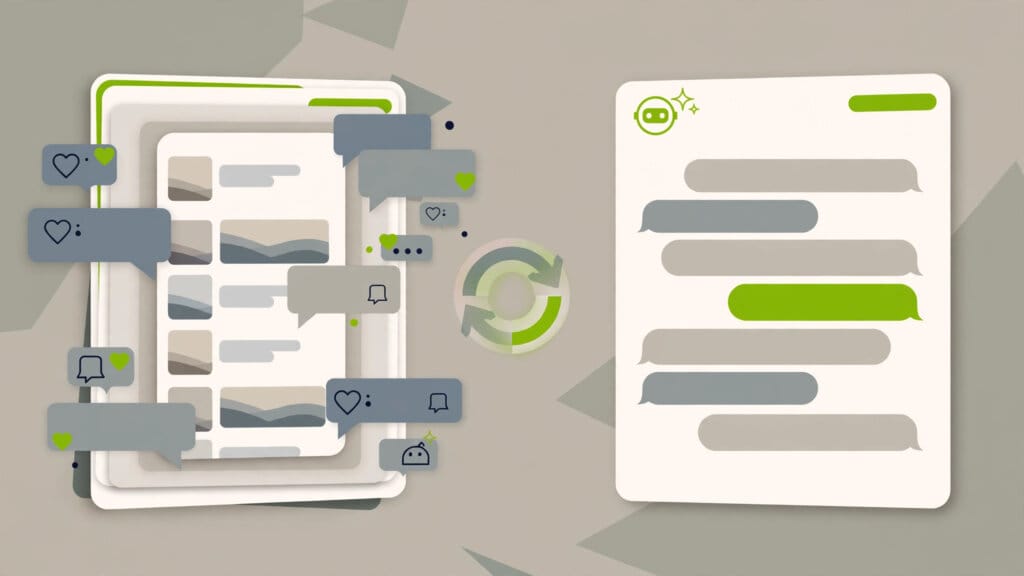
Meta AI and ChatGPT can both answer questions, draft text and brainstorm ideas, so the difference is not always obvious from a single prompt. The real distinction is where each assistant lives, what company strategy sits behind it, and what kind of everyday use it is designed for.
ChatGPT is OpenAI’s standalone assistant, built around its own model family and offered as a destination app and website in its own right. Meta AI is Meta’s assistant, built on Llama models and woven into social, messaging and wearable products that existed long before generative AI arrived.

Where You Encounter Them
You usually go to ChatGPT on purpose. You open the app or site, start a conversation, and treat it as a focused workspace for writing, coding, analysis, learning or problem-solving, often with files, voice or specialised tools depending on the plan and features available.
You are more likely to encounter Meta AI in passing. It appears inside WhatsApp, Instagram, Facebook and Messenger, where you can invoke it in a chat or use it alongside content you are already viewing, without switching to a separate AI product or starting a new workflow.
That difference shapes expectations. ChatGPT is optimised for a session you begin with a task in mind. Meta AI is optimised for brief, contextual help in the middle of communication — a quick explanation, a suggestion in a group chat, or an idea while you are scrolling.
The Models and the Openness Question
Underneath, Meta AI runs on Meta’s Llama models, which are released as open weights for outside developers to download and adapt under licence. OpenAI’s models behind ChatGPT are closed by comparison, accessed through OpenAI’s own products and developer services rather than downloaded and hosted independently.
For an ordinary user chatting in an app, that distinction may not change today’s answer to a simple question. For developers, researchers and businesses building their own systems, it matters a great deal, because open weights offer control over hosting and customisation that a closed service cannot.
It also reflects two different bets. Meta bets that widespread adoption of Llama strengthens its ecosystem and its own products. OpenAI bets that a tightly controlled, continuously updated service, sold directly to users and organisations, is the better way to fund and improve frontier AI.
Features, Ecosystem and Devices
Because Meta AI is tied to Meta’s platforms, its strengths lean social. It fits group conversations, content discovery and the informal, short-form interactions that dominate messaging apps, and it extends into Ray-Ban Meta smart glasses for voice and hands-free questions while you are out in the world.
ChatGPT’s strengths lean toward depth as a standalone tool. People often choose it for longer projects, sustained writing, coding help and complex reasoning tasks where they want a dedicated environment, a conversation history centred on work, and features built specifically around that assistant experience.
Meta holds over 80% of the AI-glasses market in the first half of 2026, which gives its assistant a hardware route ChatGPT does not match in the same way. OpenAI, in turn, has the advantage of a product whose entire identity is the assistant itself, not a feature inside larger social networks.
Safety, Trust and Business Incentives
Both assistants can make mistakes, and both need the same caution on important topics. Neither should be treated as a final authority for medical, legal or financial decisions, and both are more useful when you check important claims against a reliable source rather than accepting a fluent answer at face value.
Safety scrutiny applies to the whole category, not just one product. Recent legal action focused on ChatGPT and child safety, covered in reporting on state lawsuits against OpenAI, shows how regulators are now testing the claims and safeguards of leading assistants, whichever company builds them.
Their incentives also differ in ways worth understanding. Meta’s wider business is advertising on social platforms, so Meta AI mainly needs to make those platforms more useful. OpenAI sells ChatGPT directly, so its assistant itself has to persuade users and organisations that it is worth paying for.
If your AI use starts in messages and social apps, or you want help without leaving a conversation, Meta AI is the more frictionless choice. If your use starts with a substantial task you want to sit down and work through, ChatGPT’s standalone focus may suit you better.
Many people will not choose exclusively. They will use Meta AI for quick, in-context moments, especially on mobile and glasses, and turn to ChatGPT or another dedicated assistant for longer sessions. The competition is less about one winner than about which assistant is present at the right moment.
That presence is ultimately the headline difference. ChatGPT asks you to come to the AI. Meta AI tries to bring the AI to where you already are — in your chats, your feeds and, increasingly, on your face — and that shapes almost everything else about how the two feel.

0 Comments