
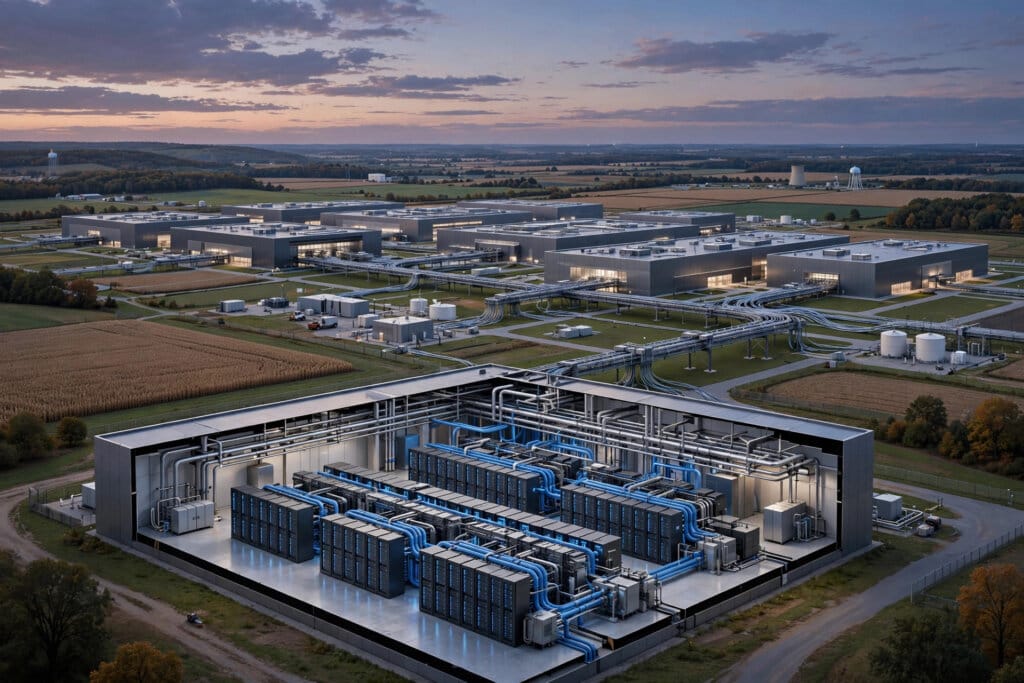
Meta has completed the first phase of Prometheus, its gigawatt-scale AI supercluster in New Albany, Ohio, and used it to train the Muse family of foundational models — including the Muse Wonder frontier models. In a detailed engineering post published on October 19, Meta’s team said the cluster already runs hundreds of thousands of GPUs as a single machine and is being scaled toward roughly one million GPUs.
Two years ago the New Albany site was a conventional data centre running web traffic. Meta reworked it in phases for frontier-model training, spreading the system across traditional halls, an AI-optimised building and rapid-deployment structures, all operating in lockstep. The post, by Kevin Lee, Yashar Bayani, Ahmed Sharif and Yee Jiun Song, is the fullest technical account Meta has given of the machine that now trains its models.
Prometheus By The Numbers: Goodput And Interruptions
Training at this scale fails constantly, and Meta’s headline figures are about how rarely it has to stop. The company reports more than 85% goodput — the share of compute time that actually advances training — on Muse Wonder pre-training runs, and more than 90% on reinforcement learning runs. During those runs the wall-clock mean time between interruptions was about 47,000 GPU hours; fleet-wide changes since, including firmware fixes, have raised that to more than 54,000 GPU hours.
The starting point shows why the work mattered. In the initial phase in mid-2025, interruptions peaked at nearly 1,000 events per 8,000 GPUs per day. Meta says it has since cut interruptions by 99%, against a stated reliability goal of two interruptions per 8,000 GPUs per day — roughly 100,000 GPU hours between interruptions. Each 72-GPU group also keeps spare processors, so isolated failures can be handled without pausing the whole training job, and the cluster can run multiple training jobs of tens of thousands of GPUs at once.
The Three Platforms: Catalina, Clemente And San Miguel
Prometheus runs on two deployed NVIDIA platforms, with a third planned. Catalina pairs NVIDIA GB200 NVL72 systems in a two-rack configuration — 72 Blackwell GPUs with 13.4 TB of HBM3e memory, 720 peak petaflops of FP8 training compute and about 120 kW across the rack pair, each GPU matched with a Grace CPU and dual ConnectX-7 400G network cards. Clemente moves to GB300 NVL72 in a single rack: 72 Blackwell Ultra GPUs with 20.7 TB of HBM3e — 288 GB per GPU, 50% more than GB200 — over an exaflop of peak FP4 compute, about 135 kW per rack, and a 5–10% performance improvement over the GB200 systems.
Next comes San Miguel, based on NVIDIA’s Vera Rubin NVL72: 72 Vera Rubin GPUs with 288 GB of HBM4 each, 2.52 peak exaflops of FP4 training compute per rack, fully liquid-cooled trays at over 170 kW per rack, and a claimed 10–20% improvement in performance per watt over GB300.
Networking And Cooling A Million-GPU Machine
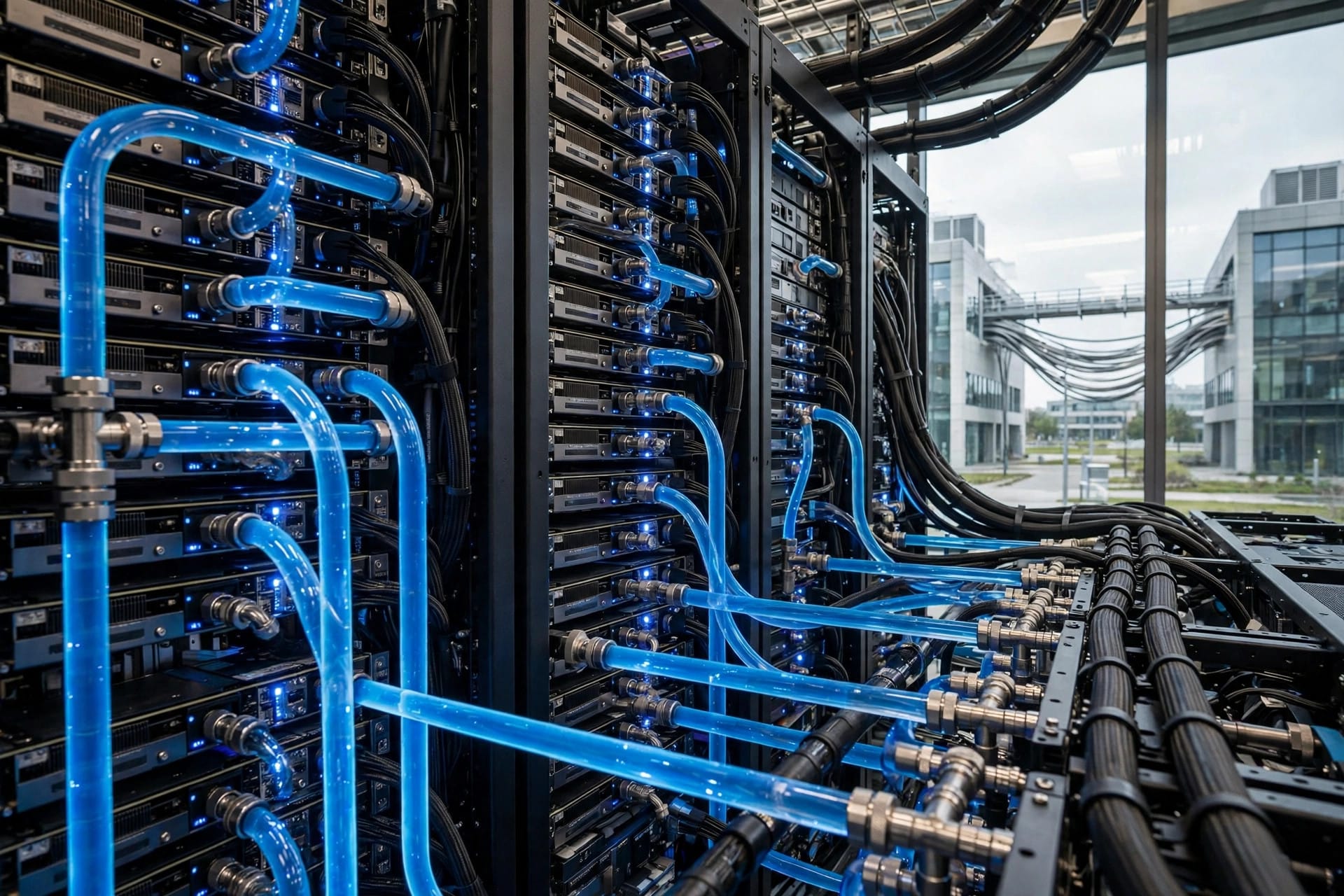
The buildings are joined by a dedicated Ethernet back-end network for GPU-to-GPU traffic. Each building-level fabric interconnects up to 20,736 GPUs, and a multi-layer Backend Aggregation network links the buildings over distances from 2 km to more than 100 km with multiple petabits per second of bandwidth per region pair — millions of miles of fibre strand and tens of thousands of switches in total. Cooling is closed-loop, direct-to-chip liquid cooling: air-assisted liquid cooling in the free-air buildings and rapid-deployment structures, and facility liquid cooling in the purpose-built AI building, where power density is highest.
Prometheus is the infrastructure half of the strategy GERoundtable has tracked from the product side in its explainer on Meta AI, Llama and AI glasses: the Muse models Prometheus trains are the same family Meta is putting in front of billions of users, and the cluster’s NVIDIA foundations connect it to the hardware race covered in GERoundtable’s guide to NVIDIA’s AI chips and to sovereign-scale buildouts like Germany’s industrial AI partnership with NVIDIA.
Why It Matters
Prometheus’s central entity is the supercluster itself, and its attributes — hundreds of thousands of GPUs today, roughly a million planned, gigawatt-scale power, 85–90% goodput — measure how far the training bottleneck has moved from chips to reliability engineering. Its neighbours are the Muse models it produces, the Meta AI products those models power, and rival clusters at OpenAI, Google and Anthropic competing on the same axis. A completed first phase that has already trained a frontier model family turns Prometheus from an announced construction project into proven capacity — the kind of capacity that decides how fast Meta can iterate on the models behind its assistant and glasses.
Background
Meta announced Prometheus as part of its multi-gigawatt data-centre programme, converting the New Albany campus — opened for conventional web workloads — into its flagship training site. The October 19 engineering disclosure, following a walkthrough at the OCP Global Summit on October 12, is the first time Meta has published the cluster’s training results, platform specifications and reliability figures together; the system is now being scaled with Meta Superintelligence Labs’ next frontier models in mind.
Source: Engineering at Meta, “Inside Prometheus” (official, October 19, 2026); Unite.AI




0 Comments