

NVIDIA expanded its Isaac open robotics platform at GTC Berlin on Wednesday, adding Agile Robots’ Agile ONE SN — a full-stack reference humanoid preconfigured with Isaac GR00T and powered by Jetson Thor — alongside a new Isaac OS runtime, Isaac Lab 3.0 and open datasets for robot learning.
“General-purpose robotics is advancing at extraordinary speed — the ChatGPT moment for robotics is fast approaching,” said Jensen Huang, NVIDIA’s founder and CEO. The package is aimed at the unglamorous problem behind that claim: robotics teams spend weeks stitching together simulation, training and deployment tools before a robot learns anything, and NVIDIA wants Isaac to be the single integrated path from data to deployment.
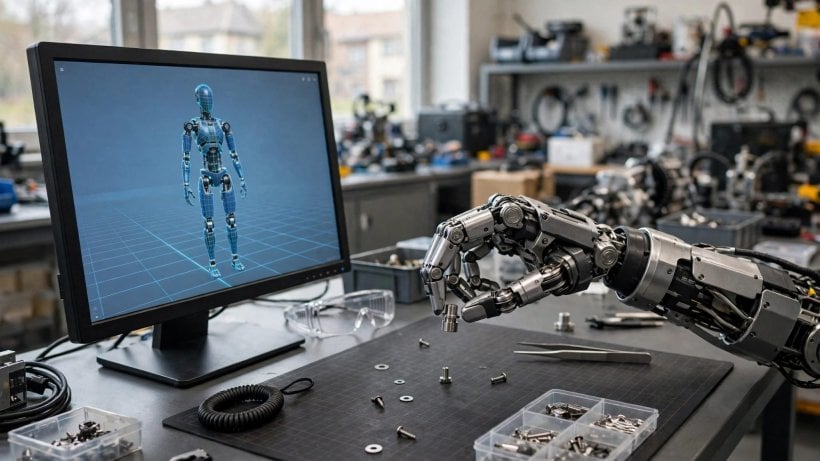
Agile ONE SN: The Reference Humanoid In Detail
Agile ONE SN pairs the Agile ONE S humanoid body with NVIDIA’s stack. The robot stands 1.40 metres tall, weighs 40 kilograms, and has 31 degrees of freedom with a 3-kilogram payload per arm. Its two WUJI Hand 2 five-finger hands each offer 20 degrees of freedom, 1kHz force control and tactile sensing for dexterous manipulation.
Onboard compute is NVIDIA Jetson Thor, delivering 2,070 FP4 teraflops and 128GB of unified memory for onboard reasoning and real-time control. The platform is preconfigured with Isaac GR00T, NVIDIA’s foundation-model line for humanoid robots, with planned integration of the NVIDIA Halos safety system. NVIDIA says unifying the tools on one platform cuts setup time from weeks to days. Agile ONE SN is scheduled to be available in early 2027, with research institutions including Stanford University and ETH Zurich among those interested, according to coverage of the announcement.
Isaac Lab 3.0, Isaac OS And The Data Pipeline
Isaac Lab 3.0, the open-source robot learning framework, is now generally available. Isaac OS is a new open-source runtime built on Holoscan that connects AI models, sensors, controls and robot hardware at deployment time — the layer that runs on the robot after training.
NVIDIA is also releasing open-source reference workflows for DGX Station that combine Isaac and Cosmos world models — including post-training workflows using ChatGPT Astra — to speed up robot data generation, training and evaluation. The SimReady Central Library, with more than 2,000 simulation-ready assets, and the Human 1M Dataset are available on Hugging Face, with the full dataset open to Cosmos Coalition partners.
Europe’s robotics industry is the immediate audience. ABB Robotics, Flexion, Hexagon Robotics, Humanoid, KUKA, NEURA Robotics, Sereact and Universal Robots are among the companies building on the Isaac platform, NVIDIA said — a list that reads as a roll-call of the continent’s established robot makers rather than startups alone.
Why It Matters
A reference humanoid is a bet on standardisation. When one body, one compute module and one model stack ship pre-integrated, every university lab and startup building on it produces skills, data and evaluations that transfer to everyone else’s robots — the compounding effect that made NVIDIA’s data-centre stack hard to displace, and the dynamic behind Cosmos world models moving into specialised fields such as robotic surgery. The open pieces matter too: Isaac Lab, Isaac OS and the Hugging Face datasets lower the cost of starting a robotics programme to a download, which is how a platform recruits the developers who later buy the hardware — the same playbook as the Nemotron open-model releases. And the safety thread is consistent with the rest of GTC Berlin: Halos integration on the humanoid mirrors the containment-first framing of the OpenShell architecture for agents, extended from software agents to machines that move.
Background
NVIDIA’s Isaac platform began as a simulation and development toolkit for robots and has grown, piece by piece, into a full stack: Jetson modules for onboard compute, Isaac Sim and Lab for training in simulated worlds, Cosmos world models for synthetic data, and GR00T foundation models for humanoid control. What it lacked was a standard body. Agile ONE SN fills that gap with a research humanoid any lab can buy and benchmark against, much as reference designs anchored NVIDIA’s earlier pushes into cars and data centres.
Source: NVIDIA via GlobeNewswire, The Circuitry


0 Comments