

NVIDIA co-founder and chief executive Jensen Huang proposed turning Kazakhstan into a global hub for physical AI during a meeting with President Kassym-Jomart Tokayev in Astana on October 23, according to the Kazakh presidential press service. Huang argued that Kazakhstan has the energy resources and science, mathematics and technology talent that AI development demands, and Tokayev welcomed the idea as fresh momentum for the country’s AI ambitions. The proposal came with no announced deal, funding figure or timetable, and Tokayev closed the meeting by awarding Huang the Order of Dostyk for his contribution to AI development in Kazakhstan.
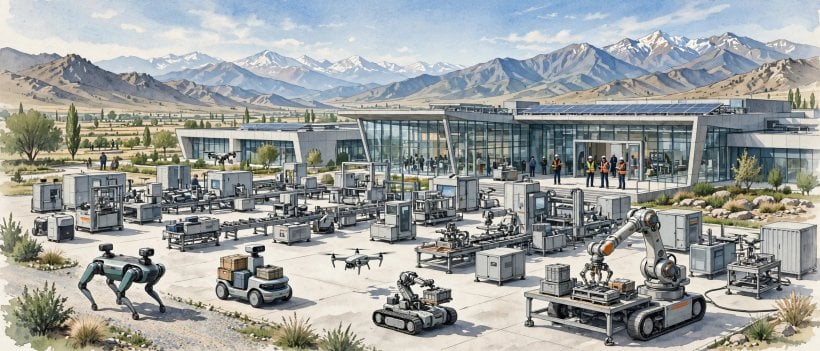
What Huang proposed in Astana
The meeting took place at Akorda, the presidential palace, where Tokayev and Huang discussed cooperation in artificial intelligence and digital technologies. According to The Astana Times, Tokayev thanked Huang personally for his contribution to strengthening the partnership with NVIDIA and for what the company is doing for Kazakhstan. Huang described physical AI as a field that combines artificial intelligence with physical systems, including robots, autonomous machines and industrial equipment. His proposal would position Kazakhstan as a centre for that work, rather than only as a market for AI products built elsewhere.
Tokayev framed the visit in national terms. He identified AI development and digitalisation as national priorities and noted that 2026 has been declared the Year of Digitalization and Artificial Intelligence in Kazakhstan. He said Huang’s visit was of great importance in giving serious momentum to cooperation with NVIDIA, and he expressed confidence that it would push bilateral cooperation further.
Energy and talent: the case Huang made
Huang’s argument rested on two ingredients. “AI development requires, first and foremost, energy resources, as well as people with knowledge in science, mathematics and technology,” he said. “Kazakhstan has significant potential to develop each of these areas.” The remark connects the country’s power supply with its workforce: physical AI needs both cheap, abundant energy to run machines and data centres, and engineers who can build and maintain them.
He also praised Kazakhstan’s strategic ambition to become an AI nation, describing it as a goal set at the beginning of a new industrial revolution. The Astana Times reported that Huang highlighted progress in NVIDIA’s cooperation with Kazakhstan over the past year, particularly in building ties with local technology businesses, and described that cooperation as the beginning of a long-term journey.
The partnerships Huang named
Huang named three Kazakh connections during the visit. According to Azernews, which cited the presidential press service, he said: “We are developing partnerships with Kazakh companies, including Firebird AI KZ Ltd and Kazakhtelecom, and supporting Higgsfield, the first Kazakh technology unicorn, which has become a notable participant in the global technology ecosystem.” He added that he was deeply impressed by and proud of what the two sides had accomplished together.
Tokayev welcomed NVIDIA’s partnership with Higgsfield in particular, saying Kazakhstan was proud to see the company involved in a domestic technology project. Following the meeting, Tokayev awarded Huang the Order of Dostyk, or Friendship, in recognition of his contribution to the development of artificial intelligence in Kazakhstan.
Why It Matters
The proposal matters because it would give Kazakhstan a defined role in the next phase of AI competition. Most AI attention goes to chatbots and models that live in data centres, but physical AI covers the machines that move through the real world: factory robots, autonomous vehicles and industrial equipment. A country that hosts that work gains factories, engineering jobs and technical know-how, not just access to someone else’s software. For NVIDIA, a Kazakhstan hub would extend a partnership that already spans robotaxi work with Pony AI and inDrive in the country, and it would put the company’s hardware at the centre of a national industrial strategy. For Kazakhstan, the prize is a place in an industry where energy and talent, rather than only capital, decide who builds what. The open question is what follows the proposal: no projects, investments or deadlines were announced alongside it.
Background
NVIDIA’s Kazakhstan ties have deepened through 2026, from the robotaxi agreement signed with Pony AI and inDrive to Higgsfield’s NVIDIA-backed Series B extension, announced during Huang’s visit, while Huang himself has spent the autumn touring the region’s AI stage, including NVIDIA’s Berlin conference, where he dismissed warnings about AI-driven extinction.
Source: The Astana Times, Azernews


0 Comments