
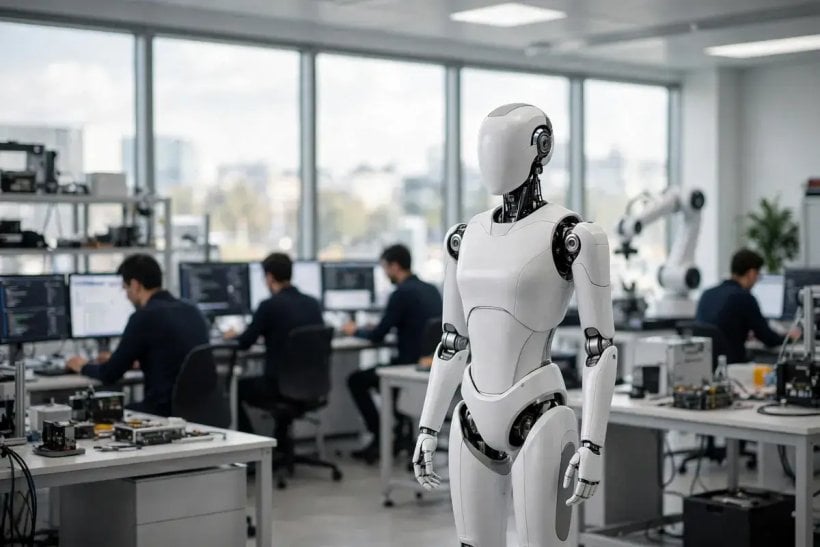
OpenAI has disbanded its standalone robotics team and folded its researchers into the company’s main research and applied groups, betting that its general-purpose AI models can now run robots without a dedicated unit. The company confirmed the change on Friday, saying robotics remains central to its long-term plans and that the reorganisation will speed its robot work rather than end it. It is the second time OpenAI has broken up a robotics team, and its own humanoid robot is still on track for a first public demonstration in 2027.
Where the staff went
The robotics research team now sits inside OpenAI’s main research group, reporting to Chief Research Officer Mark Chen. The applied robotics and hardware teams have moved into the Applied organisation, which reports to President Greg Brockman. OpenAI has published no statement or blog post of its own about the change, and it has not said how many people were affected.
The move came so recently that OpenAI had already registered a stand at CoRL, the leading academic robotics conference in Austin, Texas, this week. When Fortune’s reporter visited booth 208, it stood empty, with no OpenAI logo in sight — although a few former members of the team still drew a crowd there.
The general-model bet
OpenAI told Fortune that at the start of 2026, its researchers assumed the best route to capable robots ran through models like Sora, its video generator, which has to grasp something of how the physical world works to make realistic clips. Since then, the company said, its frontier models, including GPT-6 Astra, have turned out to work directly on robots.
Outside tests back part of that claim. In an October 14 study, Nvidia researchers ran GPT-6 Astra as a robot’s controller on RoboLab-120, a simulated pick-and-place benchmark, with no special robot training. Running inside a Codex session, Astra succeeded on 74.8 percent of tasks, against 51.0 percent for the best dedicated robot model on the leaderboard, a system called Lakeside.
The same study found the catch. The best setup cost about 36.40 dollars in tokens per attempt, and even the simplest version took 18.56 seconds per model call — far too slow for most real robots to be useful on a factory floor.
Guanya Shi, an assistant professor at Carnegie Mellon University’s Robotics Institute, said the move suggests OpenAI sees robotics as no longer a special problem. He still sees a need for small models that run on a robot’s own computer, without a constant internet connection, and that gap is where the general-model bet faces its hardest test.
Our Read
This is OpenAI’s third chapter with robotics, and the pattern is hard to miss. It wound the first team down in 2020, rebuilt one in 2024, and has now folded it into the groups that build its general models. Each time, the company decides robotics is a downstream application of general intelligence.
The hard part is still waiting at the end of the road: real machines, real latency and real factory floors. The 2027 humanoid demonstration is the test that will settle whether the bet works — a simulation score, however striking, is not a robot that can keep up on a production line.
OpenAI is the outlier among the big labs in making this bet. Nvidia built a robot foundation model, GR00T 2, which learns skills from video, and Google DeepMind runs a robotics line, Gemini Robotics 2.5, sorting parts on Mercedes-Benz lines. OpenAI is saying one model family can do all of it — chat, code and the factory floor.
If Astra’s edge survives contact with real hardware, every company selling its own robot brain faces a squeeze — and robotics start-ups have raised billions on the opposite idea. If latency and token costs bite, OpenAI has scattered the very people it would need for 2027.
As MIT professor Russ Tedrake put it, robot makers hold one edge the labs lack: their machines are gathering experience on factory floors, and better base models make that data more valuable, not less. Meta is building its own humanoid too, so the race for the factory floor is crowded even as OpenAI bets one model can win it.
Why It Matters
If general-purpose models become robot brains, the economics of humanoid robots change. One model family could serve chat, code and the factory floor, and the specialist robot-model companies that raised billions would have to prove their dedicated systems are still worth paying for. That is the market OpenAI’s bet puts under pressure.
For OpenAI itself, the move is a focus play. The company lost a reported 10.9 billion dollars on an adjusted operating basis in its latest quarter while raising new money. Fortune notes it has already dropped some projects, including Sora, to free up computing power — and folding robotics into the main research effort fits the same pattern.
Background
OpenAI’s first robotics team dates to its early years, and it was wound down in 2020, when cofounder Wojciech Zaremba later cited a shortage of robot data and a more efficient path to general intelligence. The company rebuilt a standalone team in 2024, alongside a partnership with humanoid maker Figure.
Figure ended that partnership in February 2025 to build its own robot AI, and OpenAI has said it is developing its own humanoid robot, with chief executive Sam Altman targeting a first public demonstration in 2027 — the date the whole reorganisation will be judged against.
The 74.8 percent figure behind the reorganisation comes from a simulation, not a real robot, and the leaderboard’s best dedicated model, Lakeside, is the benchmark the specialists will point to when the results are tested on real factory floors instead of in simulation.
Source: Fortune’s report, via Let’s Data Science and MadRobot’s full account




0 Comments