
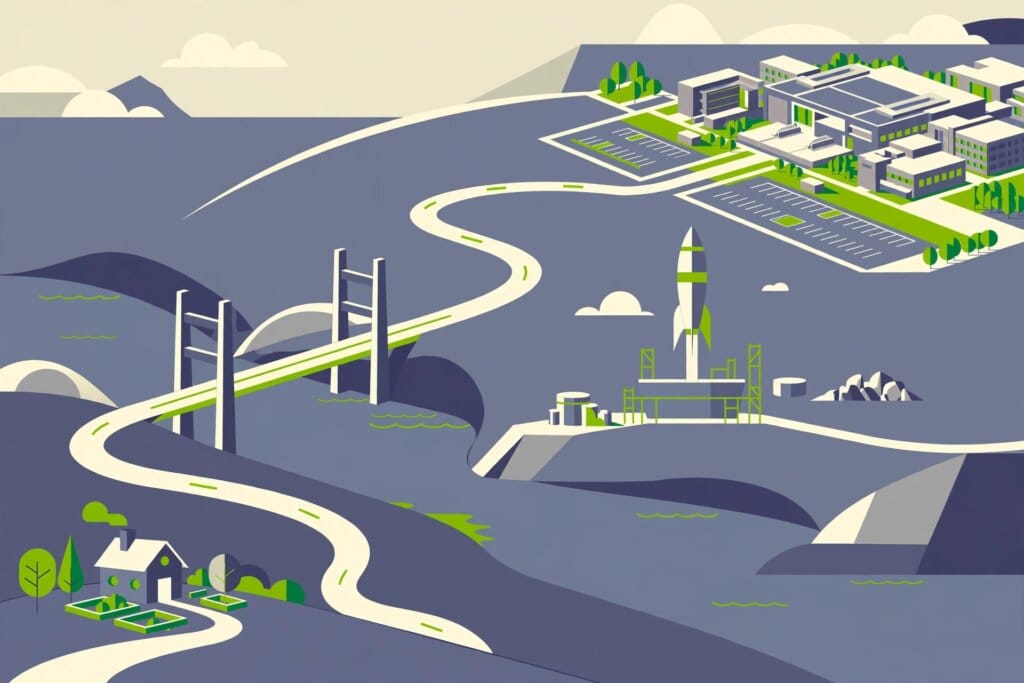
OpenAI’s history compresses a corporate lifetime into a decade. Founded in 2015 as a nonprofit research lab worried about who would control advanced AI, it became — through a chatbot launched almost as an afterthought — the most influential technology company of the 2020s. This is the road, in brief.
The through-line is tension between the founding mission and the money required to pursue it. Nearly every major event in OpenAI’s story is that tension surfacing in a new form.

2015–2018: the lab years
OpenAI began with a pledge of roughly a billion dollars from backers including Sam Altman and Elon Musk, organised as a nonprofit to develop artificial general intelligence for public benefit. Its early fame was experimental: game-playing systems that beat professionals at Dota 2, dexterous robot hands, and the first GPT language models.
Two problems emerged. Training serious models cost far more than donations covered, and the talent market rewarded equity a nonprofit could not offer. Musk departed in 2018 amid disagreements, and the lab began redesigning itself.
2019–2022: capped profit and the Microsoft bet
The redesign arrived in 2019: a capped-profit subsidiary inside the nonprofit, letting investors earn returns up to a limit. Microsoft invested a billion dollars that year and became OpenAI’s cloud partner; the total would grow past ten billion as the relationship deepened.
The GPT line matured in public — GPT-2’s staged release over misuse fears, GPT-3’s API in 2020 — building a developer business while the consumer moment waited. It arrived on 30 November 2022, when a “research preview” called ChatGPT reached a million users in five days and a hundred million within about two months, the fastest consumer adoption then recorded.
2023–2024: rocket ship and board crisis
GPT-4 launched in March 2023 and set the industry benchmark; Microsoft embedded the models across its products, and imitators multiplied. Then, in November 2023, OpenAI’s nonprofit board abruptly fired Altman, citing candour concerns. Within days, under pressure from employees and Microsoft, he was reinstated and the board largely replaced.
The crisis taught two lessons that shaped everything after: the mission-governance structure could not actually control the company it owned, and the market had already decided who led it. Restructuring became a matter of when, not whether.
The product era accelerated through 2024. GPT-4o made the assistant natively multimodal — voice, vision and text in one model — and the first dedicated reasoning models, the o-series, arrived late that year, trading speed for depth on hard problems. ChatGPT’s paid tiers multiplied, and the API business compounded quietly underneath the consumer spectacle.
The era also cost OpenAI people. Co-founder Ilya Sutskever departed in 2024 to start a new safety-focused lab, chief technology officer Mira Murati left the same year, and a steady stream of senior researchers joined rivals. The company that emerged was more product company, less research commune — a transformation the 2025 restructure simply made official.
Two 2023–24 milestones deserve their own lines. GPT-4’s launch in March 2023 was the moment “frontier model” became an industry category, briefly giving OpenAI a capability lead measured in years. And its first DevDay conference that November — custom GPTs, a GPT Store, cheaper API tiers — announced the platform ambition plainly: OpenAI intended to be the operating layer other companies build on.
The GPT Store’s January 2024 opening, with a revenue programme for popular builders, sketched the endgame: an app economy on top of the models, with OpenAI taking the platform’s cut and setting the platform’s rules.
2025–2026: restructure and scale
In 2025 OpenAI completed the conversion of its commercial arm into a public benefit corporation, with the nonprofit reborn as the OpenAI Foundation holding a major equity stake. The change unlocked conventional fundraising at extraordinary valuations and committed the company to infrastructure spending on a national scale.
Scale brought the scrutiny of scale. Copyright litigation continues, and in October 2026 eight state attorneys general sued over claims ChatGPT was marketed as safe while endangering children — the consumer-protection era of AI arriving on schedule.
The road, in one line: a lab founded to keep AI’s power from concentrating became the place where it concentrated most — and its story is now the industry’s argument about whether mission and market can share a building.

0 Comments