
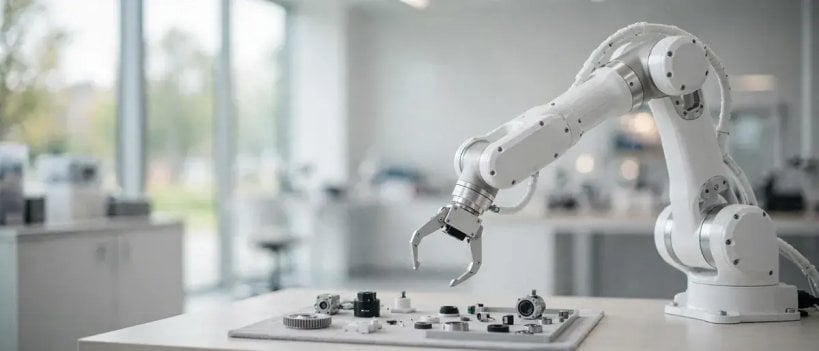
Runway has released the weights for Praxis-1, its model for controlling robot arms, under the Apache 2.0 licence. The 27-billion-parameter system, which predicts video and robot actions together, is now free for any developer or researcher to download, adapt and use commercially.
What Praxis-1 does
Praxis-1 is what Runway calls a world action model. Given an instruction, camera frames and the arm’s current pose, it imagines the next moments of video and derives the robot’s motion from that imagined future. It is a mixture-of-experts diffusion transformer built on Runway’s video models.
The headline number comes from NVIDIA’s RoboLab-120 benchmark, where Praxis-1 completed 46.2% of 1,200 simulated episodes. That leads FLUX 3 Action at 42.9%, Cosmos3 Nano at 36.8% and π0.5 at 28.0%, making it the top world action model on the board by Runway’s count.
Runway’s research argues that web video can stand in for teleoperated robot video as pretraining data, shifting the bottleneck to how much general video a model can learn from. A single checkpoint has adapted to varied embodiments with light fine-tuning, and LoRA can adapt it to new cameras and tasks.
Open weights, full toolkit
The release goes beyond a weights file. It includes inference and fine-tuning code, support for full fine-tuning and the lighter LoRA method, native support in Hugging Face’s LeRobot library, availability in vLLM-Omni and hosted inference on Reactor. Everything is released under Apache 2.0.
Runway introduced Praxis-1 in September, and three launch partners have run it on their own hardware since then: Noble Machines with a legged humanoid, Standard Bots with a six-axis industrial arm, and Ultra with a dual-arm warehouse robot. It runs on NVIDIA hardware from H100 cards to Jetson Thor.
Why It Matters
Praxis-1 lands in the middle of a crowded week for robot brains. NVIDIA opened its GR00T 2 model days earlier, and Google’s Gemini Robotics 2.5 is already working on a Mercedes-Benz factory line, putting a vision-language-action system into real production work.
Runway’s entry is the most permissive of the three. Full weights, fine-tuning code and a licence that allows commercial use mean any robotics team can start from a working system rather than building one. That is the point: Runway says US leadership in physical AI will depend on shared foundations.
Our Read
The benchmark deserves a careful read. Every figure so far is Runway’s own, with no independent reproduction, and 46.2% still means failing more than half the episodes on simulated tabletop tasks. The open weights are what make the claim checkable, and that is the real test ahead.
The adaptation result is the more interesting number. Fine-tuned on Google’s RT-1 robot, which never appeared in its training data, Praxis-1 reached 80.0% on SimplerEnv against 52.4% for the original RT-1 policy. It is the opposite bet to OpenAI’s, which has folded its robotics team into general research.
Background
Praxis-1 builds on Runway’s work as a founding member of the Cosmos Coalition, advancing open world models for physical AI with NVIDIA. The model is available now on GitHub and Hugging Face, with hands-on tutorials for post-training it on new hardware.
Source: Runway’s announcement.




0 Comments