
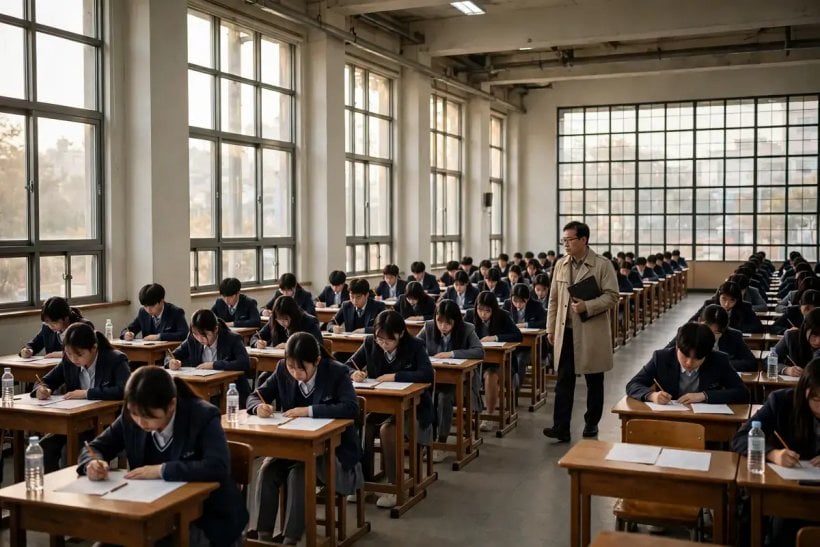
South Korea’s education minister Choi Kyo-jin resigned on Sunday, taking responsibility for confusion caused by last-minute rules meant to stop AI-assisted cheating in the national college entrance exam. President Lee Jae Myung accepted the resignation within an hour and ordered a full review of exam management and related laws.
A week of last-minute rule changes
The panic began when the top scorer in this year’s certified tax accountant exam admitted cheating with a miniature camera, a smartphone and generative AI. The ministry then rewrote its anti-cheating rules repeatedly in the days before Thursday’s College Scholastic Ability Test, known as the Suneung.
At first the rules targeted smart glasses, then widened to other devices. Two days before the exam the ministry deployed 8,400 extra staff, including 1,800 to detect smart devices and 6,600 hallway proctors. The day before, it limited exam rooms to black pencils only and covered clothing buttons with stickers.
During the eight-hour exam, officials restricted Wi-Fi, checked glasses and buttons for hidden devices, and sent three nationwide emergency alerts to catch phones that students had failed to hand in. The measures uncovered dozens of prohibited mobile phones, though it was unclear whether all were meant for cheating.
111 suspected cases
The education ministry said on Friday that 111 suspected cheating cases involving electronic devices were detected during the exam. The figure counts suspected cases, not confirmed cheating, and it is not yet clear how many will lead to formal action against individual students.
Choi said the repeated changes had inconvenienced students and officials. “As the minister in charge, I believe I cannot escape criticism that we failed to prepare in advance,” he said. “Now that the exam has concluded, I feel a deep sense of responsibility and am offering my resignation.”
Choi also drew criticism for telling parliament he could not be fully confident that AI-assisted cheating could be detected. Asked whether he was 100 percent confident, the 72-year-old replied: “I don’t think I could, because of my age.” The remark became a symbol of the ministry’s unpreparedness.
Yonhap also reported that a man who earned a perfect score on this year’s law-school entrance exam was found dead on Thursday after facing cheating allegations. Police said they will continue investigating the allegations, which remain unproven. The report added to the sombre mood surrounding the exam season.
Our Read
The irony is that the measures worked as detection while failing as administration. Officials caught 111 suspected cases and dozens of phones, yet the ministry lost its minister because the rules kept changing until the eve of the exam. Detection without preparation still reads as failure to the public.
The resignation also marks the first major political casualty of AI-assisted cheating. Exam bodies worldwide face the same problem: generative AI and miniature devices make old invigilation rules obsolete, yet every new rule risks punishing honest students with confusion and anxiety.
Why It Matters
The CSAT is seen as a major life event in South Korea, where university admission heavily influences career prospects. More than 550,000 students registered this year, so a botched process touches every family. Governments everywhere are moving from AI principles to enforcement, and exam halls are part of that shift.
Background
President Lee ordered a comprehensive review of national exam management and related laws, and the nomination of Choi’s successor will proceed through due procedures. The resignation follows other accountability moves in AI policy this month, including Character.AI’s new privacy ombudsman.
Source: Reuters report and Yonhap report




0 Comments