
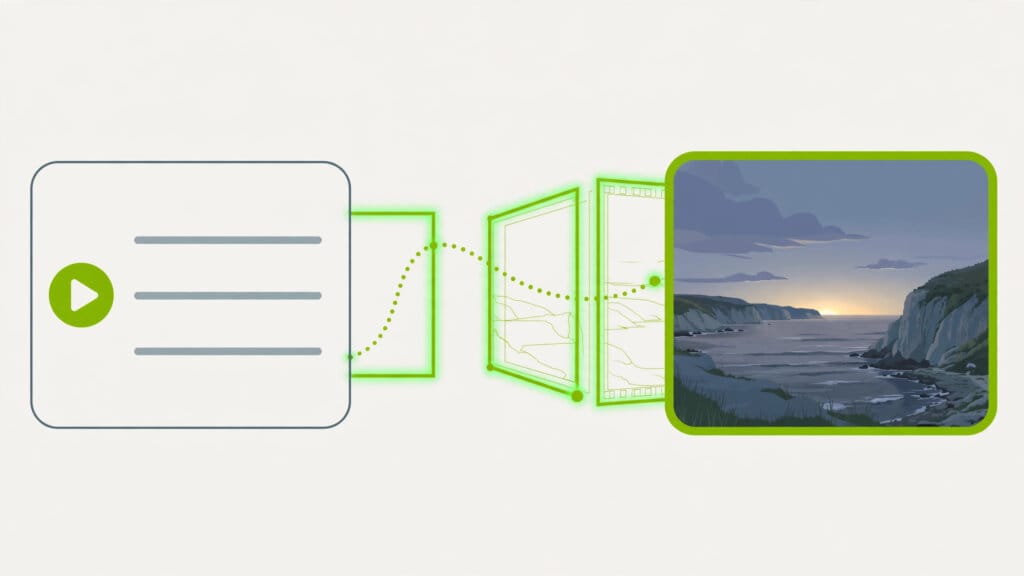
Text-to-video does what it says: you describe a scene in words, and the software generates moving pictures of it. “A lighthouse in a storm, waves breaking, cinematic light” goes in one end; a few seconds of stormy coastline come out the other. Two years ago that was a research curiosity. In 2026 it is a product category with real businesses attached.
Underneath sits a video diffusion model — a system trained on enormous amounts of video paired with descriptions, which has learned how the visual world moves. This explainer covers how that generation actually works, and where its limits still show.
From noise to a scene
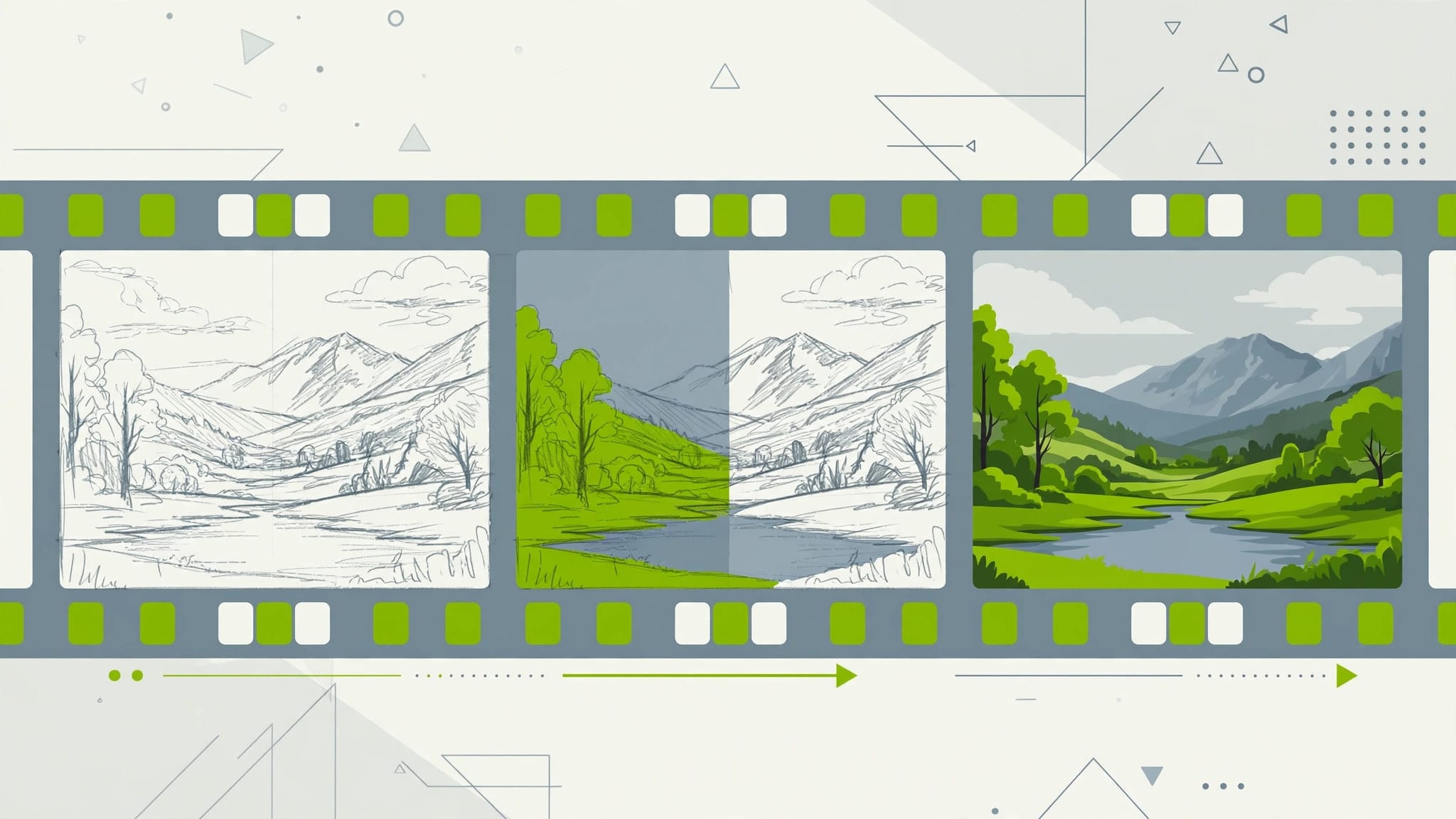
Generation starts from static — a screen of random noise, the video equivalent of an untuned television. The model then refines that noise step by step toward something that matches your description, the same diffusion process that powers AI image generators, extended across time.
The time dimension is what makes video hard. An image model must make one frame plausible; a video model must make dozens of frames plausible and consistent — the lighthouse must stay the same lighthouse, the wave must break like water, the camera move must not warp the world. Modern systems handle this by generating in a compressed space where motion and appearance are planned together, then decoding the result into full frames.
Your prompt steers the process through the model’s understanding of language and images jointly. That is why prompt craft matters: the model is not following instructions like a film crew, it is dreaming in the direction of your words, and precise words produce a narrower, more usable dream.
Why it looks right — and where it doesn’t
Training on internet-scale video teaches statistical physics: how cloth folds, how light bounces, how crowds flow, how a camera pan feels. The model has never seen your exact scene, but it has seen enough of the world’s patterns to improvise a convincing cousin of it.
The failures are equally instructive. Hands gain or lose fingers, text on signs turns to alphabet soup, objects vanish between frames, and cause and effect wobble — a glass falls but does not break, or breaks before it lands. These are not bugs to be patched one by one; they are the visible edge of a system that predicts appearance rather than understanding the world.
Each model generation narrows the gap. Native audio has arrived, with dialogue and sound effects generated alongside the picture. Clip lengths keep stretching, resolution and frame rates climb, and character consistency — the same face across scenes — has gone from hopeless to merely unreliable.
What people actually make with it
The working uses are unglamorous and growing: advertising concepts and product shots, social clips, music visuals, storyboards and pre-visualisation for film, background footage, training material and rapid prototypes of scenes that would cost a crew to shoot. For a small creator, the economics are the story — shots that were simply impossible at their budget are now a subscription.
Text-to-video is best understood as a new kind of camera: one that photographs things that never happened, in a style you describe, at a quality that improves every few months. Learning to direct it — specifying shot, lens, light and motion the way directors do — is becoming a creative skill in its own right, and the gap between a vague prompt and a directed one is the gap between a curiosity and a tool.
The cost curve underneath it all
Video is the most expensive thing AI generates. A single short clip can require more computation than thousands of chatbot replies, which is why text-to-video arrived later than text and image models, and why it is sold by the credit and the second rather than bundled as an unlimited extra.
That cost shapes the market’s behaviour. Providers race to cut the price per generated second, creators build workflows around drafts and retries, and the contest between platforms such as Kling, Runway and Veo is fought as much on cost per finished minute as on raw quality.
History suggests where this ends. Image generation followed the same arc — miraculous, expensive, then ordinary — in about two years. Video is on the same curve, a little behind it. The reasonable expectation for text-to-video is not that it stays a premium novelty, but that within a few model generations it becomes what image generation already is: a standard feature, priced into everything, noticed mainly when it is absent.

0 Comments