

Tutor Intelligence has raised $75 million in a Series B round led by Andreessen Horowitz, taking the Watertown, Massachusetts robotics company's total funding to $117 million. The money will train Tutor's robot foundation models and build more of its two robot workers, Sonny and Cassie, which already handle picking and packing jobs in factories and warehouses across the United States. The company announced the round on 2 November.
A Series B for the Data Problem
Union Square Ventures and Neo, which led Tutor's Series A and seed rounds, also joined the round. The Series A was $34 million, closed in December 2025. Tutor was founded in 2021 out of MIT's Computer Science and Artificial Intelligence Laboratory by Josh Gruenstein and Alon Kosowsky-Sachs, its chief executive and chief technology officer.
Sonny is a two-armed, semi-humanoid robot built for piece-picking and kitting in factories and warehouses. Cassie is a wheeled mobile manipulator that handles case-picking and palletising. Both run Tutor's models and work real jobs in some of the country's largest manufacturing and logistics networks, handling breakfast cereals, snacks, candy, cosmetics, home goods and toys.
The robots are the training data. When a robot fails a task, a remote human operator — a “tutor” — takes control and shows the correct move, and that demonstration becomes training data for the whole fleet. Reports describe Tutor's Ti0 as a 4.5-billion-parameter vision-language-action model trained on those real-world demonstrations.
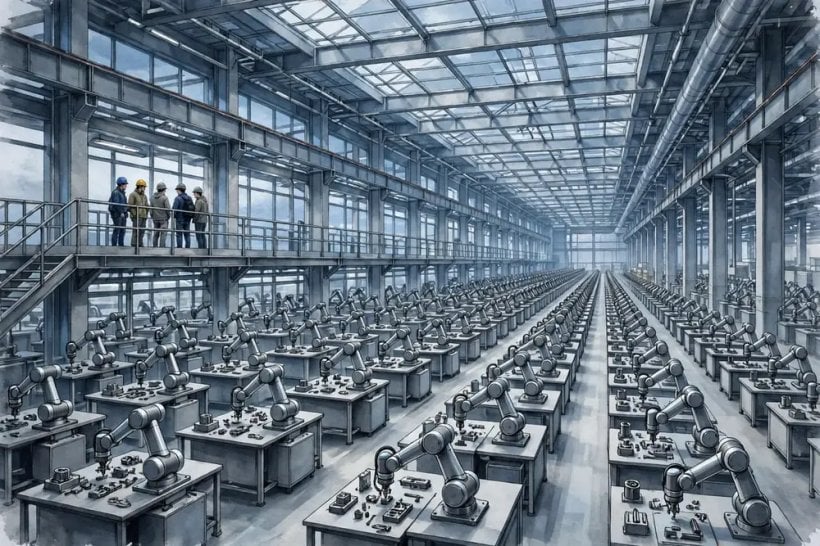
The factory behind that loop is Data Factory 1, a 35,000-square-foot facility running about 100 Sonny robots, said to generate more than 10,000 hours of manipulation data a week. Tutor sells the work, not the machine: customers pay by the hour or by the pick, with no upfront purchase or long-term contract, while Tutor owns and upgrades the fleet.
Our Read
Tutor's bet is the opposite of the simulation-first school. Eka Robotics, which raised $150 million in October, trains its robots in simulation before moving skills to hardware. Tutor puts half-finished robots into paying factories and lets real failures teach them.
The trade is speed against polish: real-world data is messy and slow to collect, but it is the data simulation cannot fake. The evidence so far favours Tutor: robots now work in almost four times as many facilities as a year ago, and nearly a third of recent customers are existing ones buying more.
The field is crowded and well funded. Physical Intelligence is reportedly in talks to raise $1 billion at a $20 billion valuation, and SoftBank's $5.4 billion ABB robotics deal was blocked by China over AI data. Global venture funding for robotics and physical AI reached roughly $16 billion in the first quarter of 2026 alone.
Tutor is far smaller than either, but it is one of the few with robots already doing paid work in American factories. That, rather than the round's size, is why Andreessen Horowitz put three of its general partners on the announcement — and why the firm's former VMware chief called deployment the way past robotics' limits, not just its destination.
Why It Matters
If Tutor's flywheel works, the constraint on robots stops being the model and becomes the factory floor: each deployment produces the data the next one needs. Tutor is unusual in that its robots earn their keep in the warehouses that would have to buy them — and the 1,000-robot target for the end of 2027 is the number to watch.
Background
Robotics funding has surged as investors bet that AI's next act is physical: the week's biggest rounds included Shield AI's $2 billion and Zipline's $1.5 billion, with Tutor's tied tenth-largest in the United States. Its round was announced on 2 November, and its robots are built and deployed in the United States, a point the company and its backers stressed.
Source: Tutor's Series B announcement and TechTimes' report


0 Comments