

Agility Robotics, the maker of the Digit humanoid robot, began trading on the Nasdaq on 5 November under the ticker AGLT, becoming the first US-listed company devoted solely to humanoid robots with robots already working in warehouses. The listing followed the completion of its merger with Churchill Capital Corp XI a day earlier, a deal that valued the company at about $2.5 billion and delivered roughly $465 million in gross capital.
The deal
Agility went public through a SPAC merger rather than a traditional IPO. The $465 million in gross capital came from three sources: $164 million from Churchill XI’s trust account, a $201 million private investment led by Foxconn, and $100 million of equity funding Agility had already received before the merger closed.
All existing shareholders rolled their full equity into the combined company, and their shares are locked up for 180 days. Agility says it will use the capital to expand manufacturing, increase commercial deployments, fulfil customer orders and keep developing its robots.
Digit at work
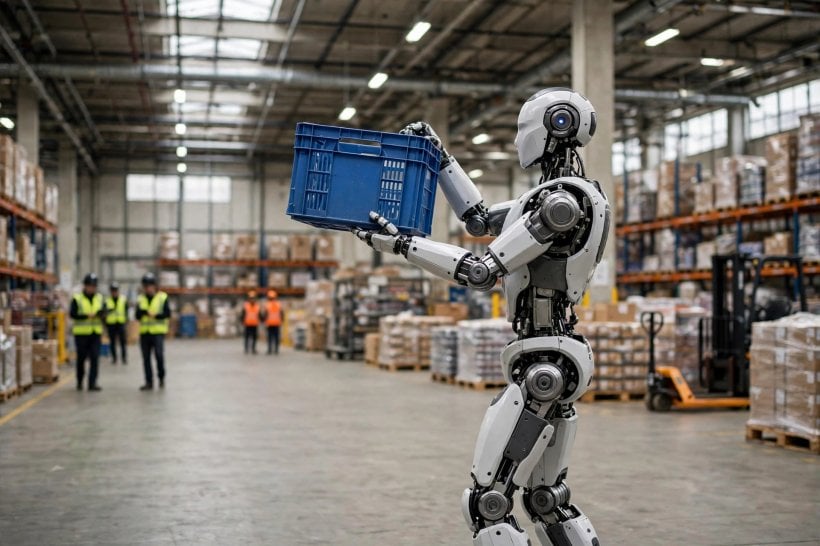
Unlike many humanoid robots still confined to laboratories and demonstration videos, Agility’s Digit is already doing paid work. The bipedal robot moves totes and handles repetitive material-handling tasks in warehouses and factories, and Agility says its robots have logged more than 65,000 hours of real-world operation with customers including GXO, Schaeffler and Toyota Motor Manufacturing Canada.
At a GXO logistics facility in Georgia, Digit robots have moved more than 100,000 totes. GXO has expanded the arrangement to two additional US facilities, with deployments due to begin in early 2027, and Agility has signed a commercial agreement with farm-equipment maker AGCO for a pilot at its Hesston, Kansas plant, also starting in 2027.
Digit 5 and the order book
Digit 5, unveiled in September 2026, is designed to work closer to people and lift up to 50 pounds repeatedly, with a nine-minute recharge target and more than 20 productive hours a day. Agility plans early-access deliveries in the first half of 2027 and general availability by the end of the year, running on Nvidia’s IGX Thor computing platform.
Agility reports more than $300 million in committed multi-year orders for Digit 5, but the figure needs care: the commitments are conditional on contractual milestones and product requirements, and the company cautions they may not convert into recognised revenue. An earlier disclosure tied the bulk of that order volume to a three-year agreement for 1,000 robots with a single customer.
Our Read
The listing gives humanoid robotics what it lacked: a yardstick. Figure AI is private, Boston Dynamics is unlisted, and Meta is building humanoid hardware. Agility’s quarterly reports will show what the business earns — and every thin revenue quarter will be visible. That cuts both ways, but it treats humanoids as an industry rather than a demo reel.
The financials are the hard part. Agility reported about $1.8 million in revenue for 2025 against a net loss of about $138 million, and its first-half 2026 revenue of about $174,000, down sharply year on year. Its pre-merger prospectus carried a going-concern warning, made before the capital arrived — the $465 million buys time, not a proven business.
Why It Matters
Agility’s debut matters beyond one company. It gives investors their first listed bet on warehouse humanoids and gives the whole sector a public valuation to argue against. If Digit 5 ships on schedule and the order book converts, rivals will face pressure to show the same discipline; if it stumbles, the market will price humanoid hype more harshly for everyone.
Background
Agility is headquartered in Salem, Oregon, and its backers include Nvidia, Amazon, SoftBank and Foxconn. Its RoboFab facility in the US is designed to produce up to 10,000 robots a year, and its cloud platform, Agility Arc, manages robot fleets.
Source: Agility Robotics’ announcement and TechRepublic’s report.


0 Comments