

Lisbon-based Beyond Vision has raised more than €28 million to scale production of its AI-powered drones for civilian and defence markets, Tech.eu and EU-Startups reported on October 22. The round was co-led by Índico Capital Partners and Lince Capital, with a follow-on investment from ActiveCap, a shareholder since 2024.
Beyond Vision, founded in 2013 and led by chief executive Dário Pedro and chairman Luís Miguel Campos, builds unmanned aerial systems with a cloud-based management platform. It is a registered NATO supplier, has grown its team to 150 employees, exceeded its 2025 revenue estimate and expanded its list of military and civilian clients across several countries, according to Tech.eu’s report.
Beyond Vision’s €28 Million Round: Who Backed It
Índico Capital Partners and Lince Capital co-led the raise, and ActiveCap followed on from its 2024 entry. Stephan de Moraes, managing general partner at Índico, said sovereign, reliable technology is now a strategic priority in defence, infrastructure management and security, and that Beyond Vision had combined high-precision hardware with advanced AI algorithms at a competitive cost. Tomás Lavin Peixe, head of venture capital at Lince Capital, pointed to Europe’s rising defence investment and the geopolitical context as the opening the company is positioned to take.
No valuation or round label was disclosed in either report, and neither report broke the €28 million-plus total down by investor. The figures the two outlets agree on are the total, the two co-leads and the follow-on investor.
Where The Money Goes: Production, AI R&D And New Markets
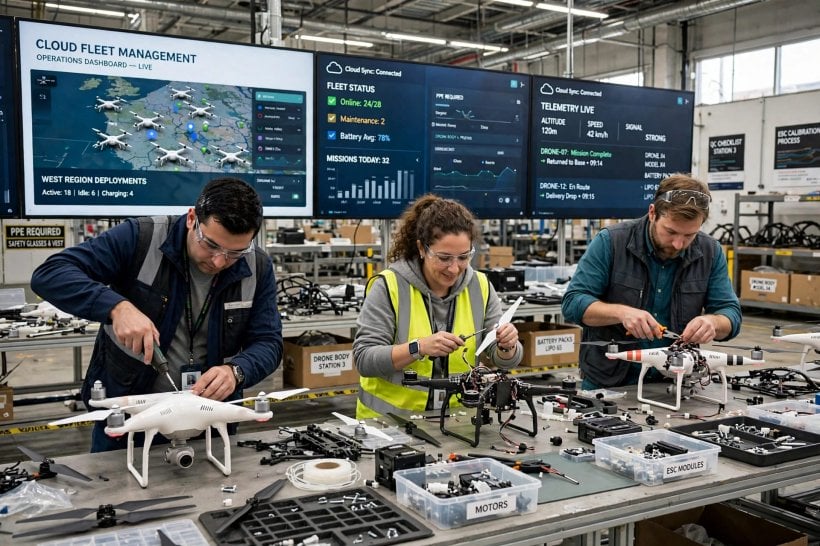
Pedro said the capital will be applied in three areas. First, Beyond Vision will strengthen its operational infrastructure and scale industrial production capacity to meet growing global demand for autonomous systems. Second, it will accelerate research and development, deepening the integration of advanced AI algorithms and new functions in its cloud management platform. Third, it will consolidate commercial expansion into new international markets, strengthening its presence across defence, security and critical infrastructure monitoring.
The raise follows a period Tech.eu describes as strong acceleration: the team has reached 150 employees, the company beat its own 2025 revenue estimate, and its military and civilian client list has grown across several countries — the trading record the new investors are funding it to industrialise.
The product line behind that plan is a family of AI-powered drones paired with cloud fleet management — the model Militarnyi documented earlier this year, when Beyond Vision systems including the BVH616 (HEIFU PRO) hexacopter were already being delivered to Ukraine, with AI algorithms used to maintain stable flight in electronic-warfare conditions. That battlefield use is context for the raise, not a new contract announced with it: neither report announced a specific new order alongside the funding.
Why It Matters
Beyond Vision’s raise is a defence-AI business story as much as a drone story. Europe is putting public money and procurement weight behind sovereign autonomous systems, and investors are funding the production capacity to supply them — the same pressure visible in NATO-facing AI work such as Palantir’s Maven deployments in Europe. For a 150-person Portuguese maker, €28 million-plus buys factory scale and AI development at the moment demand is being created by governments rather than only by commercial buyers, in a market where physical-AI funding has also backed young robotics teams such as Enact Intelligence and infrastructure plays such as Photon Bridge. Whether Beyond Vision converts that position into export contracts is the test the next announcements will answer.
Background
Beyond Vision began in 2013 as a software company and moved into AI-powered drones with cloud-based management as demand grew, winning awards and NATO supplier registration along the way. Its systems have been shown at defence exhibitions and delivered to Ukraine, and the company now sells into defence, security and critical infrastructure monitoring — the three markets this raise is meant to expand.
Source: Tech.eu




0 Comments