

Firstwork has raised a $15 million Series A to scale its applied AI platform for frontline workforce operations, the company announced on October 21. The round was led by Earlybird Venture Capital, with participation from Legion VC and Deel Ventures and existing investors Gradient and Y Combinator, and it brings Firstwork’s total funding to $20 million since it launched in 2024.
Firstwork’s AI agents handle the operational work between a job offer and a worker’s first shift: document verification, right-to-work and background checks, training coordination, onboarding and compliance. The company says more than 150,000 frontline workers now start work through its platform each month.
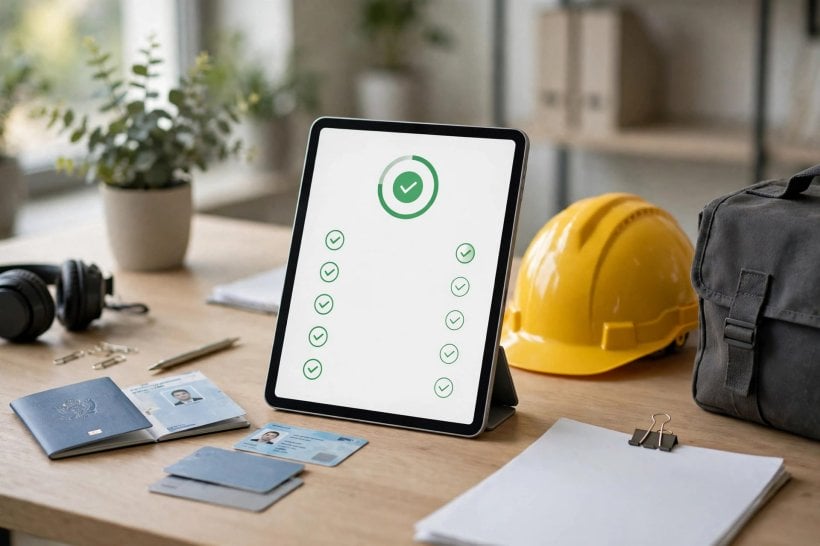
What Firstwork’s Agents Do Between Offer And First Shift
Firstwork targets the stretch of hiring where employers most often lose people they have already chosen. Each frontline hire can require documents, background and right-to-work checks, training, payroll setup and other compliance steps, spread across HR, payroll and screening systems that do not talk to one another. The longer that process takes, the more likely a candidate is to take another job or drop out altogether.
Rather than asking employers to replace those systems, Firstwork sits on top of them and does the work between them. Its agents move workers from application to first shift, manage ongoing compliance, and follow up after shifts to surface problems early, before a worker quits. Every action is logged and auditable, the company says — a design point that matters in sectors where a missed check can stop a worker legally starting at all.
The Shortages Behind Firstwork’s Pitch
The company’s announcement grounds its market in labour shortages it can cite: Europe is on track to be short 950,000 health workers by 2030 and is missing more than 500,000 truck drivers, 60% of energy companies worldwide report labour shortages, and the United States faces a projected shortfall of more than 267,000 registered nurses by 2028. Firstwork’s argument is that many of the workers employers need have already applied — they are lost in clearance, not in sourcing.
Customers named by the company include Deel, Job&Talent, Relay, Wonolo and BGSF. Firstwork says those customers have cut the time workers and HR teams spend on each new hire by up to 90%, and that at one of its largest customers it helped triple the number of qualified applicants who made it to their first shift. Earlybird general partner Tim Rehder said the firm’s diligence found Firstwork’s agents “performing millions of actions every month to reduce the time to clear a worker from days to minutes.”
Where The Series A Money Goes
Firstwork says the new capital will grow its team across applied AI, AI research, engineering and go-to-market, expand its presence across the United States and Europe, and extend its agents into more parts of frontline workforce operations. The company is hiring across the US and Europe.
The extension is the strategic part of the announcement. Having started with the offer-to-first-shift window, Firstwork is now moving its agents into the recurring work that follows: re-verification, credential renewals, recurring training, compliance management and worker support — the tasks that keep a worker cleared and current long after day one. That widens the product from an onboarding tool into a standing operations layer, closer in shape to the agent platforms now being built for other industries, from team-wide AI assistants to tools that watch other agents as they work.
Why It Matters
Firstwork’s raise is a clean example of where applied AI money is going in late 2026: not to another general assistant, but to agents that take over a defined, auditable slice of operational work inside systems employers already run. Frontline hiring is a strong test case for that model, because the work is high-volume, rule-bound and spread across disconnected software — and because the cost of failure is concrete: an uncovered shift, a delayed start, a candidate lost to a faster competitor.
The round also shows the shape of the market forming around such agents. Deel is both a customer and, through Deel Ventures, an investor; the company’s founders came from Deliveroo, Remitly, Deel and Rippling, the very employment infrastructure Firstwork now layers over. If agents that clear workers in minutes rather than days hold up at 150,000 starts a month, the same pattern — an agent layer over systems of record, sold on time saved per transaction — is the template other workforce startups, including physical-AI entrants such as Enact Intelligence, are being funded to repeat in their own sectors.
Background
Firstwork was founded in 2024 by Vardhan Kapoor, previously APAC lead at Remitly and a strategy lead at Deliveroo Singapore, where he recruited and onboarded tens of thousands of riders, and Shubham Choudhary, a former director of engineering at Deel who helped build Rippling’s global employment infrastructure. The company went through Y Combinator and had raised $5 million before this round. Its Series A arrives as employers across care, logistics and energy report structural worker shortages that hiring alone has not closed.
Source: Firstwork, Tech Funding News




0 Comments