
Eka Robotics has closed a 150 million dollar Series A round at a 1.45 billion dollar post-money valuation, TechCrunch reported on Tuesday, October 20, in one of the year’s largest early-stage bets on physical AI. The round was led by Andreessen Horowitz (a16z) and F-Prime, and it prices a startup whose claim is that robots fail at manipulation not because they cannot see, but because they cannot feel.
Eka was founded by Pulkit Agrawal, a professor at MIT, and Tuomas Haarnoja, a former Google DeepMind researcher. Its system pairs a force-sensitive gripper with a new kind of deep-learning model. The valuation makes Eka a unicorn on laboratory results and secretive industrial pilots, before any public commercial deployment.
The Round And The Valuation
The Series A totals 150 million dollars and values Eka at 1.45 billion dollars post-money, according to TechCrunch. a16z confirmed its role in its own announcement the same day. Raghu Raguram, the a16z partner who co-led the round, told TechCrunch the system already exceeds superhuman performance for certain tasks, with more expected over the next few months.
The size is itself a signal: Series A rounds this large usually go to companies with revenue or a deployed product, and Eka has neither in public. What it has is a demonstration record veteran researchers describe in unusual terms, and founders who helped create the reinforcement-learning methods the system is built on. It follows Tenstorrent’s 1.5 billion dollar raise for AI chips and Town’s 108 million dollar Series B for AI assistants in the same week.
A Vision-Force-Action Model, Not Vision-Language-Action
Eka’s technical break is architectural. Most robot models today are vision-language-action models, connecting what a camera sees and an instruction says to what a robot should do. Eka’s is a vision-force-action model: it connects visual input with force input, so contact itself becomes information the policy uses while a grasp is happening, not after it has failed.
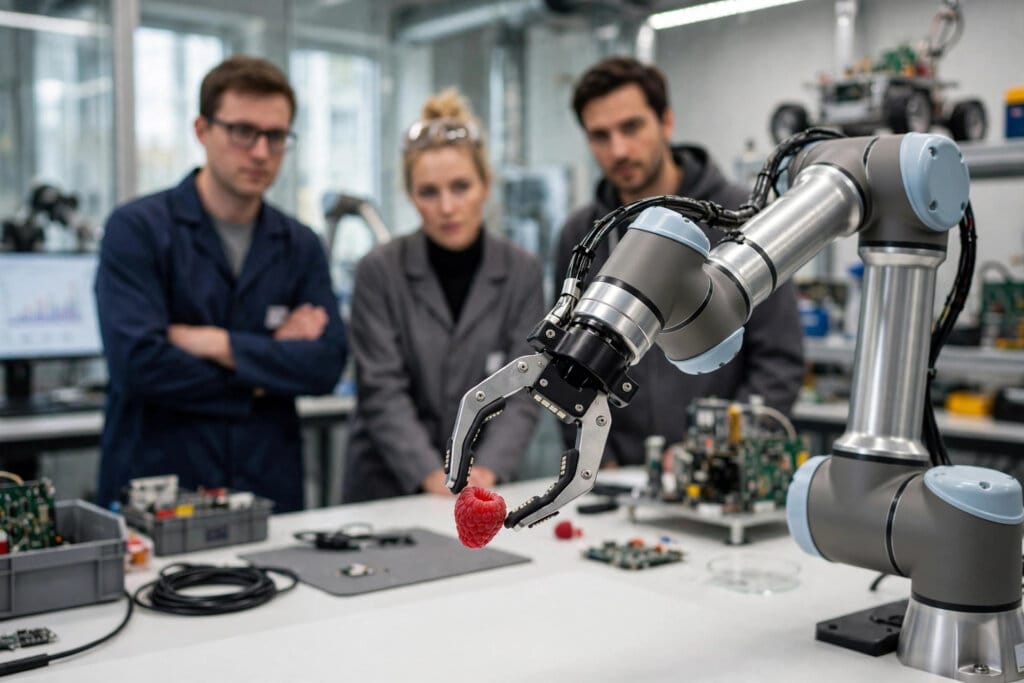
“Vision is not the primary way in which you close this last millimeter problem,” Agrawal told TechCrunch. “Vision tells you roughly where the object is, what the pose is, but the actual grabbing, the actual searching is happening through forces.” Eka therefore designed its own hand, more flexible than traditional grippers and fitted with more force sensors, so it reacts to contact instead of crushing what it holds. In demonstrations, the robot handled a raspberry gently after rushing toward it at speed, adapted to many different objects without retraining, and retried failed grasps with a persistence observers called almost human.
The performance figures are specific. Eka says the robot picks about 1,500 objects weighing up to 1 kilogram an hour, against about 600 for a human, reliably more than 95 percent of the time. Its gripper costs less than 1,000 dollars and is rated for 5 million duty cycles, Agrawal said, against a goal of the 20 million cycles standard industrial arms achieve. a16z reported the same rate — up to 1,500 picks per hour in laboratory bin-picking, two and a half times faster than humans.
Learning Grip In Simulation, Not From Demonstrations
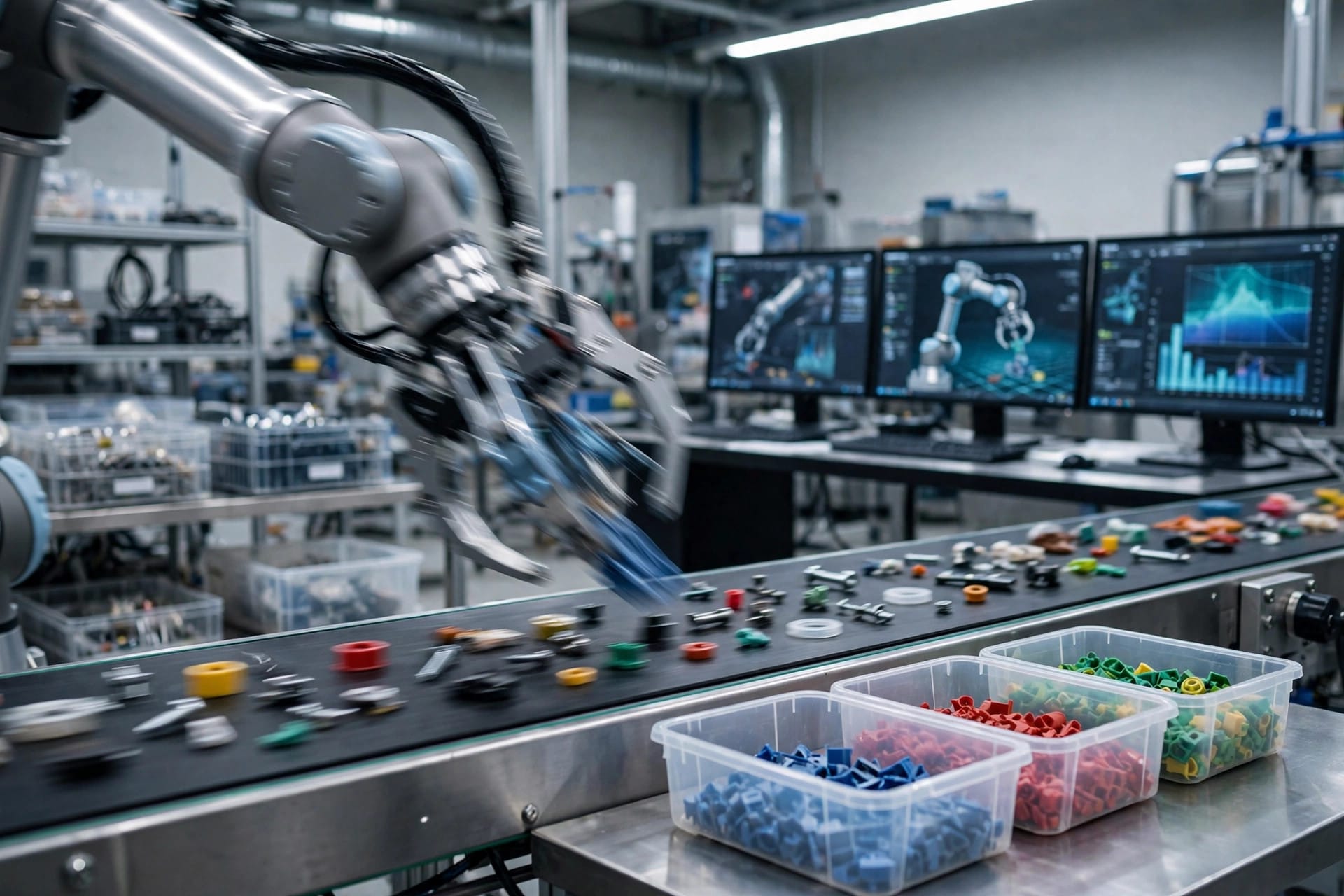
The second break is how the model learns. Rather than training on human demonstrations, Eka trains its policies through reinforcement learning inside a physics simulator modelling the forces a robot meets when it grasps something. The founders say that generates thousands of hours of robot experience in minutes, including failure modes demonstrators rarely show.
Kris Hauser, a professor at the University of Illinois Urbana-Champaign who saw the system, told TechCrunch its ability to adapt without retraining had a “wow factor.” a16z made the underlying argument in its announcement: virtual robots can practise millions of variations in object position, friction and contact before a policy reaches hardware, so robot experience can scale with compute rather than human labour — if the simulation-to-reality gap can be closed.
That gap is the open risk. Eka is running secretive pilots with industrial customers on pick-and-place and wire manipulation, but Hauser noted the harder test is running without breaking for a full year on a real assembly line, and generalising beyond pick-and-place. Eka is starting pragmatically, Agrawal said, aiming to make pick, arrange, place and wire handling “home runs” first.
Why It Matters
The central entity is Eka Robotics, and the attribute investors just priced is dexterous manipulation treated as a learnable, force-based skill rather than a vision problem. Its neighbours show why the price is high. The large model labs supply the planning layer — a general model can decide that plates belong in a cupboard — but they handle the physical act slowly and at high cost; Eka is building the layer underneath, the one that picks the plate up without breaking it. Manufacturers feel it first: a robot that adapts without retraining turns automation from a per-product project into a reusable capability. It lands in the same current as Different’s 48 million dollar seed this week: capital concentrating on young companies claiming a working system, not a roadmap. Whether Eka’s laboratory rates survive a year on a production line will decide if 1.45 billion dollars was early or expensive.
Background
Agrawal and Haarnoja met in graduate school at the University of California, Berkeley, and both spent the next decade on reinforcement learning for robotics: Agrawal through his Improbable AI Lab at MIT CSAIL, and Haarnoja as a co-creator of Soft Actor-Critic at Berkeley before joining Google DeepMind. Eka is their attempt to commercialise that shared research line — the bet that simulation-first training can, at modern compute scale, finally close the gap between a robot that understands a task and one that can physically do it.
Source: TechCrunch; Andreessen Horowitz (a16z), “Investing in Eka Robotics”




0 Comments