

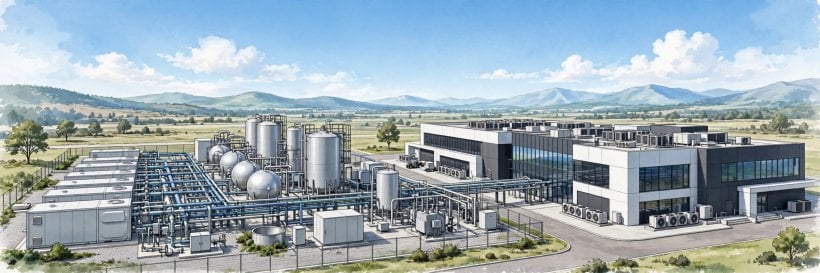
Google will spend $17 billion building its first data center in Wyoming, the company announced on Thursday, pushing ahead with a major artificial intelligence infrastructure bet even as voters and local officials push back against new data center projects. The campus in Laramie County will run on a planned 702-megawatt fuel-cell development with carbon capture and storage, which Google calls the largest of its kind. Google says it will pay for all of the power the site uses.
The power plan
The project is a partnership with Tallgrass Energy, Black Hills Energy, American Electric Power and Related Digital. At its center is a commercial-scale fuel-cell development contracted with AEP: 702 megawatts of capacity that converts natural gas into electricity through an electrochemical reaction, with carbon capture and storage fitted to the plant.
The fuel cells will be made in America by Bloom Energy, and Google says the carbon-capture system will trap a large majority of the plant’s emissions for storage underground at Tallgrass’s Eastern Wyoming Sequestration Hub. The project lifts Google’s contracted carbon-capture capacity to nearly one gigawatt. Google will buy power from gas generators run by Tallgrass and Black Hills Energy.
Water was a central concern in Google’s announcement. The Wyoming data center will be air-cooled to limit strain on local water supplies, and Google repeated its pledge to pay for all of the electricity the site consumes and to cover the infrastructure its growth directly requires.
Why Wyoming, why now
The announcement lands in a hostile political climate for data centers. Forty-one data-center ballot measures were voted on this week, and all but one went against the projects, according to Ballotpedia. Candidates opposed to data-center expansion also won key races in Texas and Georgia in this week’s midterm elections, adding to investor doubts about the buildout.
Google is not slowing down with the rest of the sector. Just this week it committed $15 billion to a data center hub in Malaysia, and the Wyoming project extends that spending to American soil. Both announcements frame power supply, not buildings, as the real investment.
What it means for Cheyenne
Google expects the project to generate hundreds of millions of dollars in property taxes for Laramie County and School District 1, alongside community spending on K-12 education, workforce development and skilled trades training. The company says it met 200 residents at a community meeting in Cheyenne and will set up a Community Council with its partners to manage growth.
Our read
The Wyoming deal shows Google answering the backlash with concessions, not retreat. Air cooling, paying for all power, carbon capture and a community council are answers to the complaints that sank ballot measures this week. The contrast with Microsoft is sharp: Microsoft has declined to expand a Texas data-center agreement with Nscale as it tightens oversight of cloud providers.
Whether the concessions work is the question. Carbon capture at this scale is unproven — Google calls the fuel-cell plant first-of-its-kind — and the company gave no construction timetable or opening date for the data center itself. Voters have shown they block projects they see as a burden; Google bets paying its own way changes that calculation.
Why It Matters
Data centers are now a political issue, not just an infrastructure one. This week’s votes show communities can stop projects, and Google’s $17 billion answer — clean power, air cooling, local taxes — is the industry’s clearest attempt yet to buy consent. If Wyoming works, it becomes the template; if it stalls, every hyperscaler faces the same fight in the next state.
Background
Google has spent two decades building data centers, and its recent spending has accelerated with the AI boom, including a satellite data center that went online in October. Wyoming is the first project where the company has wrapped the announcement in power and community pledges from the start.
Source: Google’s Wyoming announcement and Reuters’ report on the plan


0 Comments