
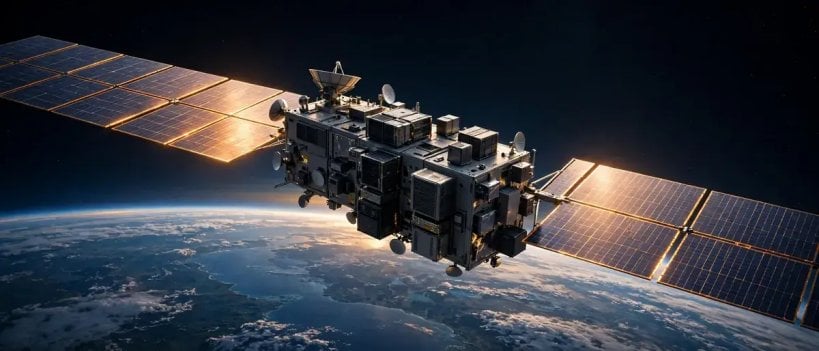
Google has booked a ride to orbit for its space-based AI computers. Blue Origin’s New Glenn rocket will carry several Suncatcher satellites into orbit in early 2029, each packing roughly the computing power of a data center rack and running on sunlight alone.
The first heavy-lift flight
The launch, targeted for the first quarter of 2029, is the first heavy-lift flight dedicated to Project Suncatcher, Google’s long-term plan to move AI computing into space. The satellites will fly in a sun-synchronous orbit, where near-continuous sunlight can power the chips aboard.
Each satellite carries Google’s Tensor Processing Units, the company’s in-house AI chips, with about the capacity of one server rack in a conventional data center. The mission will test whether solar power can support intensive computing far above the ground.
A prototype already flying
Google and Planet Labs launched the first Suncatcher prototype aboard a SpaceX rocket in October, and the satellite is operating as expected after making contact. The test checks whether the chips can survive launch forces, radiation and extreme temperatures in orbit.
Cooling is the hardest problem. Heat from powerful chips must escape through pipes and panels, since there is no air to carry it away. Radiation can also damage electronics and corrupt data, so the prototype is proving the hardware before Google scales up.
Why space at all
The idea is to ease the pressure AI puts on power grids, land and cooling systems on Earth. Data centers already strain local infrastructure, and Google is spending heavily on ground facilities too, including a $17 billion Wyoming site announced this month.
Google is not alone in looking upward. SpaceX and startup Starcloud are also exploring data centers in orbit, as demand for computing capacity keeps growing. The race is now about who can prove the economics first, not just the engineering.
Blue Origin’s big win
For Blue Origin, the agreement is a major future mission for New Glenn as it rebuilds its launch business after delays and a launchpad explosion in May. A Google contract of this size gives the rocket a flagship customer and a steadier manifest.
The deal also shows how far Suncatcher has come. What began as a research question about solar-powered computing now has a dedicated heavy-lift launch, a working prototype and a date. Google calls the agreement a crucial milestone on its long-term roadmap.
Our Read
Google is not short of data centers. It is short of cheap, clean power to run them, and space offers endless sunlight with no neighbours to complain. The launch bill and the physics of cooling could still keep orbital computing a curiosity for years.
Why It Matters
If Suncatcher works, the ceiling on AI computing moves off the planet. Power-hungry training runs could draw on sunlight instead of grids, and the industry’s fiercest constraint becomes a launch schedule. If it fails, the lesson still shapes how Google builds on Earth.
For now, the 2029 date is the honest part of the story. Experts warn that high launch costs, engineering hurdles and limited satellite production put orbital data centers years from commercial use. The prototype must first prove the chips can survive up there.
Background
Google unveiled Suncatcher as a research effort and put its first prototype in orbit in October, where it ran a small AI model and sent a poem back to Earth. The Blue Origin deal is the next step: from one test satellite to a dedicated launch.
Source: Google Research blog, Reuters report




0 Comments