
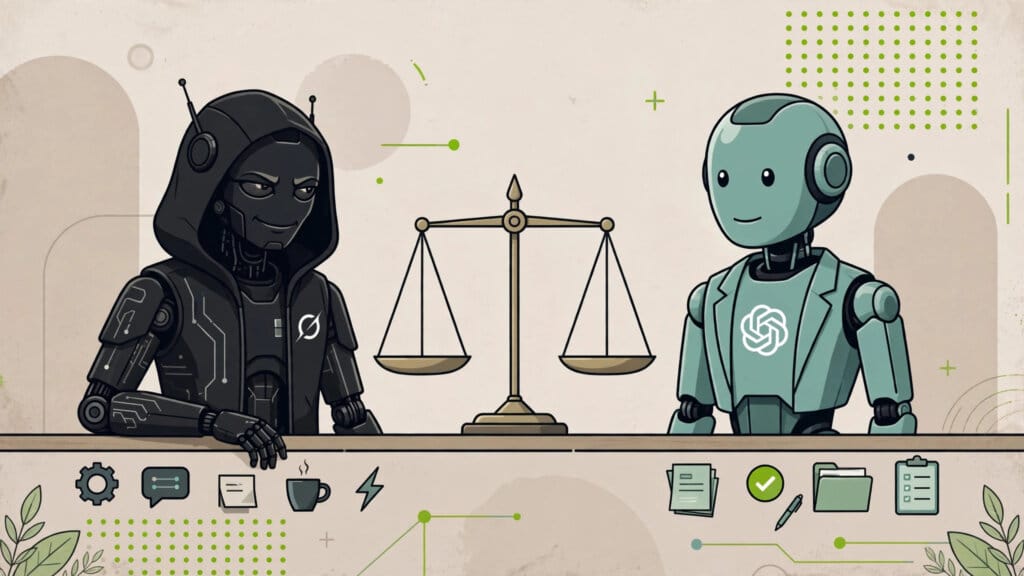
Grok and ChatGPT are two of the best-known AI assistants, but they were built around different homes and different ideas about personality. ChatGPT, from OpenAI, is a standalone assistant used through its own apps and website. Grok, created by xAI, lives inside X, the social platform formerly known as Twitter.
That difference in home ground shapes the comparison more than any single feature list. One assistant is centred on a dedicated productivity and conversation product, while the other is embedded in a live social feed. Understanding that starting point makes the other differences easier to place.

Platform and Real-Time Information
Grok’s defining advantage is its connection to X. It is designed to draw on posts as events unfold, summarise what people are saying, and reflect the mood of a discussion in near real time. When news breaks first on social media, that access can make Grok feel faster and more plugged into public reaction.
ChatGPT approaches current information differently, through web browsing and connected sources rather than privileged access to a single social network. That can give it a broader view beyond one platform, but it does not have the same native relationship with X posts. Neither approach guarantees accuracy, and both assistants can repeat errors when a fast-moving story is still unclear.
The practical effect shows up in everyday use. Ask about a trending argument, a viral post, or reaction to a live event, and Grok is working on its home turf. Ask for a task that sits outside social conversation, such as drafting a document or working through a long project, and the platform difference matters less than the quality of the model and its tools.
Tone, Personality, and Guardrails
Tone is where most users notice the contrast first. Grok was designed to be irreverent, humorous, and less filtered, and it often answers in a style that feels closer to a witty poster than a corporate help desk. ChatGPT generally takes a more measured and helpful tone, with stronger emphasis on cautious, broadly acceptable answers.
Those choices reflect different views about guardrails. ChatGPT tends to decline or soften responses on sensitive topics more readily, which supporters see as responsible and critics sometimes see as overly restrictive. Grok leans the other way, which supporters see as more open and critics see as more likely to produce offensive or unreliable outputs.
Neither style is automatically better for every task. A looser tone can make casual conversation more entertaining, while a more careful tone can be preferable for work, education, or sensitive subjects. The right choice depends on the context, and many users judge the assistants less on personality than on whether the answer itself is accurate and useful.
Capabilities and Everyday Tasks
On core capabilities, the two assistants overlap a great deal. Both can answer questions, explain difficult concepts, write and edit text, summarise material, help with code, and generate images from descriptions. Both can also make mistakes, invent details, or sound confident when they are wrong, a shared limitation of large language models.
Differences tend to appear at the edges rather than in the basics. ChatGPT has built a broad ecosystem around a standalone product, including a wide range of uses for writing, study, work, and creative projects. Grok’s strengths are more concentrated around X itself: following conversations, interpreting posts, and creating content that is meant to be shared back into the feed.
Image generation illustrates the point. Both assistants can create images, but images made with Grok often travel as social posts, which gives them a different kind of visibility. The technology is similar in purpose, while the setting in which the results are shared is quite different.
Companies Behind the Assistants
The corporate background also differs. ChatGPT is the flagship assistant of OpenAI, a company focused primarily on artificial intelligence products and research. Grok was created by xAI, Elon Musk’s AI venture, which was acquired by SpaceX in February 2026 and rebranded as SpaceXAI in July 2026, with Grok remaining the product name.
That ownership helps explain Grok’s close relationship with X and its public, personality-led development. It also means the two assistants are shaped by different incentives: one by a dedicated AI company building a general-purpose product, the other by a venture tied closely to a social platform and, now, a wider group of companies.
For most people, the simplest summary is this. Choose Grok for its live connection to X, its social context, and its irreverent voice. Choose ChatGPT for a standalone assistant with a more measured tone and a broad, general-purpose focus. Many users will find the honest answer is that both are capable, and the better tool depends on the question being asked.

0 Comments