

How Y Combinator Works
Y Combinator invests $500,000 in every company it accepts, takes 7% of the company on a standard deal, and runs a three-month, in-person batch program in San Francisco four times a year. That is the whole model in one sentence — but the sentence hides the parts founders actually need to decide on: how the $500,000 is structured, what the three months really look like, how hard it is to get in, and whether giving up roughly a tenth of your company is worth it. This guide answers each of those questions from Y Combinator’s own published pages. Checked 22 November 2026. Primary sources read in full: Y Combinator’s standard-deal page, its SAFE documents page, its “What Happens at YC” page, its application page for the Winter 2027 batch, its FAQ, Paul Graham’s “How to Apply to Y Combinator,” and YC’s account of DoorDash’s path from application to IPO. Secondary sources (Wikipedia and OpenAlmanac) were used only to cross-check founding history and scale, and every figure that could not be confirmed on a YC page is flagged as such in the text.
If you are a founder weighing an application, read this guide in order. The deal comes first, because it is the one part of YC that is identical for every company and fully documented. Then the application and the interview, then the batch itself, then Demo Day and the long afterlife of the alumni network. The last section does the honest arithmetic on the 7% question, including the criticisms YC’s own fans tend to skip.

What Is Y Combinator?
<img src="

” alt=”Founders collaborating around laptops in a bright co-working space” />
Y Combinator — universally shortened to YC — is a startup accelerator and seed investor based in San Francisco, California. It was founded in March 2005 in Cambridge, Massachusetts, by Paul Graham, Jessica Livingston, Robert Morris, and Trevor Blackwell, and it has since become the best-known accelerator in the world, the model that Techstars, 500 Global, and dozens of other programs were built to imitate. YC also operates Hacker News, the news site at news.ycombinator.com, which is where much of the startup world reads its morning news — a fact that tells you something about how deeply YC is wired into the industry it serves.
The model is simple to describe and hard to copy. Four times a year, YC admits a batch of startups — around 150–200 companies per batch in recent years, according to counts of YC’s public company directory (YC itself does not publish a current batch-size figure). Each batch runs for three months, in person in San Francisco, and ends with Demo Day, when founders present their companies to a specially selected audience of investors and press. Every accepted company gets the same deal: $500,000 invested on the day of acceptance, structured as two SAFEs — $125,000 on a post-money SAFE that converts into a fixed 7% of the company, and $375,000 on an uncapped SAFE with a Most Favored Nation provision. There are no fees, no milestones, and no negotiation over the terms. The deal is the deal.
But the money, YC insists, is only a small part of what it does. “At least half of the startups we fund don’t need the money,” YC’s FAQ says — a striking claim, and one worth taking seriously, because it points at what founders are actually buying: three months of intensive work with partners who have built companies themselves, a peer group of founders at the same stage, an alumni network YC describes as “probably the most powerful community in the startup world,” and a credibility stamp that changes how investors, hires, and customers treat a young company. The $12 million-plus in free credits and deals each company receives — from OpenAI, Anthropic, Amazon Web Services, Google Cloud, Microsoft Azure, Stripe, and others — is itself worth more than the cash investment for many software startups.
Who is YC for? In YC’s own words, it will consider startups in any field — “we’ve funded companies that make everything from microbes to fusion reactors to coffee carts.” About 40% of the companies funded in each batch are just an idea, and most have no revenue at all. Solo founders are regularly accepted, though YC advises that a co-founder improves the odds. The founding team must be able to build the product themselves, which for most businesses means a technical co-founder is needed. And YC says it “can probably help any startup that hasn’t already raised a series A round from VCs” — which means the program is aimed squarely at the earliest stage, before a company has institutional venture funding.
The 30-second answer, then: YC gives you $500,000, three months in San Francisco with experienced partners and a cohort of ambitious founders, a network that stays with you for the life of the company, and a Demo Day that puts you in front of the investors who fund the next round. In exchange it takes about 7% of your company on day one — closer to 9.5% once the second SAFE converts, as the deal section below shows. Whether that trade is worth it depends on what you would do with the three months and the network, which is why the rest of this guide exists.
A Short History: From 8 Startups in Cambridge to the World’s Best-Known Accelerator

Y Combinator began in March 2005, in Cambridge, Massachusetts, when Paul Graham, Jessica Livingston, Robert Morris, and Trevor Blackwell decided to fund startups the way they wished someone had funded theirs. The first batch, in the summer of 2005, contained just eight companies — among them Reddit and Loopt. Sam Altman, who would later become YC’s president in 2014, was a founder in that first cohort. The amounts were tiny by today’s standards and the model was untested: give very young companies a small amount of money, a summer of intense work, and introductions to investors, and see what happens.
What happened was that the model worked, and then it scaled. YC moved to Silicon Valley and eventually settled in San Francisco, grew from one batch a year to four — Winter (January to March), Spring (April to June), Summer (July to September), and Fall (October to December) — and grew its batches from eight companies to hundreds. Batch size peaked at around 414 companies in Winter 2022, after which YC deliberately cut intake by roughly 40%, to around 250 companies in Summer 2022, according to Wikipedia’s account of the program’s history. In recent years the batches have settled at around 150–200 companies each, per counts of YC’s public directory — still an enormous number for a program that promises every founder direct access to partners.
The scale of the whole enterprise is now very large, though the precise figures deserve care. YC has funded more than 5,000 companies, and the combined valuation of its portfolio is widely reported at more than $600 billion — but that valuation figure comes from secondary sources such as Wikipedia and OpenAlmanac, not from a YC page read for this guide, so treat it as a widely reported estimate rather than a YC-published fact. The same caution applies to the older tallies: Wikipedia records that, as of 2019, more than 400 YC companies were worth over $100 million and around 100 had become unicorns. Those numbers are dated — they describe the portfolio seven years ago — and should not be presented as current.
The alumni list is the strongest evidence for the model, and it needs no caveat. Reddit came from the Summer 2005 batch; Dropbox from Summer 2007; Airbnb from Winter 2009; Stripe from Summer 2010; Coinbase from Summer 2012; DoorDash from Summer 2013. Instacart, Twitch (originally Justin.tv), Scale AI (Summer 2016), Deel, Brex, Rippling, GOAT, Whatnot, and Helion Energy (Summer 2017) followed. OpenAI, meanwhile, was co-founded by Sam Altman while he was YC’s president — a connection that ties YC directly to the company that now dominates the AI industry. If you want to understand how OpenAI came to exist, YC’s history is part of the story.
Two things about that history matter for a founder deciding whether to apply today. First, the model has been copied everywhere — Techstars, 500 Global, Antler, Entrepreneur First, and countless regional programs all descend, directly or indirectly, from the 2005 experiment — which means YC’s distinctive value is no longer the batch format itself but the network and brand that twenty years of alumni built around it. Second, YC’s own history shows the program changing its mind: it ran remotely during Covid, then returned to in-person in San Francisco in 2022; it grew batch sizes to more than 400, then cut them back. The YC of 2026 is a deliberate, curated program, not a volume operation — and the application process reflects that.
How YC Works in One Picture: The Batch Model
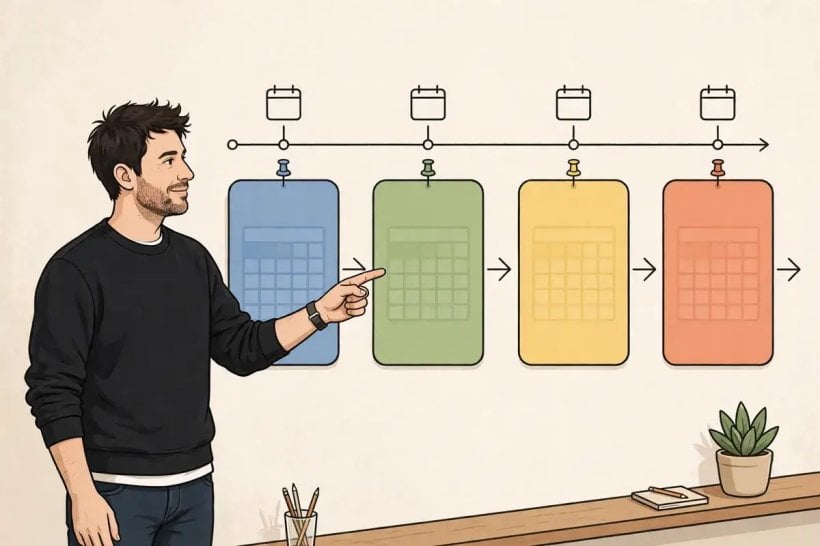
The whole of Y Combinator fits into five steps: apply, interview, spend three months in the batch, present at Demo Day, and then belong to the alumni network for life. Everything else — the deal, the office hours, the credits, the talks — hangs off that skeleton. If you can hold the five steps in your head, you understand the program; the rest of this guide fills in the detail.
The calendar runs four times a year. The batches are Winter (January to March), Spring (April to June), Summer (July to September), and Fall (October to December). Each lasts three months, or about eleven weeks from the kickoff to Demo Day. The live example at the time of writing is the Winter 2027 batch, which runs January to March 2027 in San Francisco. Its on-time application deadline was 2 November 2026 at 8pm Pacific Time; late applications were still being accepted when this guide was checked, and on-time applicants were promised a decision by 11 December 2026. Interviews for that batch were scheduled by video conference in November and December. If you are reading this after Winter 2027, the dates will have moved on — but the shape will not have: a deadline roughly two months before the batch starts, interviews in the weeks after the deadline, and a decision that arrives fast.
The batch is in person in San Francisco. YC ran the program remotely during Covid, but since 2022 it has been back in person, and the FAQ is blunt about it: the batch is in person, with a three-day in-person retreat to kick it off and weekly meetups in San Francisco throughout. That is a real commitment, and for international founders it means visas, relocation, and three months away from home. YC works with immigration attorneys and gives accepted international founders an individualised immigration plan, which removes some of the friction — but it does not remove the move itself. Founders who cannot spend three months in San Francisco should think carefully before applying, because the in-person element is where much of the program’s value lives: the chance conversations, the weekly meetups, the office hours, the peer group.
The three months themselves are structured around a rhythm rather than a curriculum. There is a three-day kickoff at the start, group office hours every two weeks, one-on-one office hours as often as founders want them, weekly meetups, and a weekly talk from an eminent startup person — founders of Airbnb, Stripe, DoorDash, and Ginkgo Bioworks often return to speak, and the talks are strictly off the record. YC says many founders describe the eleven weeks leading up to Demo Day as “the most productive period in their lives.” The time commitment for the formal activities is modest — “a few hours per week if you participate in all the recommended activities,” according to the FAQ — and, strikingly, all parts of the program are optional. YC does not run a school with mandatory classes. It runs a pressure cooker with expert help on tap, and founders take as much of it as they want.
That optionality is worth understanding, because it shapes who gets the most from YC. The program’s job, as YC describes it, is to help startups “really take off” — a better product with more users, and more options for raising money. It does that less through teaching than through focus: three months in which the only job is to build something people want and talk to users, with partners pushing you, peers around you doing the same thing, and the hard deadline of Demo Day at the end. The batch model works because the deadline is real, the peer group is real, and the help is available on demand. The next sections take each part of that model in turn, starting with the deal — the one part of YC that is written down, identical for everyone, and fully public.
The Standard Deal: $500,000 for 7% — the Exact Math

YC’s deal is public, identical for every company, and written up on YC’s own deal page in unusual detail. There is no negotiation, no special terms for favoured founders, and no hidden fee schedule. If you are accepted, this is the deal you get — which is exactly why it is worth understanding precisely, because it is the price of everything else in this guide.
YC invests $500,000 in every accepted company, in two parts. The first part is $125,000 on a post-money SAFE that converts into a fixed 7% of the company. The second part is $375,000 on an uncapped SAFE with a Most Favored Nation (MFN) provision. The two parts convert at different times and on different terms, and confusing them is the most common mistake founders make when they talk about “YC’s 7%.”
The $125,000 SAFE is the straightforward one. It converts into 7% of the company when the company raises its first priced round — a priced round being the first round in which shares are actually sold at a set price per share, as opposed to SAFEs, which are promises of future shares. The 7% is fixed, but it is measured after all SAFEs and convertible instruments have converted in that priced round, including any existing option pool. That matters: the priced round itself, and the creation of the option pool that usually comes with it, dilute YC’s ownership, just as they dilute the founders’. The 7% is 7% of the company at the moment of conversion, not 7% forever.
The $375,000 MFN SAFE is where the real cost sits. It has no valuation cap and no discount. Instead, its Most Favored Nation provision means it converts in the priced round on the terms of the lowest-cap SAFE — or other most favourable terms, such as a discount — issued between the MFN start date (around the batch start) and the priced round. In plain terms: whatever the best deal any later SAFE investor gets, YC’s $375,000 gets the same deal. YC’s own worked example makes the arithmetic concrete. If the next SAFEs a company raises are at a $15 million post-money valuation cap, the $375,000 MFN SAFE converts into 2.5% of the company — $375,000 divided by $15 million. Add the fixed 7%, and YC’s total in that scenario is about 9.5% of the company. That is the number to carry into the “is it worth it” calculation in the final section: not 7%, but roughly 9.5% in a typical scenario, and more if the company’s next SAFEs are raised at a lower cap.
Three further features of the deal are important. First, the investment is not contingent on milestones, and it does not wait for the batch to start. YC commits the money the day a company is accepted. That is unusual among accelerators, many of which tranche their funding against progress, and it means a founder can start spending — on hiring, on infrastructure, on the move to San Francisco — before the batch begins. Second, YC gets a pro rata right: the right to invest in future financing rounds to help maintain its ownership stake. YC says it has invested millions of dollars in its companies this way, buying more shares in later rounds to keep its percentage from shrinking. Pro rata rights are standard in venture investing, but founders should know they exist: YC is not a passive holder that fades away after the batch. Third, there are no fees. YC charges nothing to participate, and it says it avoids “gotcha” terms such as enhanced returns in downside exit scenarios — provisions that would give YC more than its share if the company is sold cheaply. For a founder reading a term sheet, the absence of such terms is as meaningful as the presence of the headline numbers.
One practical constraint deserves attention, especially for founders outside the United States: YC invests only in US, Canada, Cayman, and Singapore corporations. A company incorporated anywhere else must “flip” to a parent company in one of those four jurisdictions before YC can invest, and YC introduces lawyers to help with the flip. Incorporation is not required before applying — you can apply as an unincorporated team — but the flip has to happen before the money moves. For founders in countries with exchange controls or complex corporate law, this is a real piece of work, and it should be planned for, not discovered after acceptance.
Two other points from YC’s own pages round out the picture. The deal is the same for every company, including companies that have already raised money — and many companies in each batch have already raised over $1 million. A prior higher valuation is not a problem in YC’s eyes: YC’s test, drawn from a Paul Graham essay, is to ask whether joining YC can improve the outcome by at least 7%. If the answer is yes, the deal is worth it even for a company that has already raised at a good valuation. And YC is explicit that the money is a small part of the offer: at least half the startups it funds do not need the money at all. They come for the rest of the program. The next two sections explain what that rest is — starting with the instrument that makes the deal work.
The SAFE, Explained in Plain English

The SAFE — the Simple Agreement for Future Equity — is the instrument at the heart of the YC deal, and it is worth understanding on its own terms, because you will meet it again in almost every early-stage fundraising conversation after YC. It was created at Y Combinator by Carolynn Levy in 2013, and YC standardised on the post-money version in 2018. The forms are free to download from YC’s documents page, and YC’s “Send a SAFE” tool generates, signs, and sends the official forms for free in about two minutes. The SAFE has become the default early-stage instrument in the startup world largely because YC made it one.
What is a SAFE? It is a short contract in which an investor gives a startup money now and receives the right to shares later. The shares arrive automatically when the startup raises its first priced round — the moment real shares are sold at a set price. Until then, the SAFE holder owns no stock, has no vote, and receives no dividend. The crucial point, and the one founders most often get wrong, is that a SAFE is not debt and not a loan. It carries no interest and no maturity date. There is no date by which the company must repay anything, because there is nothing to repay: the money converts into shares or, in the scenarios below, is returned or lost. A SAFE never expires. It terminates only when the holder receives stock — or when the company is acquired, goes public, or dissolves, as described below.
Three terms control how a SAFE converts: the valuation cap, the discount rate, and the MFN provision. The valuation cap is the highest valuation at which the SAFE converts into shares. On a post-money SAFE — the version YC uses — the ownership the investor receives is simply the investment divided by the valuation cap. YC’s own example: $500,000 invested on a $6.7 million post-money cap converts into about 7.5% of the company. That arithmetic is the whole reason the post-money SAFE became standard: a founder can compute exactly what percentage they are selling before signing, because the denominator is fixed. Under the older pre-money version, the percentage depended on how much other money was raised, which made the math opaque.
The discount rate is the second lever. A SAFE with a discount converts into shares at a price below the priced round — commonly 10% to 20% below. A 20% discount SAFE converts at a price 20% below the priced round, so the early investor gets more shares per dollar than the priced-round investors, as compensation for taking the earlier risk. Many SAFEs carry both a cap and a discount, and the holder gets whichever produces the better outcome.
The MFN provision is the third lever, and it is the one behind YC’s $375,000 SAFE. An MFN SAFE has no cap and no discount. Instead, it automatically takes the best terms of any SAFE issued after it. If a company later issues SAFEs at a low cap, the MFN holder converts on that low cap. One technical detail matters here and is easy to get wrong: the MFN uses the later of the signing date or the date the wire is received — so a founder who wants to preserve a low cap for the MFN holder should close lower-cap SAFEs, fully wired, before issuing an uncapped MFN. The sequencing of paperwork changes the economics, which is why YC documents the rule.
What happens if the company never raises a priced round? The SAFE’s terms cover three endings. In a liquidity event — an acquisition or an IPO — a valuation-cap SAFE holder receives the greater of one times their money back or what they would receive on conversion to common stock. In a dissolution, the holder gets the purchase amount back. And a SAFE is junior to outstanding debt, so lenders are paid first. Board approval is required to issue SAFEs, transfer of a SAFE requires the company’s consent (except to an affiliate), and SAFE investors should be accredited investors — the usual securities-law plumbing that sits underneath the simplicity of the form.
How does a SAFE compare with the alternatives? A convertible note is the older instrument: it is debt, with interest and a maturity date, and it converts into shares — but if the company has not raised a priced round by the maturity date, the note comes due, and the company must repay it or renegotiate. That repayment risk is the main reason the SAFE displaced the note for very early-stage deals. A priced round, by contrast, sells shares directly at an agreed valuation, which requires negotiating a valuation, drafting full investment documents, and usually giving the investor a board seat and other rights. It is the right instrument for a larger, later round — and it is what the SAFE converts into. For a founder at YC’s stage, the SAFE’s appeal is that it is fast, cheap, and valuation-free: money in, shares later, no negotiation over what the company is worth today. Cheap AI models have lowered the cost of building a startup to the point where a small SAFE can carry a team a long way — and the same logic that makes the SAFE attractive is part of why the YC deal is structured the way it is.
What Founders Actually Get Beyond the Money

If the money were the whole of YC, the program would be easy to evaluate: $500,000 for about 9.5% is a price, and a founder could compare it with any other investor’s price. But YC’s own pages insist, repeatedly, that the money is the least interesting part — and the evidence supports them, because at least half the companies they fund do not need the money. So what does a founder actually get, beyond the wire transfer?
The first answer is partners, in the form of office hours. Startups in a batch are sorted into three groups, each led by YC partners, and each group is split into sections of six to ten companies. Group office hours happen every two weeks, and one-on-one office hours are available as often as founders want them. Office hours continue year-round after the program ends, so the relationship does not stop at Demo Day. Every company also works with a dedicated YC General Partner — themselves successful startup founders — in a direct Slack channel, meeting weekly during the batch. The partners’ job is the unglamorous core of the program: listening to what a founder is doing, asking what the users actually said, and pushing the founder back to the work that matters. Paul Graham’s original insight was that most startups fail not for lack of money but for lack of focus, and office hours are the mechanism that supplies it.
The second answer is the peer group, organised through Bookface — YC’s internal platform, described as a combination of Facebook, Quora, and LinkedIn — where founders connect, ask questions, and tag expertise. The practical value is concrete: YC says B2B and consumer companies “often get their first 40–50 paying customers from the YC community.” That is the network effect in its most useful form. A founder’s first customers are the hardest to win, and a community of hundreds of founders, each running a company that needs software, services, and tools, is a ready-made early market. The alumni network extends the same logic: founders have “6,000+ domain experts they can call on,” according to YC’s about page, and there are founder communities for hardware, biotech, edtech, international founders, women founders, Black founders, Hispanic and Latino founders, and more, plus an annual alumni reunion.
The third answer is credits and deals — $12 million-plus in free credits and deals per company, from partners including OpenAI, Anthropic, Amazon Web Services, Google Cloud, Microsoft Azure, and Stripe. YC’s about page describes access to discounts and free accounts for more than 100 products, including “hundreds of thousands of dollars of free hosting” per company from major cloud providers. For a software startup, that is a substantial subsidy: the cloud bill that would otherwise eat the seed money is, in effect, prepaid. The credits also shape what founders build with: Anthropic credits and Google Cloud credits mean that the current generation of AI models is available to batch companies essentially free, which changes the economics of building an AI product during the eleven weeks.
The fourth answer is help with the practical machinery of a company: incorporation (including the flip for non-US companies), visas through immigration attorneys, hiring through YC’s “Work at a Startup” platform, and launches. YC prepares founders for Product Hunt and Hacker News launches and for their first press pitches — the moments when a young product meets the public for the first time, and when a good launch can produce more users in a day than months of quiet work. Weekly alumni talks add a fifth element: every week an eminent startup person speaks, the talks are strictly off the record, and founders of Airbnb, Stripe, DoorDash, and Ginkgo Bioworks often return to tell the inside story. That candour — people who have actually done it, speaking without a press release in the room — is hard to buy anywhere else.
Finally, there is the credibility stamp, which is real even though it is intangible. YC companies are showcased in the YC Startup Directory, and the YC name on a company changes the first conversation with an investor, a hire, or a customer. It does not guarantee success — nothing does — but it guarantees a hearing, and for a first-time founder with no track record, a hearing is the scarcest resource of all. That is why the FAQ’s line about half the funded companies not needing the money makes sense: they are not buying cash. They are buying the hearing, the help, and the network — and the question the rest of this guide tries to answer is whether that purchase is worth roughly a tenth of the company.
Who Should Apply — and Who Shouldn’t

The most useful question a founder can ask about YC is not “can I get in?” but “would it help me?” YC’s own pages give a surprisingly detailed answer, because the FAQ is written as much for the people who should not apply as for those who should. Start with the encouraging part: the bar for stage is very low. On average, 40% of the companies YC funds in each batch are just an idea, and most have no revenue at all. There is no requirement to have a product, a user, or a dollar of income. What YC funds is a team and an idea, not a business.
That openness extends in every direction. YC considers startups in any field — microbes, fusion reactors, coffee carts — not software only. Solo founders are regularly accepted, though YC advises that having a co-founder improves the odds, and its free Co-founder Matching product exists precisely to help solo founders find one. Non-technical founders are welcome in principle, but with a hard condition: the founding team must be able to build the product themselves, which for most businesses means a technical co-founder is needed. A founder with a great idea and no one to build it is not a YC company yet; they are a YC applicant who needs a co-founder first.
Later-stage companies are also welcome, in a way that surprises many founders. Seven percent of recent batches had more than $50,000 in monthly revenue when accepted, and companies such as Rappi and MessageBird did YC while making well over $1 million a year. Each batch contains many companies that have already raised over $1 million. YC’s position is that it “can probably help any startup that hasn’t already raised a series A round from VCs” — the line being drawn at the Series A, the first institutional round, not at revenue or headcount. The test YC proposes for an already-funded company is the 7% test: ask whether joining YC can improve the outcome by at least 7%. If yes, the equity is worth it even at a prior valuation.
International founders are a core part of the program, not an afterthought. YC works with immigration attorneys, gives accepted international founders an individualised immigration plan, and runs founder communities specifically for international founders. The practical constraints are the flip to a US, Canadian, Cayman, or Singapore parent company, and the three-month in-person stay in San Francisco. Both are manageable with planning, and neither is a reason to self-reject. One cautionary note, however, comes from secondary reporting rather than YC itself: Asia Tech Review, via a secondary summary, has reported a sharp decline in Indian and Asian participation — from 96 Indian companies in a peak year to 4 in 2024, and a single Asian startup in a 2025 batch. That reporting was not verified against a YC page for this guide, so it should be treated as an attributed claim, not an established fact — but an international founder should be aware that the composition of batches has been a subject of public discussion.
Who should not apply? YC does not publish a list, so this is judgement rather than a YC claim — but it follows from the program’s own description. If your company is already profitable and growing without outside help, if you already have warm relationships with the investors you would want for the next round, and if you have no need of a peer group or a credibility stamp, then the main things YC sells are things you already own, and 7% — realistically about 9.5% — is a high price for them. The same applies to lifestyle businesses: a company built to generate a comfortable income for its founders, rather than to grow fast and raise venture capital, does not fit a program whose entire machinery is designed to produce venture-scale outcomes. And a company whose market is purely local — a business that will succeed or fail in one city, in one country, with no need for Silicon Valley’s network — gains less from three months in San Francisco than a company with global or US ambitions. YC’s model assumes you want to grow fast, raise venture capital, and play in the biggest market. If that is not your goal, the program is not designed for you, however good your company is.
The honest version of the question, then, is about fit, not quality. YC funds ideas, solo founders, non-software companies, and companies with millions in revenue. What it does not fund is a company that does not need it. If you can name, specifically, what the three months and the network would change for you — the customers you would win, the hires you would make, the investors you would meet, the mistakes you would avoid — then you are the kind of applicant the program is built for. If you cannot, the equity is better kept.
The Application, Step by Step

Applying to YC is a short process with a long tail: the form itself is quick, but the thinking behind it is the real work. The cycle runs four times a year, and the live example at the time of writing is the Winter 2027 batch, which runs January to March 2027 in San Francisco. Its on-time deadline was 2 November 2026 at 8pm Pacific Time. Late applications were still being accepted when this guide was checked, and on-time applicants were promised a decision by 11 December 2026. Interviews were to be held by video conference in November and December. Those dates are specific to Winter 2027; the pattern — a deadline about two months before the batch, interviews in the following weeks, decisions within days of the interview — is the same every cycle.
There is also an Early Decision route, for founders who want to apply now to a later batch — Spring, Summer, or Fall — rather than the next one. It is worth considering if you have a clear reason to wait: a product milestone you want to hit first, a co-founder who joins in a few months, or a launch you want behind you. Applying early to a later batch does not, as far as YC’s pages say, carry a penalty; it is a scheduling choice, not a weaker application. And late applications are accepted for the current batch, so a missed deadline is not a missed year — it is a missed on-time decision date, and a later, slower path through the same process.
The application itself has two parts: an online form and a one-minute video. The form is the substance and is covered in detail in the next section. The video is short — one minute, introducing the founders and explaining what the startup does — and its brevity is the point. YC’s blog account of DoorDash’s path from application to IPO describes the one-minute video as part of the application, and the discipline it imposes is the same discipline the whole application imposes: say what you do, plainly, in very little time. A founder who cannot explain the company in a minute does not yet understand it well enough, and the video is the test of that.
After submitting, the timeline is fast. YC reads applications during a concentrated reading season — Paul Graham’s guide notes that partners read around 100 applications a day during that period — and the strongest applications are invited to interview. The interview is ten minutes, by video, and the decision typically arrives by email within 24 hours; YC’s blog describes decisions as typically made the same day as the interview. If YC decides not to fund you, it explains why — but only if you were interviewed. Feedback is given only to interviewees; applicants rejected at the written stage receive no feedback, because of the volume. That is a hard rule worth knowing before you apply: the written application is judged silently, and the only way to learn what YC thought is to reach the interview.
Reapplying is not merely allowed; it is normal. In a typical YC batch, about half the companies applied multiple times before being accepted. Only one application per batch is permitted, but a rejection in one cycle is no bar to the next, and YC clearly treats persistence as a signal rather than a nuisance. Many of the companies in the alumni list applied more than once. If you are rejected, the practical advice that follows from YC’s own pages is to build, get users, and apply again with a stronger story — not to treat a single rejection as a verdict on the company. And no introductions are needed at any stage. One of YC’s core principles is considering all applications equally, and it says it does not rely on introductions. A founder with no connections to anyone at YC is judged on the same form as everyone else — which is, for a founder outside the usual networks, one of the most valuable features of the program.
The Application Form: What YC Really Reads

The application form is where most YC applications are won or lost, and Paul Graham’s guide to applying — “How to Apply to Y Combinator” — is unusually direct about what the partners are looking for. The decisive quality is clarity. Partners read around 100 applications a day during reading season. At that speed, an application that cannot be understood in seconds is an application that is set aside. The form must explain the idea in the first sentence, in the simplest terms, with no marketing-speak. That is not a style preference. It is a survival requirement: the reader has a hundred more applications to get through today, and the ones that make them work to understand the idea do not get a second look.
The first sentence test is the practical version of that rule. Before you submit, read the first sentence of your application as a stranger would. Does it say what the company makes, for whom, and why it matters — in words a non-expert would understand? If it leans on jargon, on a category label instead of a description, or on a claim about the market instead of a claim about the product, rewrite it. Graham’s guide is blunt that marketing-speak is a negative signal: it suggests the founder is hiding a weak idea behind strong language, or does not understand the idea well enough to state it plainly. The same applies to the question that asks what the company will make: the answer should be concrete, specific, and short.
The most important question on the form, according to Graham’s guide, is the one asking for something impressive that each founder has built or achieved. This is where the application is really decided, and the rule is the same as everywhere else on the form: be specific. A founder who has built a product with users, shipped something hard, won something competitive, or done something unusual should say exactly what it was, with numbers where numbers exist. Vague claims — “I am passionate about,” “I have deep experience in” — are worth nothing. Specific achievements are worth everything. The question is designed to separate founders who have done things from founders who can describe things, and the partners read it that way.
Two features of the process protect first-time and outsider founders, and both are worth naming. The first is that no introductions are needed: YC considers all applications equally and does not rely on introductions, so a founder’s network — or lack of one — does not affect the reading of the form. The second is that a company does not need to be incorporated before applying. Incorporation can wait until after acceptance, when YC’s lawyers help with the flip if one is needed. Neither of those facts changes what the form asks, but both change who can afford to answer it.
The honest advice for the form, distilled from YC’s own guidance, is fourfold. First, write the first sentence until a stranger understands it. Second, answer the “something impressive” question with the most specific achievement each founder has, stated plainly. Third, cut every word of marketing language — if a sentence would not survive being read aloud to a sceptical friend, delete it. Fourth, remember that no feedback comes unless you are interviewed, so the form has to do its work alone: there is no second chance to explain what you meant. A useful way to prepare is to research with the same discipline the form demands. Founders who build during the batch lean heavily on research tools, and Perplexity is one of the research tools founders commonly use to check a market, a competitor, or a technical claim before writing it down — the kind of verification the application rewards.
The 10-Minute Interview

The YC interview lasts ten minutes. That is not a figure of speech. YC’s blog account of DoorDash’s path from application to IPO describes the process directly: “we invite the top startups in for a ten minute interview.” Ten minutes, by video conference, with YC partners — and then, typically, a decision the same day. For the Winter 2027 batch, interviews were held by video in November and December, and YC’s apply page promises that founders hear back by email after the interview, “typically within 24 hours,” with an explanation if the answer is no.
Ten minutes is short enough that the interview cannot be a pitch. There is no time for slides, no time for a rehearsed story, and no time for the founder to talk the partners into enthusiasm. What the partners are doing in those ten minutes is probing: the idea, the founders, the traction, and the insight. They will ask questions that test whether the founder understands the problem deeply, whether the product actually works, whether anyone wants it, and whether the founders are the people to build it. The questions are direct and the pace is fast. A founder who answers in long, polished paragraphs will run out of time; a founder who answers concisely, concretely, and with numbers will get through more of what matters.
The best preparation, which follows from the format rather than from any YC instruction, is to be demo-ready and number-ready. If the product exists, be able to show it working in seconds, not describe it working in minutes. Know your users by name and by number: how many, how they found you, what they do with the product, what they say about it. Know your insight — the thing you believe about the problem that most people do not — and be able to state it in a sentence. And know the weak points of your own company, because the partners will find them; a founder who names a weakness before being asked about it looks honest, and a founder who dodges it looks evasive. The interview is not a test of polish. It is a test of clarity and honesty under time pressure, and the application form was the rehearsal for it.
The decision, when it comes, is fast and final for that batch. YC says founders typically hear within 24 hours, and the blog account says decisions are typically made the same day. If the answer is yes, the $500,000 is committed that day — YC invests in companies as soon as they are accepted and does not wait for the batch to start — and the founder’s next job is the practical one: incorporation and the flip if needed, visas, and the move to San Francisco. If the answer is no, YC explains why, which is the one piece of feedback the process offers. That explanation is valuable precisely because it is the only feedback available: applicants rejected at the written stage get none. A founder who reaches the interview and is rejected leaves with something a written-stage rejectee does not — a diagnosis, from the people who would have funded them, of what was missing.
There is one more thing worth saying about the interview, and it is about odds. YC does not publish a current acceptance rate on its FAQ or apply page. The most recent YC-published figure is from Winter 2024: 260 companies funded from more than 27,000 applications, described as “under 1%” — a figure cited here from a secondary summary, since the blog post itself was not opened for this guide. Third-party estimates for the 2025–26 batches range from roughly 0.6% to 2%. The safe way to state it is this: YC’s last published figure was under 1% (Winter 2024), and YC publishes no current rate. The number is low enough that no founder should treat acceptance as likely, and high enough — 260 companies in a single batch — that a strong application from an unknown founder genuinely can get in. About half the companies in a typical batch applied more than once, which means the ten-minute interview is often not the first attempt, but the one that finally worked.
Inside the Batch: 11 Weeks to Demo Day

The batch begins with a three-day, in-person kickoff in the first few weeks — a retreat that sets the tone for everything after it. Founders meet their group, meet the partners, and meet each other, and the program’s expectations are set out plainly: build the product, talk to users, and come back in eleven weeks with something demonstrably better. After the kickoff, the structure is light and the work is heavy.
The organising unit is the group. Startups are sorted into three groups, each led by YC partners, and each group is split into sections of six to ten companies. Group office hours happen every two weeks, and one-on-one office hours are available as often as founders want them — the partner relationship is on demand, not on a timetable. Weekly meetups in San Francisco bring the batch together, and every week an eminent startup person speaks, the talks strictly off the record, with founders of Airbnb, Stripe, DoorDash, and Ginkgo Bioworks often returning. The formal time commitment is small: a few hours a week if a founder does all the recommended activities, and all parts of the program are optional. The informal commitment is total. YC’s own line — that many founders describe the eleven weeks leading up to Demo Day as “the most productive period in their lives” — is a claim about focus, not about hours. The batch works by removing everything except the company for three months.
What do founders actually do in those eleven weeks? The honest answer is two things, repeated: build the product, and talk to users. YC’s help is organised around those two verbs. Office hours are where a founder brings a problem — a feature that is not working, a user who churned, a hire who did not work out — and a partner who has seen the same problem before helps untangle it. Bookface is where a founder asks the community a question and gets an answer from someone who solved it last month. The launch help — preparing for Product Hunt and Hacker News, and for the first press pitches — is for the moment the product is ready to meet strangers. And the community supplies the first customers: B2B and consumer companies often get their first 40–50 paying customers from the YC community, which is to say from the other founders in the batch and the alumni around them.
The intensity of the batch is also its risk. Eleven weeks of total focus, in a new city, with a hard deadline, is demanding — and it is demanding in a way that favours founders who can sustain it. YC’s structure acknowledges this in its own way: the formal activities are optional, so a founder who needs a quiet week to ship can take one; the one-on-one office hours are available on demand, so a founder in trouble can get help without waiting for a scheduled session; and the peer group in a section of six to ten companies is small enough that other founders notice when someone is struggling. None of that makes the batch easy. It makes it survivable, and the founders who get the most from it are the ones who treat the optionality as a tool — using the parts that help, skipping the parts that do not, and protecting the time to build.
There is a practical point about tools, too. Eleven weeks is not long, and the founders who ship fastest are the ones who use the best available leverage. The current generation of AI agents is a common theme in recent YC batches, and founders use AI coding assistants to ship in days what used to take weeks. Choosing between models matters when the whole batch is a race against the Demo Day clock, and a founder who has not yet settled on a stack will find a guide to how to choose an AI model useful before the batch starts, not during it. Claude is one of the founder tools in the YC partner-credit ecosystem, and the credits that make these tools free during the batch are part of what the $12 million-plus package is for: removing the cost of the tools so the only constraint is the founder’s time.
Demo Day: How Fundraising Actually Works

Demo Day is the end of the batch and the start of the fundraise. YC’s description is simple: “the latest batch of Y Combinator-funded founders present their companies to an audience of specially selected investors and press.” The audience is curated — these are not random attendees but the investors YC believes are most likely to fund the companies presenting — and the presentation is the moment the three months of work becomes a public claim: here is what we built, here is who uses it, here is why it will grow.
One detail that founders often ask about is how long each pitch is. YC’s own pages do not state a pitch length, and third-party guides variously say one to two minutes, so this guide does not assert a figure. What YC’s 2020 year-in-review does say is that Demo Day is a two-day event — the batch is large enough that the presentations are spread across two days. The safe way to think about it is that the pitch itself is short, the audience is large and selected, and the real work happens after the presentations, not during them.
That after-work is where YC’s help is most distinctive. In the weeks after Demo Day, YC stays in close touch with founders and helps them “decipher the real messages in investors’ sometimes deliberately ambiguous responses.” That sentence, from YC’s own about page, is worth reading twice, because it describes the actual skill of post-Demo Day fundraising. Investors rarely say no directly. They say “let’s stay in touch,” “come back when you have more traction,” “we’re interested but the timing isn’t right” — and each of those sentences means something different depending on who said it, when, and in what tone. A first-time founder cannot reliably decode them. A YC partner, who has watched hundreds of founders go through the same conversations, can — and that decoding is often the difference between a round that closes and a round that drifts.
YC also says its funded startups “tend to get higher valuations than they might otherwise.” That is a claim about the brand’s effect on the fundraise: the YC stamp, the curated Demo Day audience, and the competitive dynamic of many investors meeting the same companies in the same weeks all push valuations up. It is also a claim to treat with the usual care — it comes from YC about YC — but the mechanism is plausible and widely observed: a company that many investors want at once is a company that can set its price.
What Demo Day is not matters as much as what it is. It is not a guarantee of funding. Not every company that presents raises a round, and not every round that is raised is a good one. The fundraising window after Demo Day is a real window — attention is concentrated, investors are engaged, and the batch’s momentum is behind the founders — but windows close, and a company that has not built something investors want will not be saved by a good presentation. The batch’s job was to make the company fundable; Demo Day’s job is to make the fundable company visible. Both halves have to work, and the first half is the one that takes eleven weeks.
What Happens After Demo Day — and the Alumni Network for Life

“YC doesn’t end after 3 months. We continue to help founders for the life of their company, and beyond.” That sentence, from YC’s application page, is the program’s longest promise — and it is the one that most distinguishes YC from a one-off accelerator. The formal program lasts three months. The relationship does not.
The practical continuation is office hours, which continue year-round after the program ends. A founder who hits a problem a year after Demo Day — a key hire leaving, a pricing decision, a term sheet with an unfamiliar clause — can still sit down with a partner. The community continuation is Bookface and the alumni network: founders have 6,000-plus domain experts they can call on, according to YC’s about page, and the founder communities — hardware, biotech, edtech, international founders, women founders, Black founders, Hispanic and Latino founders, and others — persist as working networks rather than reunion mailing lists. There is an annual alumni reunion, and there is an Alumni Demo Day, which gives active founders an early look at each new batch — a mechanism that keeps the alumni close to the newest companies, and the newest companies close to people who have already made the mistakes they are about to make.
The alumni trajectories are the network’s proof, and they are worth listing plainly because they show how far the model reaches. Airbnb (Winter 2009) went from air mattresses to the world’s largest short-term rental platform. Stripe (Summer 2010) became the payments infrastructure of the internet. DoorDash (Summer 2013) became the dominant US food-delivery company, and YC’s own blog tells the story of its path from application to IPO in detail. Coinbase (Summer 2012) took cryptocurrency mainstream. Reddit (Summer 2005) became one of the largest communities on the internet. Dropbox (Summer 2007) and Instacart followed similar arcs. Scale AI (Summer 2016), Deel, Brex, and Rippling show the model working for the current generation of companies, not just the early ones. Each of those companies still sends founders back to speak to new batches — Airbnb, Stripe, and DoorDash founders “often come back to tell the inside story” — so the network is not a list of names but a set of people who keep showing up.
There is also a subtler after-effect, and it matters for founders weighing the 7%. The alumni network is a hiring network, a customer network, and an investor network all at once. A YC founder hiring an engineer can post on Work at a Startup and reach people who specifically want to work at YC companies. A YC founder selling to other startups can find their first 40–50 customers inside the community. A YC founder raising a Series A can ask alumni who raised one last year what the term sheet really meant. Those are not benefits that expire. They compound, and they are the reason YC can describe its alumni community as “probably the most powerful community in the startup world” without it reading as mere marketing. Whether that compounding is worth a tenth of the company is the question of the final section.
Outcomes, Criticism, and Alternatives: Is 7% Worth It?

The honest arithmetic first. YC takes 7% on the $125,000 SAFE, and in a typical scenario — the next SAFEs raised at a $15 million post-money cap — the $375,000 MFN SAFE converts into a further 2.5%, taking YC’s total to about 9.5% of the company. If the next SAFEs are raised at a lower cap, YC’s share is higher; if at a higher cap, lower. Add the pro rata right, which lets YC maintain its stake in later rounds, and the total cost of the relationship over the company’s life is more than the headline 7%. That is the price. The question is what it buys, and the answer differs by founder.
Start with what the equity buys. It buys three months of full-time focus with expert help on demand, in a peer group of founders at the same stage. It buys the $12 million-plus in credits and deals. It buys the first customers from the community, the hiring channel, the launch help, and the weekly talks from people who have done it. It buys the Demo Day audience and the post-Demo Day help decoding investors. And it buys the alumni network for life — 6,000-plus domain experts, the founder communities, the annual reunion, and the credibility stamp that gets a first-time founder a hearing. For a first-time founder with no investor access, no network, and no track record, that package can change the trajectory of the company. The 40% of each batch that is just an idea, and the half of each batch that applied more than once, are evidence that founders who have weighed the price keep deciding it is worth paying.
Now the criticisms, stated as they are made rather than as YC would state them. The first is the equity cost itself: roughly a tenth of the company for three months of help is expensive, and critics argue that a strong team could raise the same $500,000 on better terms from angels or a seed fund without giving up the network premium. The second is the pressure the model creates: a program built around venture-scale growth pushes every company towards the same path — raise, grow fast, raise again — and founders whose companies would be better as profitable, sustainable businesses can find themselves forced onto a treadmill they did not choose. The third is relocation: three months in San Francisco is a real cost in money, time, and disruption, and it is a cost that falls hardest on founders from outside the US. The fourth is survivorship bias: the alumni list is a list of winners, and the companies that went through YC and failed — which are the large majority, as they are for any early-stage portfolio — do not appear on the about page. Critics also cite statistics to make these points — for example, one critical essay claims that only about 1.25% of YC companies become unicorns, and one analysis claims that around 40% of YC companies close a Series A within 12 months compared with 10–15% for non-YC teams — but those are critics’ and analysts’ claims, not YC data, and this guide does not present them as established fact. They are included here because a founder deciding on the trade should know the argument exists, not because the numbers are verified.
When is it worth it? The case is strongest for first-time founders, for founders with no warm access to investors, and for founders with global or US ambitions who need the San Francisco network. If the three months would change what you build, who your first customers are, and who funds your next round, then the 7% — realistically 9.5% — is buying something you cannot buy elsewhere at any price. The case is weakest for founders who already have traction and warm investors, for profitable or lifestyle businesses that do not want the venture path, and for companies whose market is local and does not need Silicon Valley. YC’s own 7% test is the right frame: ask whether joining YC can improve the outcome by at least 7%. If the answer is a confident yes, apply. If the answer is a shrug, keep the equity.
The alternatives are real, and a founder should know them before choosing. Techstars runs a similar batch model with mentorship and a Demo Day, and suits founders who want a strong local ecosystem in a specific city. 500 Global offers a large global network and an emphasis on international markets. Antler is built for founders at the pre-team stage — it helps you find a co-founder before it funds the company. Entrepreneur First works the same way, backing talented individuals before they have an idea. The a16z speedrun program is a newer, more specialised accelerator for particular sectors. And beyond accelerators altogether, there is bootstrapping — building on revenue, slowly, without giving up equity — and a direct seed raise from angels or a seed fund, which buys money without the program. This section deliberately gives no figures for any of those alternatives: competitor deal terms were available only from secondary comparisons, and the brief for this guide required that any such figure be verified on each programme’s own site before publication. A founder comparing YC with Techstars or Antler should read the terms on those programmes’ own sites, not rely on a comparison article’s numbers. What matters here is the shape of the choice: YC is the biggest network and the strongest brand, and it charges the most for it. Smaller or more specialised programs charge less and offer less. Bootstrapping charges nothing and offers no network at all. European founders weighing the choice may also want to understand the European AI ecosystem, where companies such as Mistral AI show how a regional hub can produce global companies without a San Francisco batch — a reminder that YC is one route to scale, not the only one.
The final judgement is the one YC itself invites. The program is a trade: about a tenth of your company for three months, a network, and a brand. It is a good trade for the founder who needs what YC sells, and a bad trade for the founder who already owns it. The application costs nothing but the time to write it clearly, no introductions are needed, and about half of each batch applied more than once before getting in — so the cost of finding out whether YC wants you is low, and the cost of deciding whether you want YC is the thinking this guide has tried to do. If you apply, apply with the first sentence clear, the achievements specific, and the idea stated in the simplest terms. And if you get in, spend the eleven weeks building something people want. That, in the end, is the whole of how Y Combinator works.
Sources
Primary sources, read in full on 22 November 2026:
- Y Combinator — The Y Combinator Standard Deal
- Y Combinator — The SAFE
- Y Combinator — What Happens at YC
- Y Combinator — Apply to YC (Winter 2027 cycle)
- Y Combinator — Frequently Asked Questions
- Y Combinator — How to Apply to Y Combinator (Paul Graham)
- Y Combinator — DoorDash from application to IPO
- Y Combinator — 2020 Year in Review (Demo Day as a two-day event, via search snippet)
Secondary sources, used only for cross-checks on founding history and scale:
- Wikipedia — “Y Combinator (company)”: founding, first batch, batch-size history, alumni batches, portfolio scale figures (the unicorn and $100M+ counts are dated to 2019).
- OpenAlmanac — “Y Combinator”: scale and alumni cross-checks.
- Foundinity — “Is Y Combinator Worth It? (2026 Review)”: Winter 2024 acceptance-rate figure (260 companies from 27,000+ applications, “under 1%”), cited second-hand; the YC blog post was not opened for this guide.
- RoundFunded — “When Is the Next YC Batch?”: batch calendar and directory counts.
- Kurums — accelerator comparisons (alternatives terms, secondary only; no figures used).
- Asia Tech Review (via secondary summary) — reported decline in Indian/Asian participation; attributed, not verified against a YC page.
Figures flagged in this guide as attributed or dated: the acceptance rate (YC’s last published figure, Winter 2024, under 1%; no current rate published); recent batch sizes of around 150–200 (counts of YC’s public directory, not YC-published); the combined portfolio valuation of $600B+ (widely reported estimate, not headlined on a YC page read for this guide); the unicorn and $100M+ counts (Wikipedia, dated to 2019); the criticism statistics in the final section (critics’ and analysts’ claims, not YC data). No Demo Day pitch length is asserted, no non-profit terms are stated, no competitor deal figures are given, and YC’s current president is not named, because none of those was verified on a YC page read for this guide.




0 Comments