

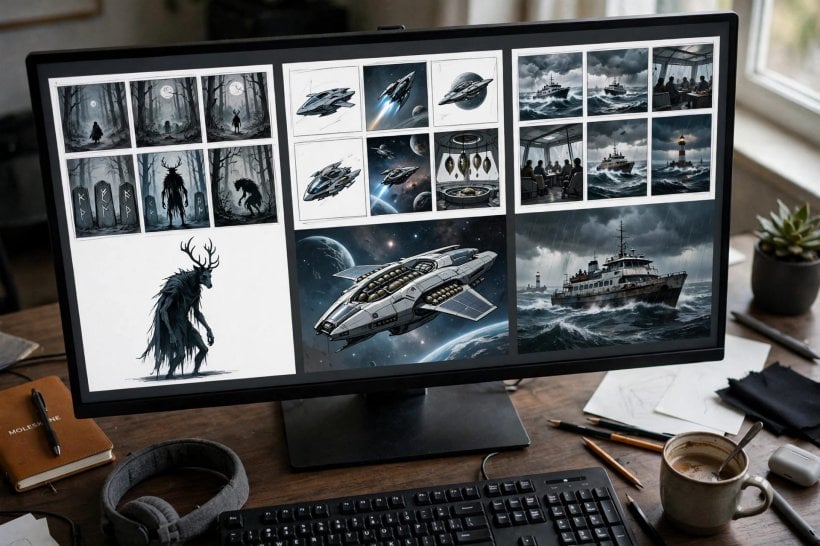
Nova, a Los Angeles AI video platform, has begun production on a slate of three original drama series budgeted at more than $10 million, the company announced on October 22. The disaster thriller “The Last Ferry,” the science-fiction epic “Starsown” and the folk horror “Nian” all star signed, real actors, with AI working at every stage of production — from script breakdown and character looks to storyboards and every single shot, according to the announcement.
The slate is aimed at global streaming platforms such as Netflix and YouTube, and the first title is expected to premiere in summer 2027. First-look teasers for all three series are complete, Nova said. The company describes the slate as one of the most ambitious real-actor-plus-AI drama projects attempted so far — a claim the finished series, rather than the announcement, will have to prove.
How Nova’s Slate Is Made: Actors, Digital Doubles And Registered Faces
Lead roles are played by Nova’s signed performers, combining live performance with authorised digital doubles for large-scale and effects-heavy scenes. Each character’s look is registered on the platform, so the same face holds across hundreds of shots, and creatures such as the title beast of “Nian” are designed once and stay identical from scene to scene, the company said.
Every shot is built, in Nova’s words, to Hollywood feature-film lighting and texture standards. The platform — available in 17 languages, per the company — is pitched as a complete drama pipeline in one place: script, cast, storyboard and final cut. That end-to-end scope is what distinguishes the slate from the single-shot and short-clip uses that have defined AI video so far, a progression GER has tracked from text-to-video generation through the post-Sora race between Kling, Runway and Veo.
The Three Series, Title By Title
“The Last Ferry” follows the last ferry between Hong Kong and Macau on a typhoon night, driving into a ten-metre wave; at dawn it docks to find both cities empty. It is made in Mandarin, Cantonese, English, Japanese and Korean.
“Starsown” is set eighty thousand years after Earth sent out its seed ships: the last woman from Earth wakes to meet humanity’s descendants, raised by AI “Mothers.” It is made in English, with an international cast.
“Nian” is set on Lunar New Year’s Eve in 1897, in a round earthen fortress in the mountains of southern China, where four hundred people keep one rule older than memory: every year, one of them is fed to the Nian. This year the lot falls on a twelve-year-old boy, and his sister has come home from overseas with a crate of fireworks to break the rule. It is made in Mandarin and English.
From Single Shots To Whole Series
Nova’s own announcement places the slate against the industry’s recent steps. In July 2025, Netflix co-chief executive Ted Sarandos told investors that a building-collapse sequence in the Argentine series “El Eternauta” had been made with generative AI and finished ten times faster than traditional effects workflows allowed — the first generative-AI footage in the final cut of a Netflix original. A month later Netflix published guidance on generative AI for its production partners, and in September 2025 YouTube brought Google’s Veo 3 video model to Shorts, free for creators.
Those were single shots and short clips. A ten-metre wave, cities in the clouds and a monster, Nova argues, used to take a huge crew and years of visual effects. “Our actors are real, their faces stay the same, and AI builds the worlds around them shot by shot,” a Nova spokesperson said. “We aren’t making AI demos. We’re making the best AI series the world has ever seen, the kind audiences everywhere will want to binge.” That is the company’s ambition, stated in its own words; no distributor, episode count or completed episode has been announced, and the first premiere is not due until summer 2027.
Why It Matters
Nova’s slate matters because it tests the question the whole AI video industry is circling: can generative tools sustain long-form drama, where a face, a creature and a world must stay consistent across hundreds of shots and several episodes, rather than shine in a thirty-second clip? The tools GER compared in its guide to AI video tools for creators were built for clips and creators. A $10 million-plus, three-series slate with signed actors, authorised digital doubles and registered character looks is a different bet — that consistency, not spectacle, is the product, and that streaming platforms will buy series made this way. If the teasers convert into a distributed, watched series in 2027, the production model spreads; if they do not, the slate will read as the moment AI video’s ambitions outran its distribution.
Background
Nova (mynova.ai), headquartered in Los Angeles, is an AI video platform built for drama and film, covering script, casting, storyboard and final cut in one system and available in 17 languages. Its slate announcement follows a year in which generative video moved from short creator clips — Veo 3 in YouTube Shorts in September 2025 — into professional production, beginning with Netflix’s single AI-made sequence in “El Eternauta.” Nova’s three series are its attempt to take that step at full series scale, with the first title due in summer 2027.
Source: Nova via EIN Presswire


0 Comments