

NVIDIA is putting cash behind its supply chain. At GTC Berlin on October 21, the company announced capacity agreements with six semiconductor manufacturing partners spanning substrates, advanced packaging, chip testing and optical engines — including a $1.1 billion capacity reservation advance to testing company King Yuan Electronics for new US facilities. Jensen Huang framed the deals in his keynote: “We are in the midst of the largest infrastructure buildout in human history. Demand is extraordinary. Capacity is the constraint.”
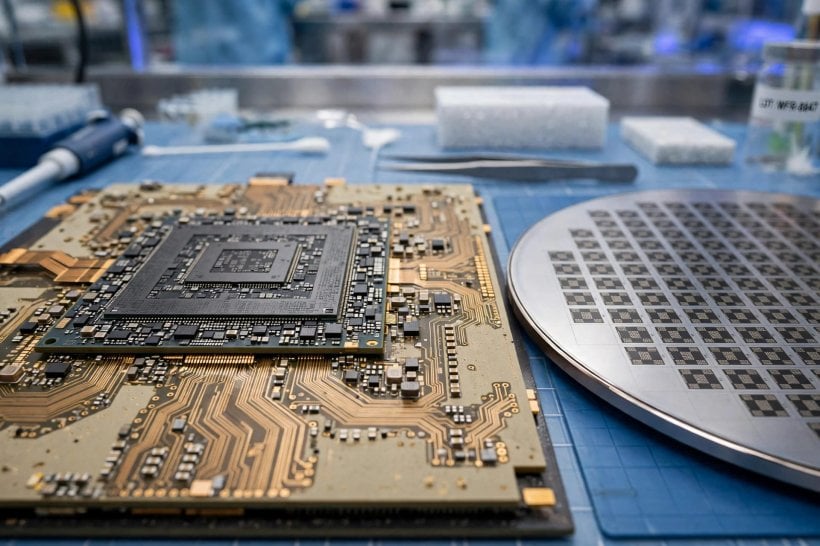
The six partners are Amkor Technology, IBIDEN, King Yuan Electronics (KYEC), Samsung Electro-Mechanics, Siliconware Precision Industries (SPIL) and Unimicron Technology Corporation. NVIDIA says the agreements with new and existing suppliers will expand critical manufacturing capabilities while strengthening the resiliency and redundancy of its global supply chain, with the partners expanding capacity around the globe to scale production of its AI supercomputing systems.
$1.1 Billion For US Chip Testing
The largest single disclosed figure goes to testing. NVIDIA’s $1.1 billion capacity reservation advance to KYEC will support new US testing facilities and equipment, with high-volume production targeted for April 2027. In Singapore, expanded testing operations are expected to begin high-volume production in February 2027. Overall, NVIDIA expects its total semiconductor testing capacity to double from calendar 2026 to calendar 2027, with buildouts across the US, Taiwan and Singapore.
Testing is the unglamorous chokepoint of the AI boom: every GPU has to be validated before it ships, and when demand doubles, test capacity has to double with it. By prepaying KYEC, NVIDIA is effectively buying its place at the front of the queue for the next two years of output.
Substrates, Packaging And Optical Engines
The substrate deals are the broadest. Agreements with IBIDEN, Samsung Electro-Mechanics and Unimicron will in aggregate drive a 2.5 times increase in substrate capacity over the next three years. IBIDEN gets a multibillion-dollar capacity reservation advance for its Ono Plant in Japan, targeting 3 times current capacity with additional output ramping in the first quarter of 2028. Samsung Electro-Mechanics brings immediate capacity from its existing South Korean operations, with facility upgrades and new factories in Sejong and Busan; by 2028, NVIDIA’s allocation is projected to account for a significant portion of the company’s total annual package substrate production.
On advanced packaging, NVIDIA and Amkor plan to grow interposer wafer capacity in South Korea by more than 300 percent by the end of 2028 — a separate arrangement from Amkor’s own $1.3 billion NVIDIA deal announced the same day, which covered the packaging partner’s side of the relationship. And for the networking layer, NVIDIA and SPIL are expanding optical-engine manufacturing in Taiwan for co-packaged optics, targeting a 15 times increase by mid-2027 with another doubling aimed by the end of 2028.
Why It Matters
This is NVIDIA acting on its own diagnosis. If capacity, not demand, is the binding constraint on growth, then the highest-return investment the company can make is not another chip design but guaranteed factory output. The prepayment structure — advances that reserve capacity years out — mirrors what Apple did with flash memory and what hyperscalers do with power contracts: lock in the scarce input before your competitors do.
For the rest of the industry, the signal is the constraint map. Substrates, advanced packaging, testing and optical engines are the four back-end layers where the AI buildout now bottlenecks, and NVIDIA has just published its shopping list. Suppliers in those layers gain multi-year demand visibility; everyone else competing for the same capacity — from AMD to the custom-silicon programs at the big clouds — faces a market where the largest buyer has already reserved the line. It also puts NVIDIA’s local AI hardware push in context: the company is securing supply for everything from data-centre GPUs down to the desktop mini PCs rolling out this week.
Background
NVIDIA’s supply-chain moves have been accelerating all year. The company has repeatedly warned that it cannot build AI factories faster than its partners can package, test and connect the chips, and the GTC Berlin keynote bundled the capacity deals with a wave of product announcements for local and automotive AI. Samsung Electro-Mechanics’ substrate investment was already on the industry’s radar as part of a widening Korea–NVIDIA manufacturing axis; this week’s release turns those bilateral deals into a single coordinated capacity programme, with Huang personally fronting it on a Berlin stage.
Source: NVIDIA official release via GlobeNewswire, TechTimes



0 Comments