
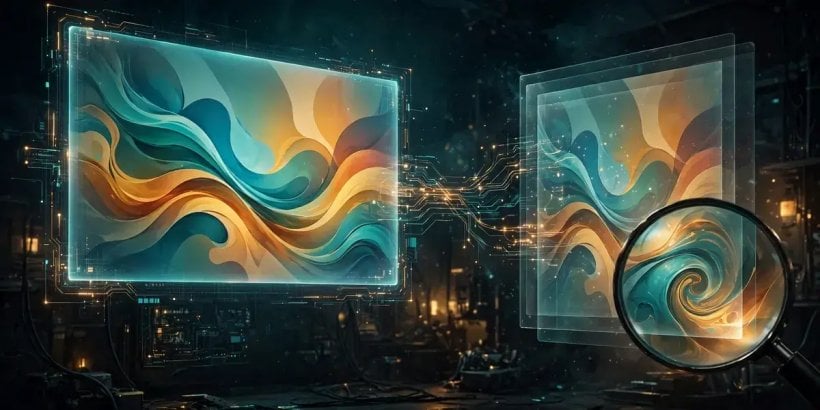
SenseTime released SenseNova U1.6 on 24 November, an open image model that checks its own pictures for mistakes and fixes them. The 8-billion-parameter model generates an image, reads it back against the prompt, and revises any text errors without disturbing the layout. Its weights are free under Apache 2.0.
How self-correction works
Text has long been the weak spot of image generators, which garble words on posters, signs and infographics. U1.6 attacks that failure directly: after a first generation, the same model inspects the rendered text, compares it with the original prompt, and produces a corrected version of the image.
On UltraTextBench, a test of dense infographics, the model scored 86.04 in a single pass and 92.28 with self-correction switched on, a relative improvement of about 7 percent. The figures are SenseTime’s own measurements, and no independent test has yet confirmed them.
The model is built on SenseTime’s NEO-unify architecture, which handles understanding, generation and editing inside one system. It can answer questions about an image, edit one, or produce responses that alternate between text and pictures in a single exchange without switching tools.
What it can make
U1.6 is aimed at design-led work rather than photorealism, with portraits, posters and illustrations as its strongest ground. SenseTime says subjective user tests put its aesthetic quality about 10 percent above U1.5, its predecessor — a different bet from Midjourney’s Niji 8, which chased character consistency in anime.
The release ships as a full BF16 checkpoint plus smaller LoRA versions that run in four or eight steps, and quantized formats for local use. It needs a graphics card with 24 gigabytes of memory and about 35 gigabytes of disk space, putting it within reach of a strong desktop.
SenseTime is candid about the limits. Brief prompts can produce conventional results, dense text and complex layouts stay unreliable, and portraits can show unnatural limb proportions. Self-correction reduces errors in dense text, the company says, but does not remove them entirely.
Our read
Self-correction is the right idea aimed at the right flaw. Garbled text has been the tell-tale sign of AI images for years, and a model that proofreads itself attacks the problem at its source. The open question is how often the second pass actually catches the error.
The honest test will come from users, not the launch numbers. SenseTime’s 7 percent gain is measured on its own benchmark, and the model has only just reached the public. If independent creators find the corrections reliable, U1.6 could set a new bar for text in AI images.
Why it matters
This matters because text is where AI images fail, and posters, infographics and art all depend on words being right. A small open model that fixes its own typos lowers the barrier for creators who cannot afford a flagship closed model or a human retoucher.
Background
U1.6 arrives in a crowded week for open models, alongside Ant’s Ling-3.2-air and Sakana’s Namazu Small, both released in the last two days. The pattern is clear: capable open weights are arriving faster, and smaller, from labs around the world than a year ago.
SenseTime is no newcomer to this race. Its SenseNova line has shipped unified models through 2026, in a year when Baidu opened ERNIE 5.5 Flash under Apache 2.0 too. The new release keeps that foundation and adds the self-checking step on top.
Source: SenseNova U1.6 model card


0 Comments