
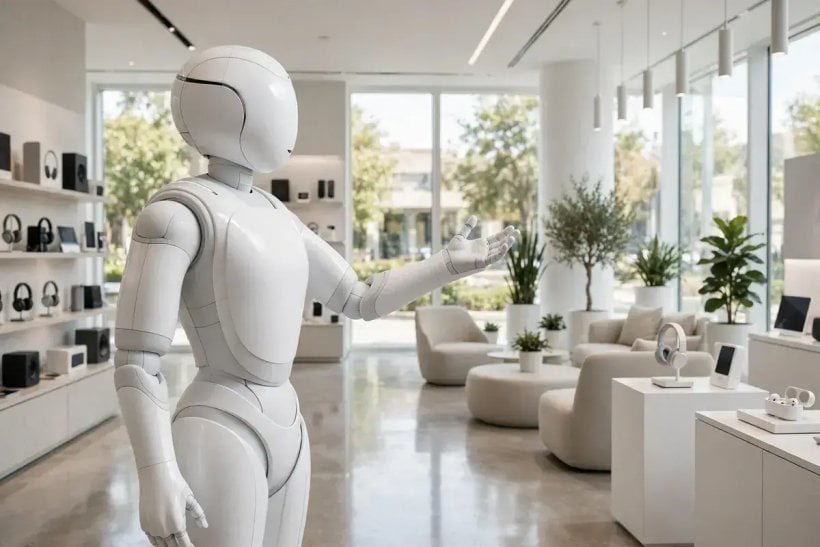
XPeng has unveiled IRON, its general-purpose humanoid robot, and put a date on mass production. The Chinese carmaker said at its AI Day in Guangzhou on 25 November that hardware production begins in January 2027, with the robot first working as a store assistant.
The Robot
IRON is built for commercial work, not stage demonstrations. It has 76 degrees of freedom, including a 21-degree-of-freedom dexterous hand, more than 1,500 tactile sensing points, 3D vision and 360-degree perception. Tactile feedback lets it sense contact and adjust how firmly it grips objects it handles.
Its onboard computing runs on three proprietary Turing AI chips, delivering 2,250 TOPS of effective power for models and whole-body motion control. A multimodal system called IRON VLM reads visual, audio and contextual cues, recognises people and holds conversational context.
Safety gets five layers of protection, covering task execution, movement paths and hardware limits, with collision detection, torque limits and emergency-stop safeguards. Redundant dual-channel communications and an independent balance controller guard against a primary system failure. Pedestrian-protection emergency braking is also built in.
The Turing Architecture
At the core sits the Turing Physical AI architecture, known as VLA 3.0, which links higher-level cognition, real-time intelligence and physical execution. Its middle layer runs XPeng’s VLA 2.0 model, reusing perception and data tools from its cars’ autonomous driving.
Production and Deployment
The manufacturing plan is unusually concrete for a humanoid launch. XPeng has built a dedicated automated production line with more than 600 AI-powered holographic inspection checkpoints and over 1,000 vehicle-grade tests, designed to finish one IRON every 2.5 minutes at full capacity.
A purpose-built Robot Data Factory spans 50,000 square metres and covers more than 250 scenarios across 15 job categories. Data from real robot tasks feeds training and validation, connecting model development directly to how the machine performs in the field.
IRON is scheduled to begin training as a store assistant in XPeng retail stores in the first quarter of 2027, greeting customers and guiding them. XPeng will sell the hardware and charge software subscriptions, with market launch for external customers in the second quarter of 2027.
Our Read
The dated production plan is what separates this from most humanoid announcements. XPeng is not promising a robot someday; it has named a month, a line speed and a first job. That specificity is either a manufacturing edge or a deadline it will be judged against.
Rivals are taking different routes to the same goal. Meta is giving its Muse assistant a humanoid body, while Agility Robotics has taken its humanoids public. XPeng’s pitch is different: a carmaker’s production machine, not a lab demo or a stock-market story.
Questions remain. XPeng has not published weight, payload or battery figures, and the first deployment is a controlled retail trial, not an open workplace. The robot’s value will be proven by repeat orders, not by a single production line at launch.
Why It Matters
Humanoid robots have spent years as demonstrations. A dated mass-production start, a named first customer role and a production line built for speed would move the category toward real deployment. If XPeng delivers in January, competitors will face pressure to show their own timelines.
The stakes reach beyond XPeng. Carmakers own the factories and quality systems that humanoids need, and XPeng has now put a dated plan on a robot production line. Google’s factory work with Gemini Robotics shows the same logic from the software side.
Background
The announcement follows XPeng’s unveiling of WorldGPT a day earlier, a single model meant to power its cars, drones and robots. Together, the two launches frame XPeng’s pitch: one physical-AI foundation, built in-house, spanning vehicles and humanoids alike under one roof.
Source: XPENG’s announcement and China Daily’s report




0 Comments