

Tractian, the Atlanta-based physical AI platform for asset-heavy industries, announced a $130 million Series D round on October 22, 2026, valuing the company at $1.4 billion. The round was led by Sapphire Ventures and co-led by M&G’s Catalyst strategy, and it pushes the seven-year-old company into unicorn territory as it expands from predicting machine failures to protecting the full health of critical equipment.
New and existing investors including N47, General Catalyst, Bosch Ventures, 53 Stations, Monashees, Endeavor Catalyst, Norte Ventures and Y Combinator also participated. Sapphire also led Tractian’s Series C, and partner Anders Ranum said the firm’s thesis — combining hardware, data and AI — has only strengthened since then.
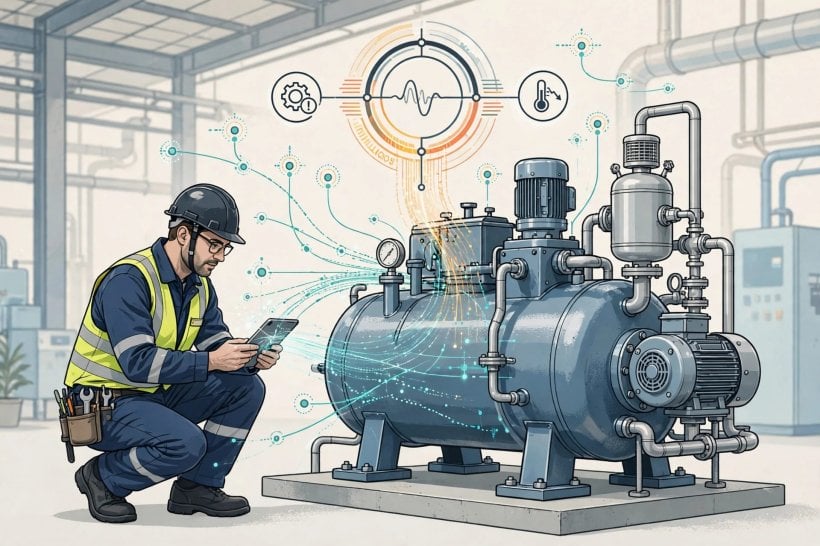
A Sensor Network, A Failure Dataset And An Agentic Diagnosis Layer
Tractian’s platform combines physically deployed sensors with AI trained on what the company calls one of the largest industrial failure datasets in existence. Its multimodal intelligence layer samples vibration, ultrasound and other sensor signals across a wide array of variables at once, turning them into a single living picture of each machine’s condition.
On top of that picture sits an agentic platform that turns the diagnosis into action: identifying the root cause of a potential problem and giving the operator a recommended plan, rather than leaving a technician to interpret raw alerts. The company frames the shift as closing the “alert-to-action gap” — moving from predicting failures to protecting the full health of every critical machine an operation runs on.
The customer list is industrial and large-scale: pharmaceutical giant Eli Lilly, McKesson’s distribution centres, Whirlpool’s appliance plants, Coca-Cola bottling facilities, Cummins’ engine production and Embraer’s manufacturing plants, plus undisclosed customers running mission-critical data centres and government infrastructure. Tractian says more than 2,000 critical facilities worldwide now rely on its technology, across compressors, chillers, palletizers, pumps and backup systems in pharma, food and beverage, oil and gas, data centres, government and defence, energy, water and manufacturing.
The Downtime Economics Behind The Round
Tractian’s pitch rests on the cost of unplanned downtime. Citing Siemens’ True Cost of Downtime study from January 2026, the company says downtime costs the world’s 500 largest industrial companies roughly 11% of annual revenue, or about $1.4 trillion a year, while industrial fixed assets now average 24 years in service.
The workforce problem compounds it: Deloitte projects that more than 2.1 million manufacturing jobs could go unfilled by 2030, taking veteran machine knowledge with them. Tractian says its system captures individual operators’ knowledge about a machine’s performance in a place the next technician can reach, so expertise stays with the plant rather than departing with retirees.
CEO and founder Igor Marinelli, who grew up watching his father work as a maintenance technician at a paper mill, said the funding will let Tractian scale further for manufacturers, data centre operators, defence companies and utilities, helping them optimise machine health and eliminate unplanned downtime and lost revenue. The raise follows the pattern of large industrial-AI rounds covered in Legora’s $550 million Series E in legal AI and Blacksmith’s $66 million Series C in code testing — applied AI companies with physical or workflow data moats commanding unicorn valuations.
Why It Matters
Tractian’s round matters because it prices a kind of AI company the model labs cannot easily copy: one whose advantage is a proprietary dataset of how real machines fail, gathered from sensors it deployed itself across 2,000 facilities. That data position, plus distribution into customers like Eli Lilly and Embraer, is what investors are paying $1.4 billion for — not a model. The timing also ties physical AI directly to the AI build-out itself: data centre operators are now among the customers who cannot afford equipment failures, so the infrastructure boom is creating its own maintenance market. For other industrial startups, a Series D of this size led by a returning investor sets the bar for what scaled physical AI looks like, in the same way Flapping Airplanes’ $1 billion raise set a marker for research labs.
Background
Tractian was founded in 2019 and is headquartered in Atlanta, with offices in Monterrey, São Paulo and Poland and more than 700 employees. It built its business on condition monitoring — sensors and software that watch machine health continuously — before layering diagnosis and recommended actions on top. Sapphire Ventures, which led both this round and the Series C, manages more than $10 billion and backs enterprise AI companies including Glean, LangChain and Grafana; M&G’s Catalyst is a global growth equity strategy backed by M&G’s With Profits Fund and the British Business Bank.
Source: PR Newswire (Tractian), The Information




0 Comments