
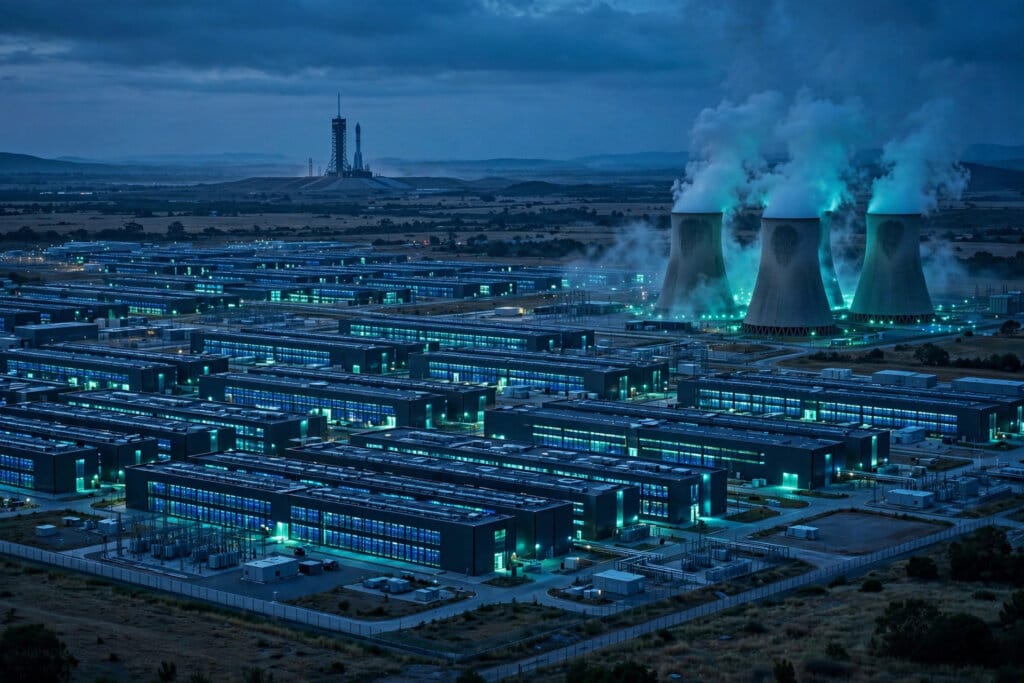
SpaceX’s artificial intelligence business is now its largest. The company reported third-quarter revenue of $14.6 billion on Tuesday, up 161% from a year earlier, and its renamed Super Intelligence segment — home to the Grok models, the Cursor coding tool and a fast-growing neocloud business — generated $7.56 billion of it, an 830% year-over-year increase that made AI 52% of total income for the first time.
The results, published in SpaceX’s regulatory filing and reported by TechCrunch, beat expectations across every segment. Analysts had expected revenue of roughly $12.7 billion to $12.9 billion. Adjusted earnings before interest, taxes, depreciation and amortisation climbed 306% to $8.8 billion, and the company posted GAAP net income of $4.4 billion, against a $1.1 billion loss in the same quarter last year. Adjusted earnings per share came in at about $0.35, more than double the $0.13 to $0.16 consensus.
Super Intelligence: $7.56 Billion From Grok, Cursor And Cloud Compute
Super Intelligence, the segment formerly labelled simply AI, grew from $813 million a year ago to $7.56 billion. TechCrunch reports the growth was driven most importantly by the company’s neocloud business — renting out its data centre capacity — alongside rising usage of the Grok models and the newly introduced Grok Bot personal agent, and the integration of Cursor, the AI coding tool SpaceX acquired earlier in 2026. Segment adjusted EBITDA reached $5 billion, although TechCrunch notes the AI business’s operating profit of $431 million would have been higher without $1.2 billion in one-time stock-based compensation tied to the Cursor acquisition.
The segment’s physical footprint is expanding just as fast as its revenue. Nameplate compute capacity stood at 1.7 gigawatts at the end of the quarter, up from 1.4 gigawatts in June and 0.6 gigawatts a year earlier. Capital expenditure totalled $19.6 billion in the quarter, with the majority allocated to AI infrastructure, including the continued expansion of the Colossus facilities in Memphis.
Musk: Power And Cooling, Not Chips, Are The Constraint On Super Intelligence
On the results discussion, chief executive Elon Musk argued that the bottleneck for deploying super intelligence now sits in power, cooling and infrastructure rather than in chips. He said he spends four days a week in Memphis working to bring the Colossus II data centre online, and that he has tasked SpaceX engineers with solving the deployment problem directly. In one example, turbine manufacturers face 12 to 18 month delays obtaining the metal blades and vanes their machines need, so SpaceX is using casting capabilities developed for its rockets to make those components itself and obtain turbines faster.
The spending is set to accelerate further. Chief financial officer Bret Johnsen said capital investment would reach $35 billion to $40 billion in the fourth quarter, and forecast total revenue of $33 billion to $37 billion for the first quarter of 2027. Musk went considerably further, predicting that SpaceX’s annual recurring revenue by the end of 2027 will be “somewhere between $500 billion and $1 trillion” — a stance the reports describe as particularly bullish even by his standards.
Starlink And Space Grew Too, But AI Took The Lead
The older businesses did not stand still. Connectivity, centred on Starlink, produced $5.25 billion in revenue, up 69% year over year, with consumer subscribers reaching 13.6 million, up 89%. The Space segment contributed $1.77 billion, and the quarter included the first revenue-generating Starship mission, carrying 26 V3 Starlink satellites. SpaceX ended the quarter with roughly $90 billion in cash and marketable securities.
Two caveats sit inside the numbers: about $1 billion of the top line came from Bitcoin price recovery and unspecified related-party income, TechCrunch notes, and SpaceX still carries a $413 million net loss for the first nine months.
Why It Matters
Super Intelligence is the central entity here, and its attributes have changed what SpaceX is. A segment that produced $813 million a year ago now out-earns Starlink and the launch business combined, which reorders the company’s neighbours: SpaceX now competes directly with the hyperscale cloud providers and neoclouds that rent AI compute, with the AI labs that buy that capacity — its reported cloud customers include major model developers — and with rival model makers through Grok itself. The Cursor acquisition pulls the same segment into the AI coding tools fight, while the comparison in Grok versus ChatGPT now has a revenue line attached to it. For the wider industry, a rocket company funding $35 billion to $40 billion of quarterly capital spending, most of it on AI infrastructure, is another signal that compute capacity — and the power to run it — is where the AI race is being financed.
Background
SpaceX built its name on reusable rockets and the Starlink satellite network, then absorbed Elon Musk’s AI venture xAI and its Grok models, bringing the lab, its Colossus data centres and later the Cursor coding tool under one roof. After listing publicly earlier this year, the company renamed its AI division Super Intelligence — and this quarter, for the first time, that division is the biggest business it has.
Source: TechCrunch, reporting SpaceX’s regulatory filing; TipRanks; Teslarati




0 Comments