
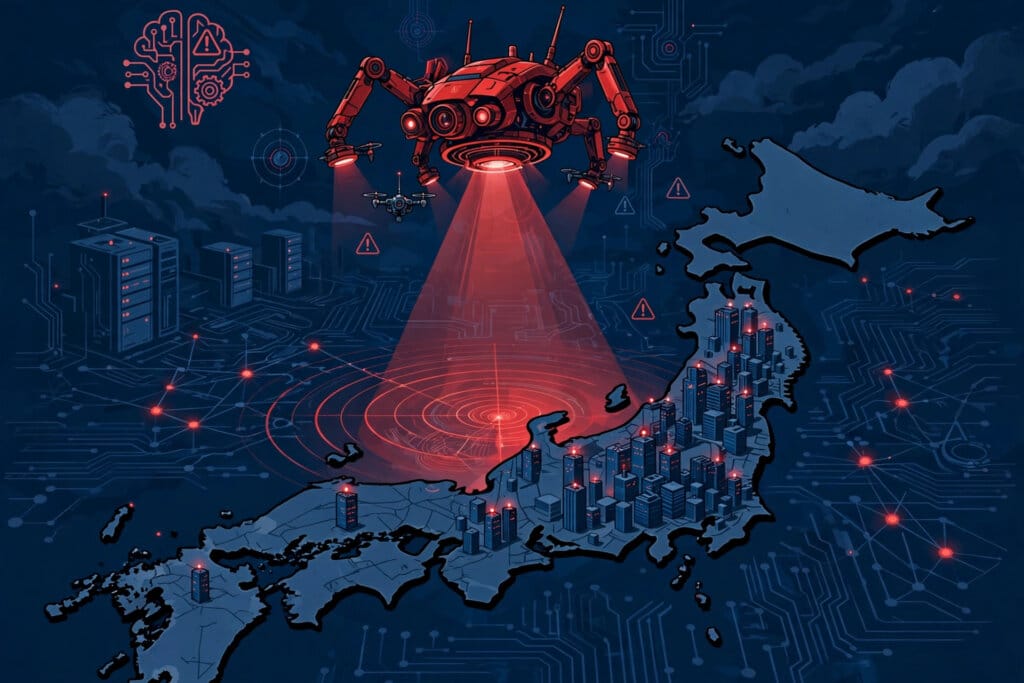
A Chinese AI security-testing tool called Artex was used in a spate of cyberattacks on Japanese companies, according to an investigation published by GMO Cybersecurity by Ierae, the security arm of Tokyo’s GMO Internet Group. The firm said on Tuesday it had confirmed Artex was used after investigating the attacks with external organisations, and that the attacks were almost exclusively targeting Japan.
Dozens of Japanese companies, from restaurant chains to a car hire operator, have disclosed unauthorised access or data breaches in recent weeks, potentially affecting millions of customers. Japanese reporting by the Yomiuri Shimbun and NHK puts the scale at roughly 80 companies targeted, with data leaks confirmed at eight. The Japanese government has called on companies to strengthen their cyber defences, and the head of the ruling party’s cybersecurity committee said this month that a “state of emergency” had been reached over emerging threats.

Artex In Japan: Six Attack Servers, One Tool
Writing on the company blog, Daiki Fukumori of GMO Cybersecurity said the investigation found six internet servers launching AI-powered attacks between mid-September and mid-October, each broadly categorised by the industries it targeted — finance, e-commerce and logistics among them. Artex traces were found across the attack infrastructure. “To prevent further damage, we have shared this information with law enforcement agencies,” Fukumori wrote.
Artex was built as a defensive tool: its developer designed it to help organisations strengthen their security through AI-powered testing that hunts for weak points before attackers do. That dual-use design is the core of the story — the same agent that audits a network can, in other hands, probe one. It is the offensive mirror of the pattern in the Cairn campaign, where one hacker used AI agents to break into more than 100 company websites.
The Developer Shuts Artex Down
The Japan findings are the second time Artex has been tied to real-world attacks. Earlier this month South Korea linked the tool to several hacks on financial institutions — an episode documented by CrowdStrike — and the developer responded by cutting off access to the source code. Using Artex for cyberattacks was “entirely contrary to” the developer’s intentions, its statement said, adding that the project would no longer be updated.
That response underlines the enforcement problem. An open security tool, once released, cannot be recalled; closing the repository stops new downloads from the source but does nothing about copies already in circulation. The episode is arriving just as governments write their first rules for exactly this class of incident — NIST, the NSA and CISA published their first incident playbook for autonomous AI agents last week.
Why AI Security Tools Keep Crossing The Line
Security testing has always been dual-use — port scanners and exploit frameworks are standard kit for defenders and attackers alike. What changes with an AI agent is autonomy and scale: the tool does not just find a weakness, it chains steps, adapts and keeps working without a skilled operator at the keyboard. That is the same capability jump that makes AI agents useful as workers, pointed in the other direction.
For Japanese companies, the immediate lesson is narrower: the attacks ran for about a month, across ordinary consumer-facing businesses rather than defence or finance targets alone, and were only connected to a single tool after a specialist investigation. Attribution of agent-driven attacks — working out which tool, run by whom — is becoming a discipline of its own.
Why It Matters
The central entity is Artex, and its attributes now include a confirmed attack campaign in a second country, a developer shutdown, and a government-level response in Japan. Its neighbours are every open-source security agent published from here on: maintainers will be pressed on release controls, hosting platforms on takedown speed, and regulators on whether an AI tool that can attack autonomously should be distributed like ordinary software at all. For defenders, the practical shift is that “AI-powered attack” is no longer a forecast — in Japan this month, it was the incident report.
Background
Artex emerged from China’s open-source AI security scene as an AI-powered penetration-testing tool, part of a wave of agent frameworks that automate work once done by human red teams. South Korea’s financial-sector hacks in early October were its first public link to real attacks; the developer’s decision to freeze the project followed within days. GMO Internet Group, whose security subsidiary ran the Japan investigation, is one of Japan’s largest internet infrastructure companies, and its findings — shared with law enforcement — are the most detailed public account yet of an AI security tool being turned on a single country’s companies at scale.
Source: Channel NewsAsia (AFP); The Straits Times (Kyodo) — both reporting GMO Cybersecurity by Ierae’s investigation, October 20, 2026.





0 Comments