

Warhound, a defence startup co-founded by Colossal Biosciences’ Ben Lamm and Anduril’s Palmer Luckey, has emerged from stealth with $200 million in funding to genetically engineer working dogs for the U.S. military, law enforcement and emergency response teams. The round values the company at $1.2 billion and includes Sequoia, 8VC, Corner Ventures and In-Q-Tel, the venture firm backed by the CIA and other U.S. intelligence agencies. The venture is led by CEO Dave Spirk, the former Marine Corps intelligence specialist who served as the first chief data officer at the U.S. Department of Defense.
Why the military’s dog supply is running out
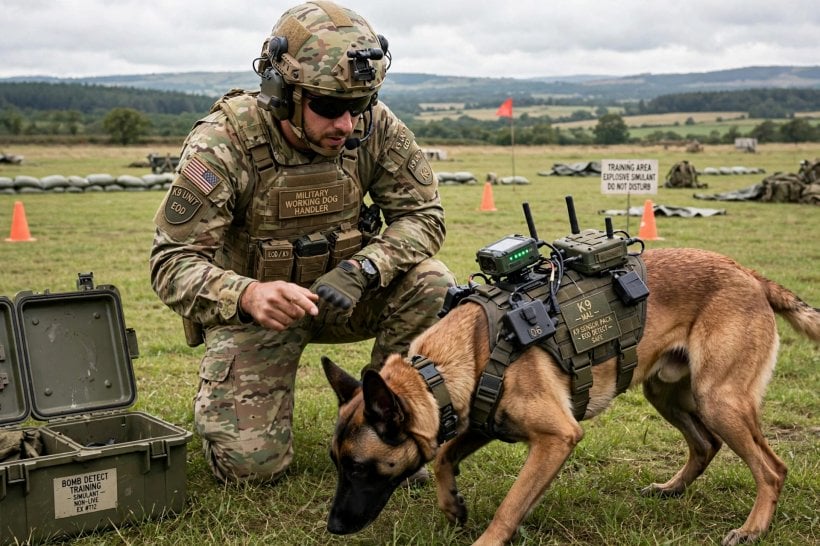
In its launch announcement, the company said that more than 80% of the U.S. military’s working dogs come from Europe, and less than half of those dogs are fit for service. The European supply chain is dwindling, which means the U.S. increasingly relies on foreign breeders for animals that play a critical role in bomb detection, searches and other specialized operations that are dangerous for humans or difficult for machines.
Lamm told TechCrunch he met Luckey about a year ago at a conference, where Luckey said more should be done for the military’s working dogs. After they kept in touch, Lamm researched how working dogs are bred and learned that many never make it through training because of inherited predispositions to problems like poor eyesight, high cancer risk, hip dysplasia and muscle atrophy. Warhound’s founding thesis is that breeding alone cannot fix a shrinking, import-dependent supply — the dogs themselves need to be engineered.
Cloning, gene editing and Anduril hardware
Warhound’s plan has two layers. The genetics layer comes from Colossal Biosciences, which holds an equity interest in the business and licenses its technology to it. The team has studied top-performing working breeds — the Belgian Malinois and German Shepherd — taking living cell lines from high performers and placing them in a biobank. From there, scientists will clone the dogs and edit their genes, adding traits that improve performance and removing traits that do not, to create what the company describes as a new type of dog.
Lamm said the first edits target inherited health problems — poor vision, cancer susceptibility, hip dysplasia, muscle atrophy — while later ambitions include enhancing traits such as speed, agility and the scent receptors used in bomb sniffing. Colossal’s sister company Viagen, which Warhound will partner with for cloning, reportedly has a high cloning success rate, and Colossal already uses the same technology in its endangered-species programs.
The hardware layer comes from Anduril, which will provide software and equipment such as protective vests and goggles, plus data sensors that send information back to handlers so they can better understand what is happening around the dog. “The idea is, if we make the dog safer, make it healthier, make it perform better, it’s going to perform better in the line of duty,” Lamm said. Lamm said the first batch of dogs is about to be cloned and incubated, with births expected early next year and service ideally beginning within two years.
The team, the money and the customers
The venture pairs two of the loudest figures in the new defence-technology wave. Lamm sits on Warhound’s board; Luckey is a partner but owns no equity, Lamm told TechCrunch. Spirk, previously a senior counsellor at Palantir after serving as the Pentagon’s first chief data officer, runs the company day to day.
Warhound does not yet know what it will charge and has no signed customers at launch. It expects to sell to first responders, the Department of Defense, military service groups and police forces. Lamm said the company has briefed many government groups, and it is working under the guidance of the American Humane Society to certify its training program. When the dogs retire, Warhound hopes they will enter the Society’s Military Working Dog Reunification Program. The Society told TechCrunch it looks forward to working with Warhound “to help ensure the animals in their care are treated humanely.”
Why It Matters
Warhound is the most extreme example yet of a broader pattern: the AI and defence technology ecosystems are now being fused with biology itself. Anduril spent the last decade turning software into battlefield hardware; Colossal spent it learning to rewrite animal genomes. Putting them under one roof, with Pentagon and intelligence-community money behind it, signals that defence investors now see living systems as an engineerable platform, much like drones or sensor networks.
For the defence industry, the deal also extends the private-equity services playbook that is reshaping enterprise AI. Frontier labs are now building deployable systems companies with private-equity backing, as Daytona’s $1 billion agentic-cloud round and the Stellantis–Wayve–NVIDIA autonomous vehicle partnership both showed. Warhound applies the same logic to a biological bottleneck. The open question — beyond the ethics of engineering combat animals — is whether cloning and gene editing can scale like software, or whether the biology defeats the economics.
Background
Colossal Biosciences, founded by Lamm and George Church, is best known for its de-extinction work on the woolly mammoth, the dodo and the dire wolf, and has been buying and building technology for gene cloning. Anduril, founded by Luckey in 2017, has become the flagship of the venture-backed defence revival. The pair’s entry into animal genetics arrives just as startup funding rounds increasingly blur the line between AI, biotech and defence technology.
Source: TechCrunch, Warhound



0 Comments