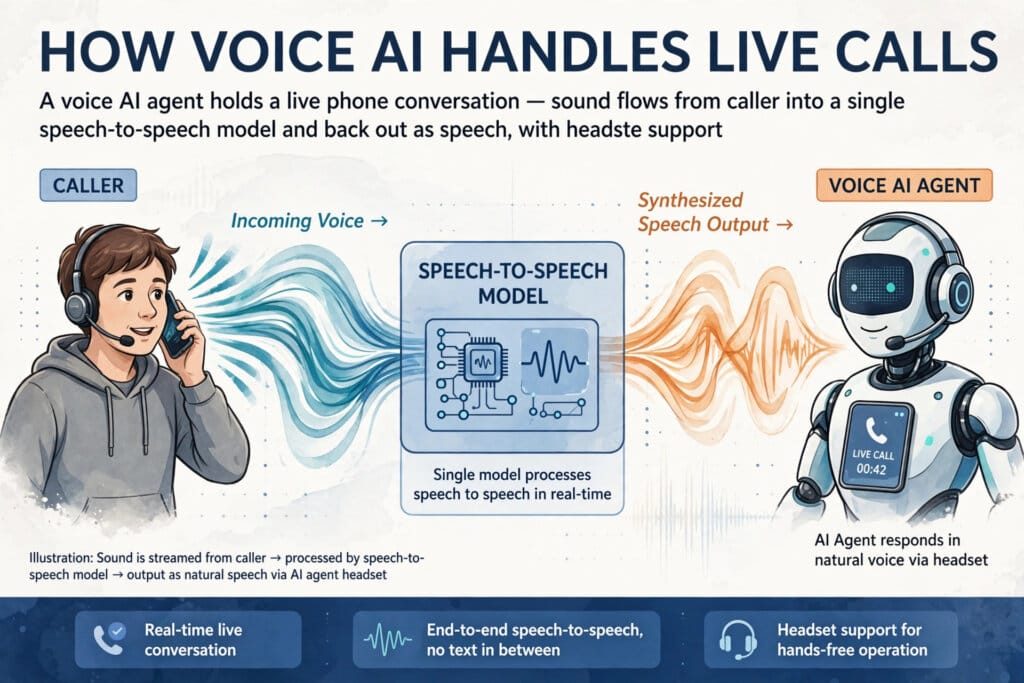
ElevenLabs has launched Eleven Realtime, a family of speech-to-speech models built for voice agents that hold live conversations. The launch, reported on October 20, brings two models — Eleven Realtime v1 Mini and v1 Max — available through the ElevenAgents platform and an OpenAI-compatible Realtime API.
Instead of stitching together separate speech recognition, a language model and text-to-speech, Eleven Realtime folds listening, reasoning and speaking into a single model. The benchmark figures in this story are ElevenLabs’ own claims, reported by the outlets cited below; no independent verification of them has been published yet.

Eleven Realtime v1 Mini And v1 Max: How The Two Models Differ
Mini is the cheaper, conversation-first model, built for natural, expressive talk — AI assistants, tutors and interactive characters. Max adds reasoning for harder work: customer support, lead qualification and multi-step workflows that rely on chained tool calls. Reporting based on ElevenLabs’ announcement and documentation says Max also carries the compliance features — Zero Retention Mode and HIPAA support — that Mini does not, needs a token limit of at least 1,024, and is not offered in the India and Singapore data residency regions.
ElevenLabs says timing and tone stay natural through interruptions and quick back-and-forth exchanges, and that the smaller model can tell the difference between a speaker who has finished talking and one who is only saying “mm-hmm” — the turn-taking problem that makes stitched-together voice agents feel robotic. The company says realtime conversation works in more than 90 languages, drawing on its voice library.
On the company’s own figures, reported by The Decoder and Journal du Net, v1 Max scored 98.8 percent on the Big Bench Audio reasoning benchmark, ahead of Grok Voice and Gemini Live figures the company compares against, with response times reported at about half a second; v1 Mini scored 75.9 percent on the same benchmark in Journal du Net’s account, with stronger conversational-dynamics scores than Max, while Max succeeded far more often on tool-calling tasks (87.1 percent against 60.3 percent). ElevenLabs says Artificial Analysis ran the evaluations independently; the figures remain the company’s launch claims.
ElevenAgents, The Realtime API And The Rollout Limits
There are two ways in, and they do not mix. Inside ElevenAgents, a builder opens an agent, switches its Voice mode to Realtime and chooses Mini or Max; the existing prompt, voice, tools and knowledge base keep working, and agents can deploy to phone, a web widget, WhatsApp and contact-centre platforms. Through the Realtime API, a developer points an existing OpenAI Realtime client at ElevenLabs by changing the endpoint and model name, with client and server events in the same shape, so existing handlers and logging keep working.
The limits matter for anyone planning a switch. The Realtime API connects over WebSocket only at launch, so applications using WebRTC have to change first. Agents using a custom language model, Amazon Bedrock, or workflow nodes that override managed settings must stay in the older Custom mode. And the models are rolling out gradually, so some workspaces will not see the option yet.
Pricing follows the usage pattern of the platform: inside ElevenAgents, Realtime agents pay the standard per-minute rate plus language-model token costs; through the API, pricing is per minute of connected audio plus tokens, with Max costing more per token than Mini. That model sits inside the wider business described in how ElevenLabs makes money from dubbing, agents and audiobooks, and alongside the same-day voice-agent push in Mistral’s Voxtral 3 stack.
Why It Matters
The central entity is Eleven Realtime, and its defining attribute is consolidation: one tuned system replaces the three-part pipeline most voice agents are assembled from, which is where latency and unnatural turn-taking usually creep in. That connects it to its neighbours. For support and sales operations, a Max model built for multi-step tool calls, with HIPAA and zero-retention options, is aimed directly at regulated, high-volume phone work. For developers already on OpenAI’s Realtime API, the compatibility layer makes a side-by-side trial cheap — an endpoint and model-name change — which is a deliberate bid for switchers, and it raises the competitive pressure on every other realtime voice offer, including the platforms covered in the wider AI voice field. For ElevenLabs itself, realtime agents move the company further from voice generation into the agent infrastructure layer, where usage is metered by the minute and the token.
Background
ElevenLabs built its name on text-to-speech and voice cloning, then expanded into dubbing, audiobooks and its ElevenAgents platform for conversational agents — the trajectory set out in what ElevenLabs is and how it got here. Until now, building a voice agent on the platform meant combining separate models for listening, thinking and speaking; Eleven Realtime is the company’s answer to OpenAI’s GPT-Realtime line, collapsing that stack into a single model choice as realtime voice becomes the contested surface for agent builders.
Source: The Decoder, AI Parabellum, Journal du Net


0 Comments