
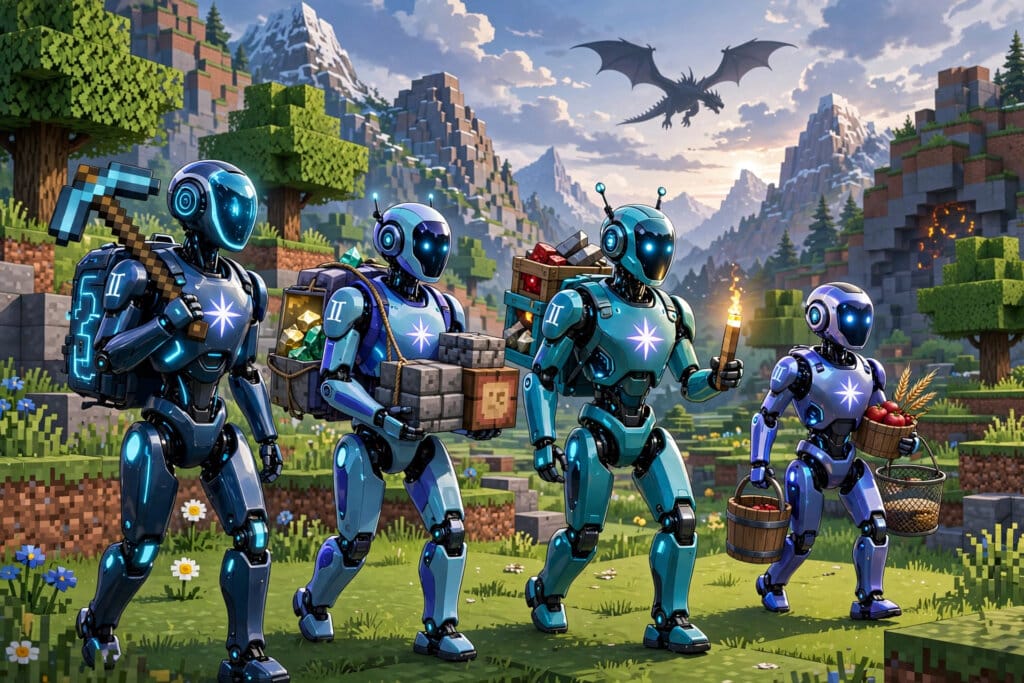
Four AI agents running on Google’s Gemini 4 Argon model have beaten Minecraft end to end without any human help, slaying the Ender Dragon in a fully autonomous run that lasted 27 hours and 14 minutes. The Google DeepMind team behind the experiment reported the result in a paper posted on October 15, and The Decoder covered the run on October 18.
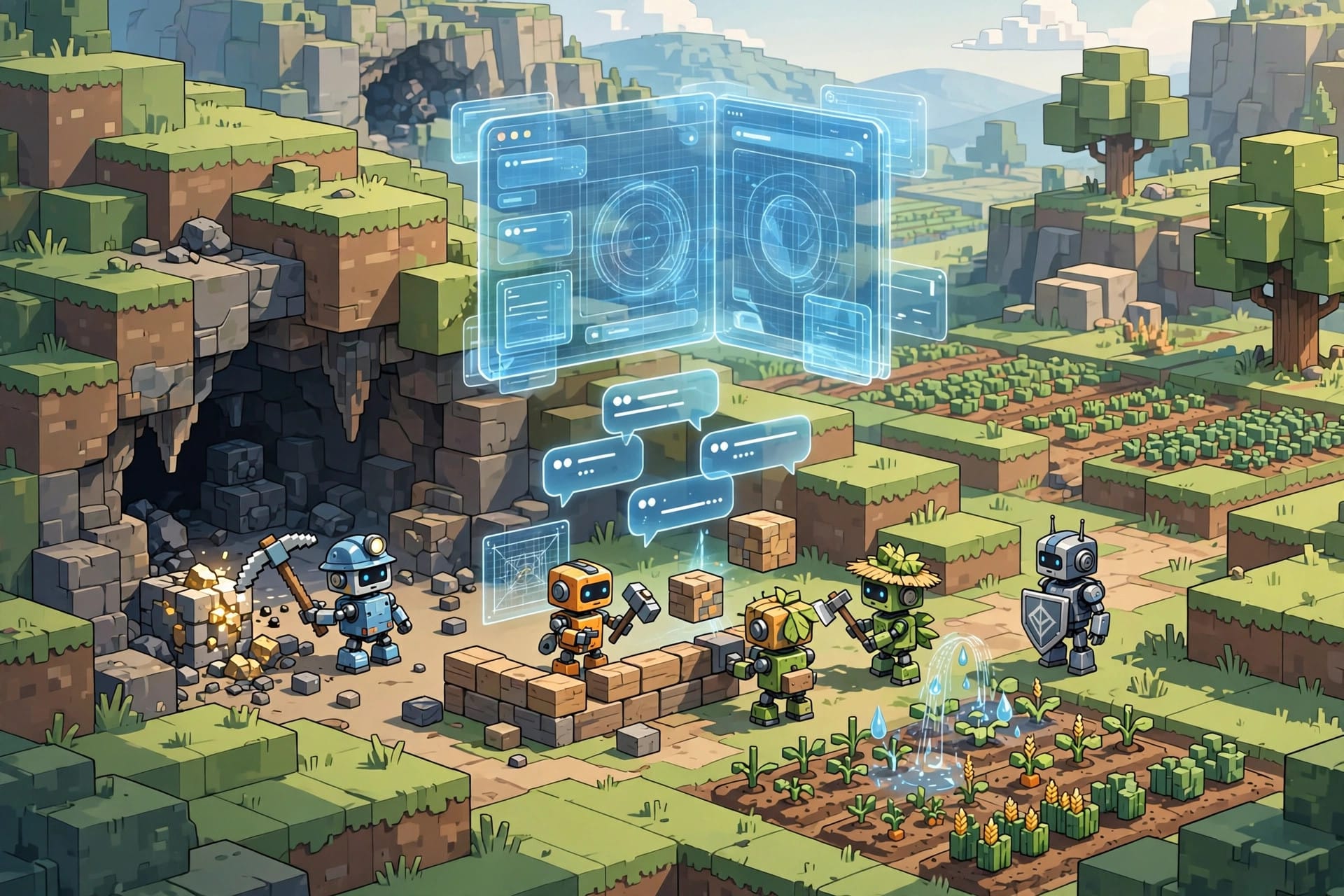
The agents were dropped into a randomly generated survival world with no assigned roles, no strategy and no game-specific tools. They divided the work themselves, warned each other about threats over chat, recovered items from fallen teammates and kept a shared log of their mistakes — behaviour that emerged from the setup rather than being scripted into it.
Gemini 4 Argon In Minecraft: 2,783 Programs, 229 Messages, 605 Deaths
The numbers describe a long, failure-heavy run rather than a clean demonstration. Over the 27 hours the four agents wrote a total of 2,783 JavaScript programs to control their actions through the standard Mineflayer library, exchanged 229 chat messages, and died 605 times before finally destroying the dragon’s healing crystals and finishing the game.
The authors — Maxence Faldor, Satinder Singh and Roberta Raileanu — say this is, to their knowledge, the first end-to-end autonomous completion of Minecraft by AI agents using only the standard Mineflayer library. The entire session cost $1,620 at the standard Gemini 4 Argon pricing that takes effect in 2027. The model behind the run is the same frontier system set out in our explainer on what Google Gemini is.
How The Gemini Agents Divided The Work Without Assigned Roles
No researcher told the agents who should mine, who should build or who should fight. According to the paper, the team converged on specialisation on its own: agents split up jobs over chat, maintained shared notes that acted as a memory outliving any single agent’s dead end, and debugged each other’s programs when an attempt failed.
That division of labour is the technically interesting part. Every action the agents took was a program, so each attempt could be read, reused and fixed by a teammate. The team also developed dozens of reusable helper functions along the way, turning one-off scripts into shared tooling — the same pattern agent builders want for long software and business tasks, where a plan has to survive thousands of dependent steps. How that pattern differs from ordinary chatbots is covered in our explainer on what AI agents are.
The Limits: Easy Difficulty, Structured Data And A 22% Error Rate
The paper and its coverage are candid about the caveats. The run was a single game, played on easy difficulty, where monsters do less damage and hunger cannot kill the player. The agents played through Mineflayer’s programmatic interface, which hands them structured game data a human player would have to perceive from pixels, and its route module steers around obstacles automatically.
About 22% of the agents’ programs ended in an error, and the final stage inside the End dimension took almost 14 of the 27 hours. Gemini 4 Argon also already knew a great deal about Minecraft and Mineflayer before the run began. None of that cancels the result, but it does separate a coordination finding from a claim that the agents played the game the way a person does — a distinction that also matters when Gemini is compared with rival assistants in our Gemini vs ChatGPT comparison.
Why It Matters
The central entity is Gemini 4 Argon, and its defining attribute in this story is persistence: a general-purpose model, not a purpose-built game AI, held a shared plan together across 27 hours, 2,783 programs and 605 deaths. That connects the result to its neighbours. For DeepMind, it is evidence that the same coding-agent machinery sold for software work can sustain long-horizon tasks in an open world. For rival labs building multi-agent systems, the run sets a public benchmark for coordination through chat and shared memory rather than through a central controller. And for developers watching costs, the $1,620 token bill for one game is a concrete price tag on autonomy at this length — impressive as research, and a warning about what unattended agents can spend.
Background
Minecraft has been an AI research target for years because it is open-ended: there is no single path to the Ender Dragon, resources must be gathered in a long dependency chain, and the world is different every time. Earlier game-playing systems were typically trained from scratch for one game or one task. The DeepMind team’s point is that those days are ending — a frontier model such as Gemini 4 Argon, released as Google’s latest flagship line this autumn, can now be pointed at the game with a general coding interface and finish it, which is why the experiment is being read as an agent result rather than a gaming one.
Source: The Decoder, October 18, 2026; AI Weekly, reporting Faldor, Singh and Raileanu (Google DeepMind), October 2026

0 Comments