

Google Cloud AI Research has open-sourced Harness2, a recursive agent harnessing framework that improves an AI agent by rewriting the files around its model while the model itself stays completely frozen. The code is public on GitHub under an Apache 2.0 licence, alongside a research paper, and MarkTechPost reported the release on October 18.
The idea is a shift in where agent performance is supposed to come from. Instead of fine-tuning weights or waiting for a stronger model, Harness2 treats the harness — the system prompt, guardrails, memory, tool guidance, subagents, skills, scripts and plugins that turn a model into an agent — as the thing to optimise, and it does that optimisation during deployment, on tasks the agent has never seen before.
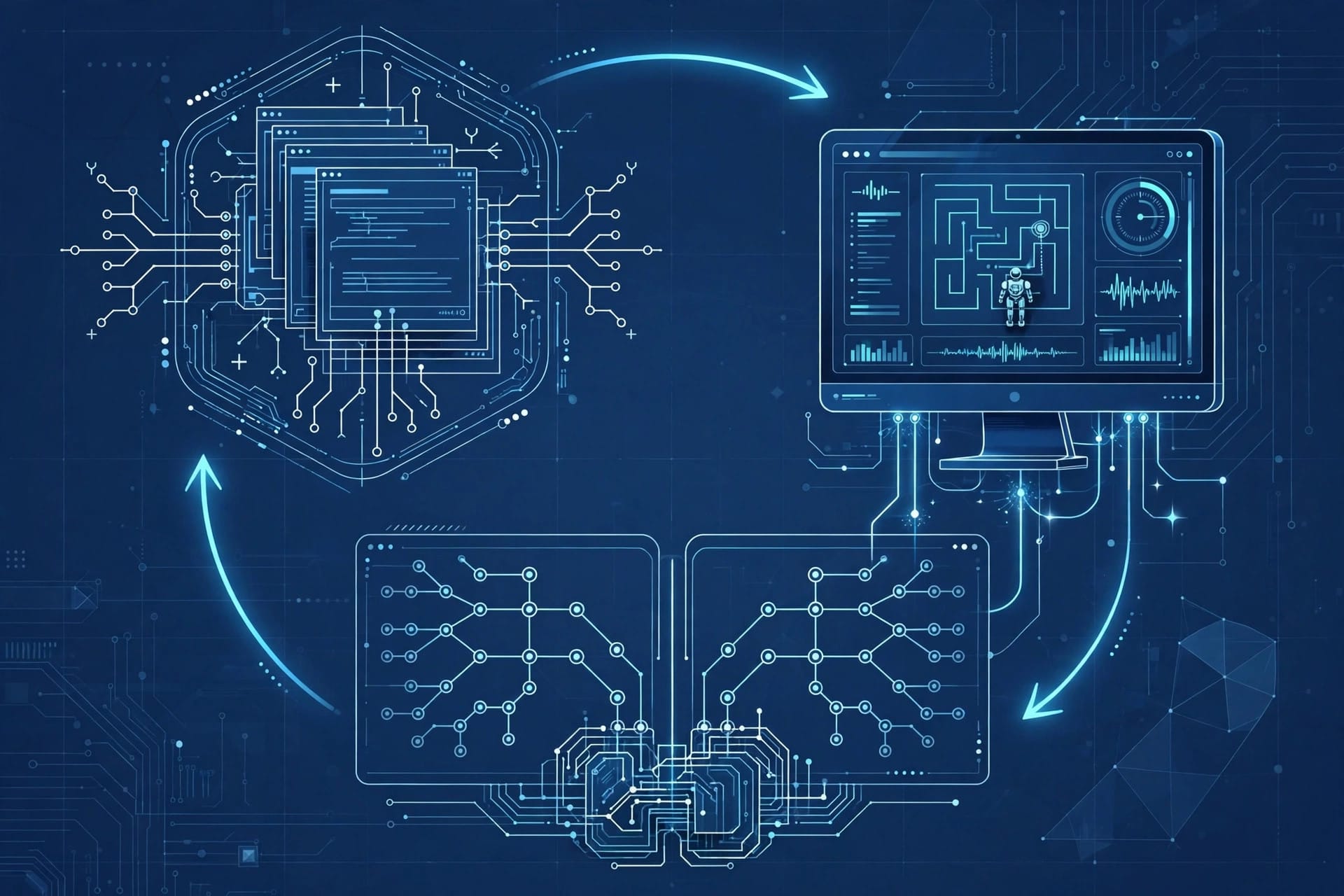
Harness2: The Eight Editable Components Around A Frozen Model
Harness2 exposes eight editable components, each mounted as a file. The system prompt, guardrails, memory and skills construct the agent’s context. Tool guidance and scripts define its tool interface. Subagents handle orchestration and delegated work, and plugins control middleware behaviour inside the tool loop.
That file-based design matters because every component is inspectable and editable by ordinary means. Nothing is hidden inside model weights, so a developer can read exactly what the framework changed after a run, keep the change, or reject it. The release supports OpenCode and Codex as executors, runs on Linux with Python 3.12 and the uv package manager, and includes a local demo that runs both recursion modes with no model credentials at all. Our explainer on what AI agents are sets out how this scaffolding layer differs from the model underneath it.
Propose, Probe, Compose: How Harness2 Improves Without An Answer Key
The framework works at two connected levels. Task-level recursion refines the harness for the current task through a contrastive Propose-Probe-Compose step: the system proposes candidate edits, probes them by running the task with each version, and composes a refined harness from the behavioural differences between those runs.
The technical point is that this needs no ground-truth verifier. Most self-improvement methods lean on labelled data or test cases to tell the system whether it is getting closer to a right answer, and in real deployment that signal usually does not exist. Harness2 instead learns from contrasts between its own executions, which is what makes it usable on unlabeled, open-world tasks.
Harnessing-level recursion then carries the lesson forward. After each task, the system keeps the adopted harness and writes evidence-supported lessons into a persistent improvement harness, so the next task starts from what earlier tasks taught it rather than from a blank slate.
Harness2 Results: Up To 11.5 Points On WorkBuddy-Bench In One Step
Across three professional benchmarks and four model-harness configurations, a single Harness2 step improved both models tested over their base harnesses. On WorkBuddy-Bench, GLM-5 rose from 64.2 to 75.7, a gain of 11.5 points, and Gemini 3.5 Flash rose from 72.4 to 77.5 under the OpenCode executor, with Claude Opus 4.8 serving as the harness editor in the reported configurations.
Scaling the recursion budget brought further gains. Parallel recursion at k=5 reached 80.8 on WorkBuddy-Bench, while JobBench scores rose from 31.5 for the base harness to 39.0, and LAB, the legal-work benchmark, saw an 11.8 percentage point lift in its partial pass rate. Parallel recursion explores several candidate harnesses at once; sequential recursion carries one refined harness through successive steps instead. The trade-off is explicit in the paper: probing multiple candidates multiplies test-time token costs, and the main experiments rely on a frontier model as the editor. The wider field of agent platforms is mapped in our guide to the agent platforms to know in 2026.
Why It Matters
The central entity is Harness2, and its defining attribute is that adaptation has moved from the model to the harness: gains of up to 11.5 points were achieved with zero weight updates, no fine-tuning run and no labelled verifier. That connects the framework to its neighbours in practical ways. Development teams stuck with fixed model budgets on platforms such as Vertex AI get a cheaper lever than a model upgrade. Rival agent frameworks, including the OpenCode and Codex executors Harness2 itself plugs into, now face a published, reproducible baseline for self-improvement — one whose risks were underlined this week by the OpenCode console breach, which showed how much trust the harness layer now holds. And because the code is Apache 2.0, any of those neighbours can adopt, audit or fork it, although Google notes in the repository that Harness2 is not an officially supported Google product.
Background
Harness2 comes from a research team spanning Northwestern University and Google Cloud AI Research, led by authors including Ruiyao Xu, Yanfei Chen, Rujun Han, Chen-Yu Lee and Tomas Pfister, and published as arXiv paper 2610.14224. It arrives after a year in which agent builders repeatedly found that identical models performed very differently depending on the prompts, tools and memory wrapped around them — the observation the paper formalises by making that wrapper, rather than the model, the object of recursive improvement.
Source: Google Research, Harness2 repository on GitHub; Xu et al., “Harness2: Recursive Agent Harnessing for an Open World,” arXiv:2610.14224; MarkTechPost, October 18, 2026

0 Comments