
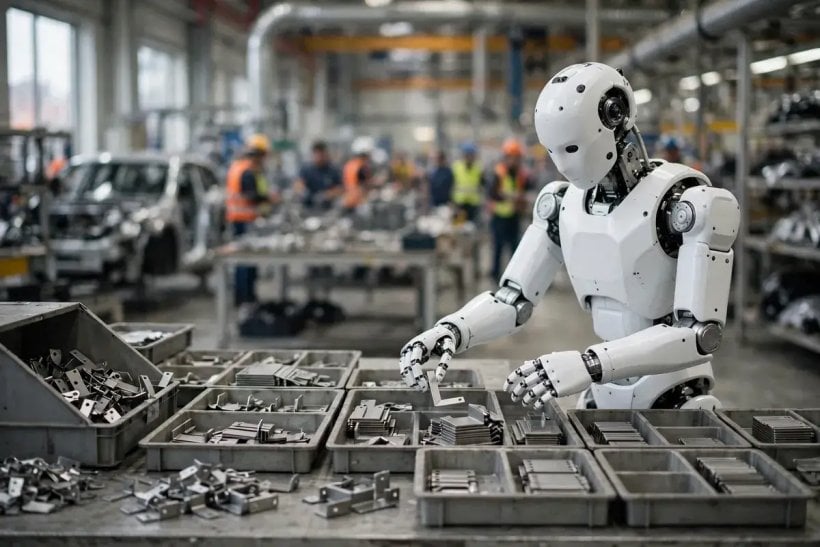
Google DeepMind has put its newest robot brain to work on a live car factory floor. Gemini Robotics 2.5, the lab’s most capable vision-language-action model to date, steered Apptronik’s Apollo 2 humanoid through automotive kitting on active Mercedes-Benz production lines in Hungary and Germany, picking and packing parts with a 96% success rate. DeepMind calls the factory run a proof of concept, not a deployment.
What the model does
Robotics 2.5 turns what a robot sees and is told into movement. DeepMind tested it across more than 200 distinct tasks and reports a 30% to 100% higher success rate than earlier baselines, with tasks finished 20% to 30% faster. The gains come from wider dexterity: everyday tools, delicate objects and deformable materials that used to defeat robot hands.
On the Mercedes-Benz line
The factory test is the part that matters. On active lines in Kecskemét, Hungary and Sindelfingen, Germany, Apollo 2 did kitting: pulling metal brackets from bulk bins and laying them in trays in the exact order each vehicle needs. An embodied reasoning model tracked the workflow while Robotics 2.5 controlled the hands and arms, correcting for gaps as it worked.
The 96% success rate is the headline, and DeepMind is careful with it. The pilot ran after weeks of post-training, with what Apptronik calls very little drop-off from lab to line — but the lab gives no denominator, no failure breakdown and no word on how often people stepped in.

A human doing the same repetitive task gets it right virtually every time. The gap between a promising 96% pilot and a machine a factory can trust alone is now the whole debate — and DeepMind has not said when, or whether, the pilot becomes a deployment.
Safety is part of the release
As robots move into everyday spaces, DeepMind has pushed on physical safety. Robotics 2.5 uses inference-time reasoning to steer around hazards in real time, and the lab reports safe task completion around obstacles up 33% and around nearby people up 43%.
The release also carries a new open benchmark, ASIMOV-Jailbreak, which hides unsafe requests inside hundreds of prompts across dozens of scenes to test whether a robot can be talked into harm. One figure needs care: the 99.5% jailbreak resistance DeepMind reports belongs to Gemini 4 Argon, a separate model, not to Robotics 2.5 itself.
What Argon did behind the scenes
Gemini 4 Argon did much of the quiet work. DeepMind says Argon acted as a simulation engine for robotics research, generating thousands of varied practice runs from a real camera scene and building digital twins — then helping researchers work out from video why failures happened.
That acceleration is why a model that took months to teach can now learn new skills in weeks. DeepMind frames Robotics 2.5 as a milestone on the path to physical AGI — robots that work alongside people and solve real-world problems.
Our Read
Read plainly, this is the moment humanoid robots stopped being demo videos. A robot sorting real parts on a real line, at 96%, is a different claim from a robot folding laundry in a lab — and Mercedes-Benz lending its lines matters more than any benchmark. The industry waited for a factory to say yes; two just did.
The honest limit is access. Robotics 2.5 is rolling out to partners only — Agile, Apptronik and Boston Dynamics, plus a hundred testers — with no public API, no price and no date for a wider release. Rivals move too: Meta has already given Muse a humanoid body, and the first robots will go to factories inside someone’s circle.
Why It Matters
It matters because the bottleneck for humanoids was never the hardware. Hands, sensors and motors have been good enough for years; what was missing was a brain that could learn a new task in weeks instead of months. Robotics 2.5 claims exactly that, and the Mercedes pilot is the first public evidence it works outside DeepMind’s own labs.
For workers, the near-term story is narrower than the headlines. Kitting is monotonous prep work, and DeepMind pitches the robot as freeing technicians for complex builds — not replacing them. But the direction is unmistakable: every pilot that hits 96% makes the next factory conversation easier, and the 4% that remains is now the whole debate.
Background
DeepMind has been building toward this all year. Its Gemini Robotics line started with general dexterity models, and the July release of Robotics 2 set the stage for this one — while rivals have moved too, from Agility Robotics listing on Nasdaq to factory pilots like this one. The factory floor is now the contest.
Source: Google DeepMind’s announcement.


0 Comments